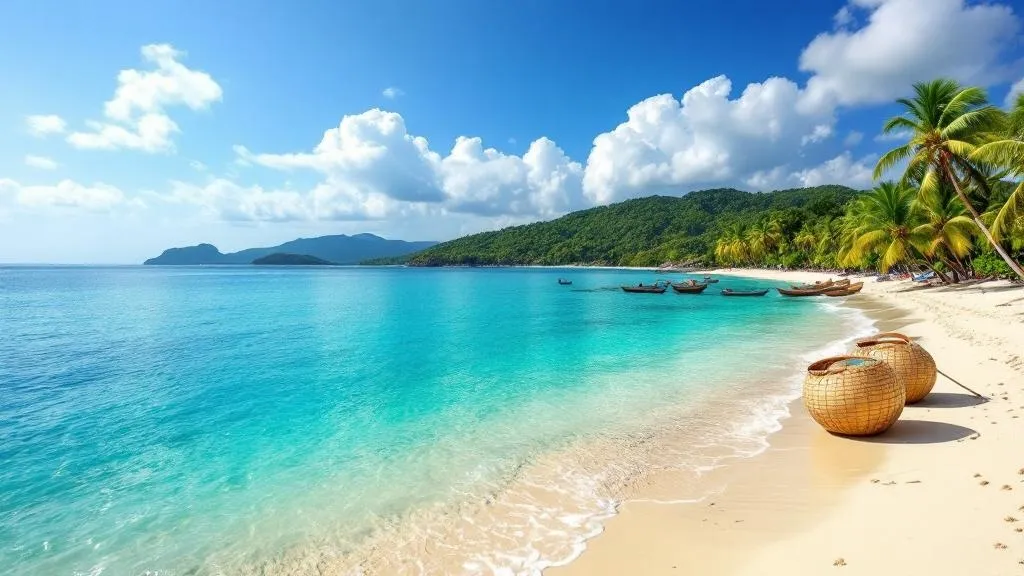
A resort city built around one long bay
Nha Trang is Vietnam’s most complete beach resort: a city of high-rises and hotels wrapped around a curving bay on the south-central coast, with a wide public beach running along the front, a ring of islands offshore and a nightlife strip a few minutes’ walk from the sand. It is not subtle, and it does not try to be. People come here for the sea, and the sea is genuinely good: warm water, visible reefs a short boat ride away, and some of the country’s most developed diving and snorkelling.
It helps to be clear about what the town is not. It is not a heritage destination like Hue or Hoi An, and its “old town” does not exist in the same sense. The city has one standout monument, the Cham towers of Po Nagar, and a handful of pleasant side trips, but you do not come to Nha Trang for culture. You come for the beach, the boats and the evenings, then you leave. Seen that way, it is easy to enjoy and easy to fit into a trip along the coast, which is why it sits in the Central Vietnam region even though its climate and rhythm differ from the cities further north.
How much time to give it
An honest answer is two to three days. One day is enough to see the town and have a beach afternoon; two lets you add a boat day to the islands; a third is for diving, a spa or mud bath, or a slow day with a book. Beyond three days you are in holiday mode rather than sightseeing mode, which is fine if that is what you want, but travellers short on time are usually better served spending the extra days in Hoi An, Da Lat or Hue.
A reasonable shape for a short stay:
| Day | Plan |
|---|---|
| Day 1 | Arrive, beach and seafront walk, Po Nagar towers late afternoon, dinner and evening on the bay |
| Day 2 | Island boat day with snorkelling or diving, back by late afternoon |
| Day 3 | Mud bath or hot spring, a river trip, or onward by road or train |
If you only have a single day, skip the full island circuit and combine Po Nagar with a half-day on the beach.
Getting to Nha Trang
By air: Cam Ranh, not Nha Trang
The most common mistake is assuming the airport is in the city. Nha Trang is served by Cam Ranh International Airport (CXR), which sits at a distance south of the city, on a different stretch of the coast. Allow proper time for the transfer rather than counting on a quick hop: the road along the bay is straightforward, but you should budget for it in your arrival and departure plans, especially for an early flight. Shuttle buses, taxis and ride-hailing cars run from the terminal, and many hotels will arrange a pickup. There is no rail or metro link to the airport, as at every Vietnamese airport.
Cam Ranh is linked to Hanoi, Ho Chi Minh City and other domestic airports, and handles some international services. For route options and carriers, see domestic flights in Vietnam, and for how the country’s airports fit together, Vietnam’s airports explained.
By train along the coast
Nha Trang is a stop on the Reunification Express, the railway that runs the length of the coast between Hanoi and Ho Chi Minh City. The station is in the city itself, a short ride from the seafront hotels, which makes it the most convenient way to arrive if you are already travelling the coast. The line from Da Nang and Hoi An runs for much of its route beside the sea, and sleeper berths make the longer legs bearable. For tickets, classes and what to expect, read Vietnam train travel.
By road
Sleeper buses and “limousine” minibuses connect Nha Trang with Da Lat, Quy Nhon, Mui Ne and Ho Chi Minh City, and private cars with a driver are an option for the winding run up from the highlands. The route from Da Lat descends from the cool plateau to the coast and is one of the more scenic transfers in this part of the country.
The city beach and the seafront
The main beach is a broad strip of sand along the bay, backed by a promenade, palms and a line of hotels. It is a real city beach: busy in the late afternoon, lively at weekends, with deckchairs, beach clubs and vendors. Mornings are the best time to swim, before the heat and the crowds build. The water is warm and generally calm in the dry season, though the sea can be rough and the red flags go up when a storm passes.
Evenings are when the seafront comes alive. Walking the promenade after sunset, eating grilled seafood, and ending up at a rooftop bar or beach club is the standard Nha Trang evening. The town has a more international, Russian- and Korean-leaning tourist scene than most Vietnamese cities, and signs and menus reflect it. If you prefer a quieter, more local feel, choose a hotel away from the busiest stretch of the front, or look further north to Quy Nhon, which has a calmer, less developed coast.
Po Nagar: the one monument to see
The Po Nagar Cham towers stand on a hill beside the Cai River at the northern edge of the city. They were built by the Cham between roughly the eighth and thirteenth centuries and dedicated to the goddess Po Nagar, a deity honoured by the Cham and still revered locally. The red-brick towers, with their carved lintels and the stone figure of the goddess inside the main sanctuary, are a living place of worship: you will see offerings of incense and flowers, and visitors are expected to dress modestly and behave quietly.
Go early or late in the day, when the heat is lower and the light is better on the brick. Plan on about an hour. This is the Cham heritage of the coast, Hindu in origin and distinct from Khmer and from the Vietnamese pagodas elsewhere in town; if the subject interests you, the Cham sanctuary at My Son near Hoi An is the larger and more complete site.
Po Nagar sits close to the Cai River, so it combines naturally with a river outing. A basket boat eco tour on the Cai River gives a calmer, more rural view of the area than the seafront and suits families and travellers who want something other than the beach.
The islands: the real reason to come
The bay is dotted with islands, and a boat day is the highlight for most visitors. Typical island circuits stop at several points for snorkelling over coral, swimming off beaches, a floating bar or seafood lunch on the boat, and sometimes a visit to a fishing village or aquarium. Quality varies: some operators run loud, crowded party boats, others keep to small groups and quieter coves. Read the itinerary carefully and decide whether you want the festive version or the calm one.
Two broad styles are worth knowing:
- The classic group circuit: a multi-stop day on a larger boat with lunch, snorkelling and a lively atmosphere. The four islands tour is the standard format and a good value for a first visit.
- The private or small-group yacht day: fewer people, more time in the water, better food. A tropical yacht day costs more but is noticeably more relaxed, which many couples and families prefer.
Diving is a second draw, with dive schools clustered along the front offering try-dives, open-water courses and day trips to the reefs. Visibility and conditions are best in the dry season; check the operator’s safety record and equipment, and ask about the group size before booking. For a fuller breakdown of routes, operators and what to expect on the water, see the Nha Trang island hopping and snorkelling guide.
On rougher days boats may not leave, so keep a spare day in your plan if the island trip is the point of your visit.
Mud baths, hot springs and slower days
Nha Trang is also a spa town. Mineral mud baths and hot-spring complexes on the edge of the city are popular after a morning on the water, and most are set up for groups and families with pools of varying temperatures, mud tubs and a restaurant. They are touristy but easy and relaxing, and they work well on a day when the weather is not ideal for boats. Our mud baths and spas guide compares the main options and explains what is included in the entry price.
If you want something in between, the Nha Trang city tours cover Po Nagar, the Long Son pagoda with its large white Buddha on the hill, and the city’s French-era stone cathedral, in half a day. It is a simple way to see the town without organising it yourself.
When to go: Nha Trang’s calendar is its own
This is where the town surprises visitors who have read about the rest of the centre. In Hue, Da Nang and Hoi An the wet season runs roughly from September to December, with typhoons and floods most likely in October and November. Nha Trang’s rains arrive later, roughly from October to December. The south-central coast has its own rhythm, and the town is often sunny and dry while the north of the region is already under water.
| Period | What to expect in Nha Trang |
|---|---|
| February to April | Dry, hot and sunny; calm sea; the safest months for boat days |
| May to August | Hot, mostly dry, good beach weather, busiest with domestic holidaymakers in summer |
| September | Transitional; weather can be mixed, check the forecast |
| October to December | The rainy season for this stretch of coast; heavy showers, rougher sea, possible storm disruption |
| January | Cooler, can be grey and windy on the coast; Tet crowds and prices rise around the lunar new year |
Nha Trang does not share the climate of Hoi An or Hue, and it is not a cool-weather destination: it is a hot coastal city all year. If you want the fresh air of the hills, that is Da Lat, a short run inland at about 1,500 m, where mornings and evenings are cool whatever the season. See Da Lat for the highland side of the trip.
For storms and when they matter to your plans, read Vietnam’s rainy season and typhoons.
Combining Nha Trang with the rest of Vietnam
Nha Trang is most often a stop rather than the whole trip, and it fits several routes.
- Coastal route: Hue, Da Nang, Hoi An, Nha Trang, then Ho Chi Minh City, by flight, train or bus. Nha Trang is the beach stop in the middle of the long run south.
- Coast and highlands: pair the beach with Da Lat, either by road or on a longer guided option such as the six-day Nha Trang and Da Lat tour, which includes snorkelling.
- Cham culture: further south around Phan Rang, Cham villages and temples are still active. A two-day Cham culture tour with a homestay is the way to see this side of the coast properly.
If you are weighing the town against Vietnam’s other major beach destination, our comparison Phu Quoc or Nha Trang sets out the differences in season, atmosphere and access, and the best beaches in Vietnam places Nha Trang against the rest.
Practical notes
- Visas and entry: rules depend on nationality and change. Check the official immigration portal or your government’s advice; our visa guide explains the main routes.
- Money: the currency is the Vietnamese dong. Cards are accepted at hotels, tour operators and larger restaurants, but keep cash for street food, markets and small cafés. Prices quoted here are indicative for 2026 and drift over time.
- Getting around town: ride-hailing apps such as Grab and Be, and metered taxis, are the easy options. Walking the seafront and the central blocks is simple.
- Water: tap water is not drinkable; drink bottled or filtered water.
- Scams and overcharging: as in most resorts, agree prices before boat trips, taxis and cyclo rides, and be wary of street touts selling “special” island tours.
- Sun: the tropical sun is strong; take a hat, reef-safe sunscreen and a cover-up for boat days.
- Electricity: sockets are mainly Type A and Type C at 220 V.
Nha Trang FAQ: planning your beach stay
Is Nha Trang worth visiting?
Yes, if you want a proper beach resort with islands, diving and nightlife. It is less rewarding if you are looking for heritage towns or quiet rural scenery; those are found in Hoi An, Hue and the northern mountains.
How many days do you need in Nha Trang?
Two to three days suits most travellers: one for the city and beach, one for an island trip, and a third for diving, a mud bath or a slower day. Spend longer only if you want a pure beach holiday.
How do you get from the airport to the city?
The airport, Cam Ranh (CXR), is not in Nha Trang itself but at a distance south of the city. Shuttle buses, taxis, ride-hailing cars and hotel transfers connect it with the centre; allow proper time and do not count on a short hop.
When is the best time to visit Nha Trang?
Roughly February to August is the best window, with sun and calm seas. The rains arrive later than elsewhere in central Vietnam, around October to December, and can cancel boat trips.
Does Nha Trang have the same weather as Hoi An or Hue?
No. Hoi An and Hue have their wet season earlier, roughly September to December, with floods and typhoons most likely in October and November. Nha Trang’s rains come later, and the city is hot all year, unlike cool Da Lat in the hills.
Can you take the train to Nha Trang?
Yes. Nha Trang is a stop on the Reunification Express along the coast, with its station in the city. It is a convenient arrival if you are already travelling between Hanoi, Hue, Da Nang and Ho Chi Minh City.
Are the island tours worth it?
For most visitors they are the highlight of a stay. Choose between a lively group circuit and a quieter yacht or small-boat day depending on your taste, and keep a spare day in case the weather stops the boats.
Where should you go instead for cooler weather or a quieter coast?
Da Lat is the cool, high-altitude alternative inland, and Quy Nhon offers a calmer, less developed stretch of coast to the north.


