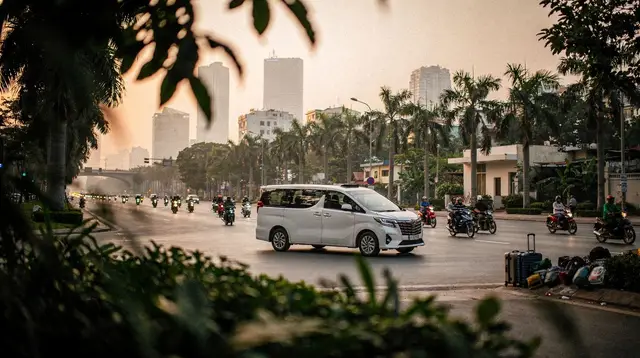
Ho Chi Minh City Airport Transfers: From Tan Son Nhat to the Centre
How do you get from Tan Son Nhat airport to central Ho Chi Minh City?
The airport is only about 7 km from District 1, but the road trip takes roughly 20 to 45 minutes depending on traffic. No train or metro serves the airport, and Metro Line 1 does not reach it, so the choice is a pre-booked car with driver, a metered taxi or a ride-hailing app.
Tan Son Nhat International Airport (SGN) is one of the closest major airports to a city centre anywhere in Asia. It sits roughly 7 km from District 1, which sounds like a ten-minute hop. It is not. Between the terminal and your hotel lie some of the busiest junctions in Vietnam, and the same 7 km can take anything from about 20 minutes to 45 minutes or more. This page deals with that one problem: getting from the arrivals hall to central Ho Chi Minh City, and back again, without losing time or money.
It is deliberately logistical. For what to see once you are in the city, head to the Ho Chi Minh City destination guide and the city tours guide.
Short distance, long road: what to expect on the ride
The airport lies in the north-west of the urban area, in Tan Binh district, and the centre is south-east of it. A single stretch of road, funnelled through a few large roundabouts and arterial streets, carries most of the traffic. The journey is short in kilometres and unpredictable in minutes.
Typical patterns, with the usual caveat that Saigon traffic does what it likes:
- Early morning and late evening: the fastest runs, often close to 20 minutes.
- Mid-morning and early afternoon: usually somewhere in the middle of the range.
- Rush hours, roughly 7–9 am and 4:30–7 pm: expect the upper end, 45 minutes or more.
- Wet-season downpours (the south’s rainy season runs roughly May to November, with short heavy showers most often in the late afternoon): traffic slows sharply, motorbikes crowd the road edges and ride-hailing cars become harder to find.
- The days around Tet, the lunar new year in late January or February: the city empties and fills in odd patterns, taxis and cars are scarce at peak moments and fares rise. Book early.
The practical rule: plan for 45 minutes door to door in the evening peak, and do not schedule anything tight within an hour of landing.
No train, no metro: what is and is not an option
A common assumption is that a city with a new metro must have a rail link to its airport. It does not. No airport in Vietnam has a train or metro connection, and Tan Son Nhat is no exception.
Ho Chi Minh City’s Metro Line 1, which runs from Ben Thanh to Suoi Tien and opened in December 2024, is a useful line for the city, but it does not reach the airport. You cannot ride it from the terminal, and no one should tell you otherwise. Likewise, the Reunification Express railway does not serve the airport; its Saigon station is in the city. For more on rail, see the Vietnam train travel guide.
That leaves road transport, and you have three sensible choices:
- A car with driver booked in advance.
- A metered taxi from an established fleet.
- A ride-hailing app (Grab, Be or Xanh SM).
Public buses also serve the airport and are the cheapest way into town, but they are slow, routes and stops change, and they are awkward with large luggage. If you want to try one, ask at the airport information desk for the current route and expect to walk some of the way at the other end. For most travellers arriving after a long flight, one of the three options above is the better call.
Comparing the three options
| Pre-booked car with driver | Metered taxi | Ride-hailing app | |
|---|---|---|---|
| Price certainty | Fixed in advance | Meter, can run long in traffic | Quoted in the app before you go |
| Waiting at the airport | Driver usually waits at arrivals with your name | Short queue at the official rank | Depends on supply and the time of day |
| Language needed | None, you have the confirmation | Show the address written down | None, the app holds the destination |
| Payment | Often agreed or paid online beforehand | Cash in dong, sometimes card | App, cash or card depending on settings |
| Main risk | Choosing an unknown operator | Unofficial drivers, meter games | Wrong pickup point, cancellations |
| Best for | Late arrivals, families, first visit | Spontaneous travellers | Confident users with local data |
None of these is the single best answer. The right one depends on the hour you land, who you are travelling with, how much luggage you have and how comfortable you are on your phone.
Option 1: a car with driver, booked in advance
A pre-booked transfer is the least stressful way to cover the first 7 km of a trip, and the reason is simple: the two things that go wrong at the airport, finding a driver and agreeing a fare, are settled before you leave home.
How it works in practice:
- You book a car for your flight, giving the flight number so the driver can track delays.
- On landing, you walk out of the customs hall and the driver is usually waiting in the arrivals area, holding a sign with your name.
- The fare is agreed in advance. Check what is included, in particular waiting time and luggage.
This is especially useful for night arrivals, families with small children, groups with several large bags and anyone landing after a long-haul flight who would rather not negotiate. You can reserve an airport transfer from Tan Son Nhat to your hotel, so the driver and fare are fixed before you land, and if immigration queues worry you, a fast track service at Tan Son Nhat can be added on arrival. Use a reputable operator, keep the confirmation on your phone and check the driver’s name against it.
The drawback is that you pay for certainty. In a quiet, fast hour, a metered taxi may cost less. But since this page is about avoiding surprises, a fixed fare is often the more sensible comparison point.
Option 2: a metered taxi
Metered taxis remain a normal way into town, and the better fleets are reliable. Two long-established names are Vinasun and Mai Linh; other fleets exist, and the rule is to choose a fleet you recognise rather than a car that approaches you.
What to do:
- Go to the official taxi rank, signposted outside the terminal, rather than accepting an approach in the arrivals hall.
- Check the fleet name, number and colours on the car and the driver’s identification displayed inside.
- Ask for the meter, and do not agree to a flat sum for a trip that should run on the meter.
- Show your hotel name and address written down, preferably in Latin script with the street and district. Many central addresses are on narrow alleys, which drivers will not always know by name.
- Keep smaller notes of dong ready. A driver who “has no change” for a large note is a classic trick.
A taxi is a good choice if you land with no booking and no data connection. See Grab and taxis in Vietnam for a longer comparison of how the two work across the country.
Option 3: a ride-hailing app
Grab is the best known, and Be and Xanh SM (an electric-car service) also operate in Ho Chi Minh City. Apps give you a fare quote before you commit, a record of the driver and plate, and no need to explain the destination.
Things to know:
- Order from the airport’s signposted app pickup area, not from inside the arrivals hall. The pickup spot can be a short walk from the terminal and can change with works, so follow the signs and the message in the app.
- You need data. Buy an eSIM or a local SIM before you leave the terminal or use airport wifi to order. See the Vietnam eSIM and SIM cards guide.
- Check the plate and driver name in the app against the car that arrives.
- Be ready for cancellations. At peak times or in the rain, drivers sometimes cancel. Reorder or switch to a taxi rank.
- Choose a car, not a motorbike, if you have luggage. Motorbike taxis (xe om) are fine for short hops across town but not for a suitcase from the airport.
Apps tend to work best for confident users who already have a data connection. For a first night in the city, many people find the pre-booked car easier.
Overcharging: how to spot it and avoid it
The main danger at Tan Son Nhat is not safety, it is money. Violent crime is rare, but overcharging at tourist hubs is common, and an airport arrival is the perfect place for it. The usual patterns:
- Touts in the arrivals hall who offer a “special price” or claim the official taxis are full or queueing for hours.
- Unmarked cars that look like taxis but are not from a recognised fleet.
- Meter tricks: a meter that runs unusually fast, or a driver who says it is “broken” and asks for a fixed sum.
- Long routes for a short trip. If the car heads away from the centre, say so, and keep your phone map open.
- Add-ons: extra “airport fees”, “luggage fees” or a toll presented as larger than it is. Some tolls and airport access charges are real, so ask what is included before you set off, and ask for a receipt.
- Hotel claims that your reservation has been “cancelled” or the hotel is “closed”, used to redirect you to another place. Phone the hotel yourself if told this.
If a driver will not agree to the meter or an app fare, walk away and use another option. More on common schemes in Vietnam scams to avoid.
Practical details that save time
Terminals. The airport has separate international and domestic terminals a short distance apart. Check your flight’s terminal on the ticket and your pickup instructions: a driver waiting at the wrong building is one of the commonest small delays. International arrivals clear immigration and customs before reaching the arrivals hall, which can take a while at busy hours. Entry rules depend on your nationality and change, so confirm them on the official immigration portal or your government’s advice, and see the Vietnam visa guide.
Cash and cards. Cash still matters, especially for taxis and small payments. Withdraw dong from an ATM in the terminal or change a modest amount, and carry small notes. The US dollar is not legal tender. Details in money in Vietnam.
Time of arrival. If you land late at night, a pre-booked car is the easiest option. If you arrive in the early morning, check whether your hotel will let you check in or store bags, since many standard check-in times are in the afternoon.
Your address. Save the hotel name, street, district and phone number offline. District 1 is the usual base, but central addresses also sit in District 3 and across the river in Thu Thiem. If you are not sure which area suits you, the districts explained guide and the where to stay in Ho Chi Minh City guide help you choose before you book.
Luggage. Standard taxis and app cars usually take two large suitcases comfortably; larger groups or oversized items need a bigger vehicle, which is easier to arrange in advance.
Going back to the airport
The return trip is the one that catches people out, because it is the one with a deadline. A few rules:
- Leave earlier than the distance suggests. 7 km looks trivial, but allow generous time. For an international departure, plan to reach the airport comfortably ahead of the airline’s check-in cut-off, and add buffer for the evening rush or rain.
- Pre-book for early flights. A car booked the night before, with the pickup time confirmed, is much more dependable than hoping to find a taxi at 4 am.
- Ask your hotel to call a taxi or arrange a car; reception can usually do this for a small fee or free of charge.
- Check the terminal (domestic or international) with the driver as you set off.
Onward travel from the airport
Not everyone is staying in the city. Some people head straight to the coast or the Mekong Delta, and for them a long private transfer from the airport can make more sense than a hotel night first.
- Mui Ne, with its sand dunes, is about 200 km north-east on the coast. A private car from the airport to Mui Ne saves finding a bus station after a flight. You can book a direct private car from the airport to the beach town, and the same operators also run the return trip when you come back to catch a flight. Mui Ne is not part of the Mekong Delta, and the drive is a real half-day.
- Can Tho, in the Mekong Delta about 170 km away, can be reached by private car from the airport to Can Tho. It is a long road, so consider whether a night in Saigon first would be kinder.
- Day trips from the city, covered in day trips from Ho Chi Minh City, leave from District 1 and do not suit an airport arrival.
If you are flying on within Vietnam, there is no need to leave the airport at all: see domestic flights in Vietnam and the Vietnam airports explained article for how Tan Son Nhat fits alongside Hanoi’s Noi Bai, Da Nang and the rest.
The future: Long Thanh airport
A second international airport for the Ho Chi Minh City region, Long Thanh, is under construction to the east of the city. It is intended to take pressure off Tan Son Nhat over time. No opening date should be assumed, and for practical planning today you should treat Tan Son Nhat as the only airport that serves the city. When Long Thanh does open, it will be considerably further from District 1 than Tan Son Nhat is, so the arithmetic of transfers will change. Until then, this page’s advice stands.
Which option should you pick?
- Landing late, with children or heavy bags: a car booked in advance.
- Landing with no plan and no data: the official taxi rank, a recognised fleet, the meter running.
- Confident with apps and already connected: Grab, Be or Xanh SM from the signed pickup area.
- Heading straight to Mui Ne, Can Tho or the coast: a private car booked ahead, so that the driver is there when you land.
Whatever you choose, the principle is the same. Decide before you reach the kerb, keep your hotel address ready, and do not let anyone in the arrivals hall make the decision for you.
Tan Son Nhat airport transfer questions answered
How far is Tan Son Nhat airport from the centre of Ho Chi Minh City?
About 7 km to the District 1 area, which is unusually close for a major airport. The ride takes roughly 20 to 45 minutes depending on traffic, and longer at the evening peak or in a heavy downpour.
Is there a train or metro to Tan Son Nhat airport?
No. No airport in Vietnam has a rail or metro link. Ho Chi Minh City’s Metro Line 1 runs between Ben Thanh and Suoi Tien and does not go to the airport, so you need a road transfer.
What is the safest way to get from the airport to my hotel?
A car with driver booked in advance, with the fare confirmed before you travel, removes most of the risk of haggling. A ride-hailing app or a metered taxi from an established fleet are also reasonable, as long as you stay inside the official pickup areas.
Can I use Grab at Ho Chi Minh City airport?
Yes. Grab, Be and Xanh SM all operate in the city, and the airport has a signposted area for app pickups. Order the ride from the app, check the plate and driver, and avoid anyone who approaches you inside the terminal.
Should I worry about taxi overcharging at the airport?
It is the main thing to watch. Drivers who approach you in the arrivals hall, refuse to use the meter or quote a flat sum for a short hop are the usual problem. Use a fleet you have chosen yourself, insist on the meter or an app fare, and keep small notes for payment.
Is the new Long Thanh airport open?
A second Ho Chi Minh City airport, Long Thanh, is under construction and no opening date should be assumed. For now, international and domestic flights to the city use Tan Son Nhat.
Getting Around Vietnam
Verified deep-linked GetYourGuide tours. Book through these links and we earn a small commission at no cost to you.
GetYourGuide does not provide a product photo for this activity — the image shows the meeting point, photographed by us.