Ho Chi Minh City Motorbike Tours: Seeing Saigon as a Pillion Passenger
Is a guided motorbike tour a good way to see Ho Chi Minh City?
Yes, if you are happy to ride behind a local driver. A guided pillion tour takes you through District 1, Cholon and neighbourhoods that coaches skip, at the pace of a city built around motorbikes. You do not need a licence as a passenger, but you should never ride yourself without the right one, and you should leave shoulder bags at the hotel.
Ho Chi Minh City is a city of motorbikes. Roughly everyone you see moving, from schoolchildren to office workers to delivery riders carrying impossible loads, is on two wheels, and the streets are shaped around that fact. A guided motorbike tour lets you join the flow instead of watching it from a pavement. You sit behind a local driver, you do not steer, and you see the city from inside its own rhythm.
This page is about that format only: riding as a passenger with a local driver in central Saigon and its neighbourhoods. It is not a guide to driving yourself, and it leaves street food at the table, airport transfers and excursions to Cu Chi or the Mekong Delta to their own pages.
What a pillion tour actually gives you
The honest case for a motorbike tour is about access and tempo, not thrills.
Reach. District 1 is walkable in pieces, but the city is not. Distances between neighbourhoods are long, pavements are often occupied by parked bikes and cafe stools, and the heat makes walking between sights tiring. On a motorbike you can cover the compact centre, cross the river and drop into Cholon, the Chinese quarter, in one outing. The Ho Chi Minh City districts explained page helps you place those names on a map before you go.
Neighbourhoods coaches skip. Tour buses stick to the big monuments: the Reunification Palace, the War Remnants Museum, the Central Post Office and the Notre-Dame Cathedral Basilica, which has been under long-running restoration. A driver on a small bike can slip down alleys, stop at a back-street temple, a cafe or a local market and take you through areas that have no bus parking and no souvenir stalls.
Pace. A pillion tour moves at the speed of the city. You feel the air, smell the grilled meat and the incense, and hear the city properly. That is why people who dislike organised tours often enjoy this one: it is the opposite of looking out of a sealed window.
Local commentary. Most tours include a driver or a guide who speaks reasonable English and can explain what you are passing. Quality varies, so reading recent reviews on the booking page is worth the time.
If you simply want the main sights with a guide in a car or on foot, the city tours guide covers that approach, and the Vespa and cyclo tours page covers the classic retro-scooter and slow cyclo formats.
Two ideas to correct before you book
Riding yourself without the right licence
Some visitors assume that because rental shops hand over keys without checking, riding is fine. It is not. In Vietnam, riding a motorbike requires a valid licence that covers the engine size, and a tourist who rides without one risks fines and, more importantly, an insurance refusal. Many insurers will decline a claim after an accident if the rider did not hold the right licence, which can leave you personally liable for hospital bills and for the other party’s costs.
Riding in Ho Chi Minh City is also much harder than it looks. The traffic is dense, unwritten rules matter more than road markings and a mistake that would be minor elsewhere can be serious here.
That is precisely why a pillion tour makes sense: someone who rides this traffic daily is at the handlebars, and you carry no licence risk as a passenger. If you are curious about renting anyway, read the guide to renting a motorbike in Vietnam first, then decide with the facts in front of you.
The shoulder bag is the target
The classic theft in Ho Chi Minh City is not a break-in; it is a snatch. A rider passes on the pavement side, grabs a phone from a hand or a bag from a shoulder and is gone. Cross-body and shoulder bags are the usual targets, particularly in District 1 and around busy evening spots, and the problem can become worse when the victim is dragged.
On a tour this matters twice: you are on a bike yourself, and you will be at kerbs and traffic lights where other bikes pull close. Put this under safety rather than as an afterthought:
- Leave handbags, shoulder bags and anything valuable at the hotel.
- Carry your phone in a front pocket or on a secure strap, and do not hold it out at the kerb.
- Carry only the cash and one card you need.
- Do not wear jewellery that can be grabbed.
- Ask your driver to keep you away from the kerb side at stops.
For wider context, see the Vietnam safety guide and the scams to avoid page. Violent crime against visitors is rare; opportunistic theft is the practical concern.
Day, evening or themed: choosing a format
Operators in Ho Chi Minh City sell many variations, and they are easier to sort once you know what you want from the outing. The categories below describe the logic, not fixed durations or prices, which change by operator and season.
Daytime tours
A daytime outing suits you if you want to see how the city works: markets in full swing, schoolchildren, shop-houses opening and traffic at its densest. You can reach Cholon’s temples and wholesale streets and see how different the Chinese quarter feels from the tower blocks of District 1.
The trade-offs are heat and light. Between roughly March and April the south is at its hottest, and midday on a bike is demanding. Wet-season afternoons can bring a downpour, so mornings are often more comfortable. Bring water, sunscreen and a light long-sleeved layer, and wear closed shoes.
A morning start tends to be the most comfortable window outside the cool of the evening.
Evening tours
After dark, the city changes. Neon comes on, the temperature drops a few degrees, families come out, and pavement cafes fill up. For many visitors the evening ride is the most memorable thing they do in Saigon, precisely because the traffic feels like a river of lights rather than an obstacle.
Evening is also the best choice if you have only one slot and want atmosphere over sightseeing. It is less suited to visiting indoor sights, which are generally closed.
If a ride is not what you want after dark, a different evening format is a dinner cruise on the water; the Saigon River cruises guide covers those. Some travellers pair a short evening ride with a river dinner, such as a buffet dinner cruise on the Saigon River, though this is simply one option among several.
Themed tours
Themed tours trade breadth for a single story. Two kinds come up often.
- Everyday-life and social tours. These take you into working neighbourhoods, markets and areas where ordinary residents live, with a driver-guide who explains daily life, housing, work and change in the city. If that is your interest, a guided motorbike tour of the city’s working-class neighbourhoods is the sort of outing to look at. Expect something more reflective than a postcard ride, and read the description closely so the tone and the way local people are treated suit you.
- After-dark and folklore tours. Some evenings are built around local legends, spirit beliefs and the city’s older stories. A ghost-story tour by motorbike after dark is a lighter, entertainment-led variant, best treated as theatre with a local flavour rather than serious history.
Choose a themed tour only when the theme genuinely appeals to you. For a first visit with a single outing, a general day or evening route generally gives a better overview of the city.
A simple way to decide
| If you want… | Choose | Why |
|---|---|---|
| The big picture of how the city works | Daytime general tour | Markets, Cholon and the centre in daylight |
| Atmosphere, lights and cooler air | Evening tour | The city at its most photogenic |
| A single story or perspective | Themed tour | Depth over breadth |
| A slower, quieter ride | Vespa or cyclo tour | Gentler pace, see the Vespa and cyclo page |
| Food as the main point | A street-food tour | Covered in the street food tours guide |
The traffic, honestly
Most guidebooks say the traffic is “chaotic”. That is a fair first impression, but it is not quite accurate. The streets are packed, and bikes will come from every direction, yet the flow is continuous and surprisingly predictable. Riders do not stop and start; they nudge, weave and merge at modest speed, and everyone expects everyone else to keep moving.
A few honest orders of magnitude, with no invented numbers:
- Density. Motorbikes dominate. At rush hour and on weekend evenings you will be surrounded by them most of the time, often within arm’s reach.
- Speed. In the centre the pace is slow to moderate. Stops and starts are frequent, and a lot of the sensation of speed comes from being close to other bikes.
- Noise and heat. Horns are short signals of position, not anger. Exhaust and heat are real, particularly at junctions at midday.
- Pavements. Bikes park on pavements, sometimes ride on them, and street stalls fill the rest, so the road is often the practical walking space too.
If you want to understand how pedestrians cross, the short guide on how to cross the street in Vietnam explains the steady-pace approach.
None of this makes riding pillion reckless. It does mean the experience is intense, and some people find it too much, particularly in the heat. If you are nervous, say so at the start; drivers adapt their pace, and an evening or early-morning slot has lighter traffic than the late afternoon rush.
Practical preparation
What to wear. Closed shoes, long trousers or a skirt you can sit astride in, and a light layer for the evening. Flip-flops are a poor choice because they slip off easily and expose your feet.
Helmet. Use the helmet you are given and fasten it. Ask for a different size if it does not fit properly.
Where to hold. Hold the grab rail or your driver’s waist as instructed, keep your knees in and avoid sudden movements. Keep your feet on the pegs, away from the exhaust, which gets hot.
Phone and camera. Take photos when the bike is stopped, not at the kerb in motion. A secure wrist strap is better than a loose grip.
Health and comfort. Drink water beforehand, avoid a very heavy meal immediately before, and use sunscreen on exposed skin. Tap water is not drinkable anywhere in Vietnam, so carry bottled water.
Insurance. Check that your travel insurance covers passenger activity on motorbikes, because policies vary. See Vietnam travel insurance for the points to look at.
Money. Carry a modest amount of cash in small notes for tips and drinks; many small cafes do not take cards. The currency is the Vietnamese dong, and prices are quoted in large numbers, so it is easy to misread a note.
Where to base yourself and how to get there
Most pillion tours collect guests from central hotels, or from a meeting point in District 1. If you are choosing where to sleep, the where to stay in Ho Chi Minh City guide compares the areas, and District 1 is the most convenient base for pickups. For getting to a meeting point, ride-hailing apps are the simplest option, covered in the Grab and taxis guide.
Ho Chi Minh City’s Metro Line 1 (Ben Thanh to Suoi Tien) opened in December 2024 and can be useful for some trips, but it does not replace a pillion ride for neighbourhood exploring.
What this format is not for
A pillion tour is not the right tool for everything, and being clear about that saves disappointment.
- Cu Chi Tunnels. They lie roughly 60 to 70 km north-west of the city, at two sites, Ben Dinh and Ben Duoc, and need a half or full day with their own logic. See Cu Chi Tunnels tours.
- The Mekong Delta. My Tho and Ben Tre are about 70 km away and Can Tho about 170 km, with boats as the main means of travel. See Mekong Delta tours from Ho Chi Minh City.
- Airport transfers. Tan Son Nhat is only about 7 km from the centre, but a motorbike with luggage is rarely practical. See airport transfers.
- A sit-down meal. If food is your main aim, the street-food page above covers that with the right pacing.
Think of a pillion tour as a way to understand the city’s texture over a few hours, not as a substitute for the major excursions or for specialist food outings.
Where it fits in a trip
A motorbike tour works best early in a stay, because it gives you a mental map of the city that makes later days easier. Many travellers book it on their first or second evening, then use the remaining time for museums and excursions.
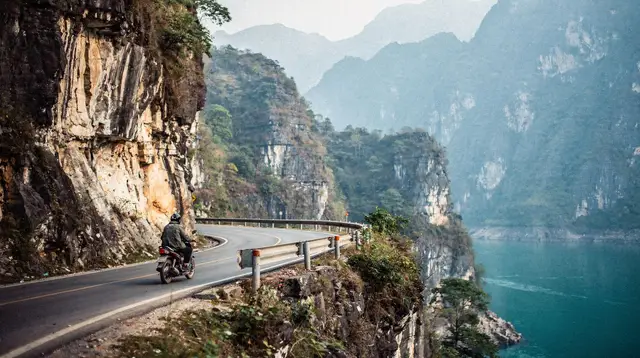
For a broader plan, the Ho Chi Minh City destination page gathers the main sights, and the things to do in motorbike loops category lists other riding formats around the country, including the long mountain routes in the north, which are a very different undertaking from a city ride.
Questions travellers ask about Ho Chi Minh City motorbike tours
Do I need a licence for a motorbike tour in Ho Chi Minh City?
Not as a passenger. On a guided tour a local driver rides and you sit behind. Riding yourself is different: without the right licence, many insurers refuse a claim after an accident, which can turn a minor fall into a very expensive one.
Is it safe to ride pillion in Ho Chi Minh City traffic?
Guided tours are generally a reasonable way to experience the traffic because the drivers know the flow of the city and ride at modest speed. The risk is never zero: traffic is dense and unpredictable, so wear the helmet provided, keep your feet on the pegs and follow your driver’s instructions.
Should I choose a day tour or an evening tour?
A daytime tour suits sightseeing, markets and Cholon, but it is hot and busy. An evening tour is cooler, brighter with neon and street life, and often feels the most memorable. Themed tours trade breadth for a single story, so pick one only if the theme genuinely interests you.
What should I bring and what should I leave behind?
Bring a phone on a wrist or neck strap you can secure, a little cash, water and closed shoes. Leave shoulder bags, loose jewellery and anything you would hate to lose at the hotel, because bag and phone snatching from passing motorbikes is the classic theft in the city.
Can I do a motorbike tour in the rainy season?
Yes. The south has a wet season from roughly May to November, usually as short late-afternoon downpours rather than all-day rain. Operators generally offer ponchos or reschedule if the weather is severe, so ask when booking. The dry season, roughly December to April, is hotter and more predictable.
Does a motorbike tour cover Cu Chi or the Mekong Delta?
No. A city motorbike tour stays within Ho Chi Minh City. Cu Chi lies roughly 60 to 70 km to the north-west and the Mekong Delta begins about 70 km away at My Tho and Ben Tre, so both are separate full-day excursions with their own logic.
How crowded is the traffic, honestly?
Very. Ho Chi Minh City is dominated by motorbikes and the flow is continuous, particularly at rush hour and on weekend evenings. It looks chaotic but works on constant, predictable movement and constant small adjustments. Expect to be surrounded by bikes most of the time.
Motorbike Loops and Countryside Excursions
Verified deep-linked GetYourGuide tours. Book through these links and we earn a small commission at no cost to you.
GetYourGuide does not provide a product photo for this activity — the image shows the meeting point, photographed by us.