Renting a Motorbike in Vietnam: Who Should, Who Shouldn't
Should I rent a motorbike in Vietnam?
Only if you already ride confidently and hold a licence that legally covers motorbikes in Vietnam. Without it, many insurers refuse to pay anything after an accident, even a minor one. Beginners are better off as a passenger with a local rider, and should keep well away from Hanoi and Ho Chi Minh City traffic.
The honest answer: rent only if you already ride well
Renting a motorbike in Vietnam is easy, cheap in the sense that nobody will stop you, and a very good way to get hurt. The country runs on two wheels, so the idea is tempting: you see the scooters everywhere, the shop on the corner has a row of them parked outside, and a rental seems like the natural way to get around.
For most visitors the answer is no. Here is the short version of who should and should not do it.
- Rent one if you ride regularly at home, hold a licence that legally covers motorbikes, have insurance that explicitly accepts it, and plan to ride on quieter roads outside the big cities.
- Don’t rent one if you have never ridden, if you have only tried a scooter on a holiday, or if your plan is to learn in Hanoi or Ho Chi Minh City.
- Go as a passenger if you want the roads and the scenery without the risk. That is what most visitors do on the northern mountain loops, and it is a perfectly good way to travel.
The rest of this guide explains why, and what to check if you decide to go ahead. For the wider picture of how people move around the country, the overview lives in getting around Vietnam; this page deals only with the motorbike question.
The trap: no licence usually means no insurance
This is the point that catches visitors out, and it is worth reading twice.
Many rental shops will give you a bike without asking to see a licence, or after glancing at a card that is not valid for the vehicle. That is a commercial decision by the shop. It is not a legal clearance, and it is not insurance cover.
If you ride without the correct licence and have an accident, many insurers will refuse to pay any claim at all. That includes medical care, an air ambulance, repatriation, and damage to other people’s property. The refusal applies even when the accident was not your fault, because the exclusion is about your status as a rider, not about who caused the crash. A medical bill from a serious accident can be enormous, and the shop’s own “insurance” is rarely more than a deposit and a damage waiver.
The practical consequences are simple.
- Check your licence class. A car licence alone does not usually cover a motorbike. Look at the categories printed on your licence, and read the official guidance from your own government on driving abroad.
- Check what Vietnam accepts. Rules on foreign and international licences are specific and they change. Look at official sources rather than a rental shop’s word, or a forum post.
- Read your policy. Look for the exclusions around motorcycles, licences and “hazardous activities”. Ask the insurer in writing whether your policy covers you on a rented motorbike in Vietnam, and keep the reply.
- Understand the police angle. Officials can stop foreign riders and ask for documents. A missing or invalid licence can mean a fine and a confiscated bike, on top of the insurance problem.
Our guide to travel insurance for Vietnam goes through what a policy should say, and what to ask before you pay for it. If the answer to any of those questions is unclear, the sensible conclusion is that you are not covered.
Traffic in Vietnam: what you are actually riding into
Traffic drives on the right and is dominated by motorbikes. In a big city that means a flowing river of bikes, with cars, buses, delivery riders, pedestrians and the occasional cart all sharing the same space. There is an order to it, but it is not the order you learned at home.
A few things surprise newcomers.
- Flow beats rules. Riders merge, filter and cut across in a continuous stream. The skill is predictability: hold your line, keep your speed steady, and signal your intent by what you do.
- Horns are information. A horn usually means “I am here”, not “get out of my way”.
- Right of way goes to the bigger and faster vehicle in practice, whatever the law says. Buses and lorries do not slow for you.
- Junctions are negotiated. Nobody waits for a clean gap. You edge in and everyone adjusts.
That same logic is why crossing the street on foot works at all. You walk at a steady, predictable pace and let the bikes flow around you; stopping or darting is what causes trouble. There is more on that in how to cross the street in Vietnam. The same principle applies to riding: smooth and predictable is safe.
None of this is a good thing to learn on your first day in a new country, on a vehicle you have not ridden before.
Why big cities are the wrong place to start
If you do rent, keep it out of Hanoi and Ho Chi Minh City, at least until you are comfortable with the way the country rides.
Hanoi. The Old Quarter is a maze of narrow, one-way streets packed with parked bikes, vendors and pedestrians. The ring roads and bridges are fast and dense, and the roundabouts are a lesson in controlled chaos. There is nothing relaxing about riding there for a beginner, and the area is easy to see on foot. If you want to explore with someone else at the controls, a Hanoi Vespa and cyclo tour puts you in the city without putting you at the handlebars.
Ho Chi Minh City. The scale is larger and the flow is faster. This is also where the most common crime against visitors happens: bag and phone snatching from motorbikes. A thief rides past, grabs a phone from a hand or a bag from a shoulder, and is gone. It happens to pedestrians, and it happens to passengers on the back of a bike. It is a real risk, not a rumour.
Keep your phone out of sight near the road, wear a bag across your body on the side away from the traffic, and do not hang anything from the handlebars. The Ho Chi Minh City districts guide explains which areas feel calmer, and our Vietnam scams to avoid page covers the other tricks that target visitors.
What to do instead in a city. Use a ride-hailing app for a car or a motorbike taxi, walk the compact central districts, or book a guided city ride with a local driver. How the apps work is explained in Grab and taxis in Vietnam. In every case, you get the city without the exposure.
Riding with a local: the easy-rider option
There is a middle path that suits most visitors who want the motorbike experience, and it is the one to consider first.
An easy rider is a local driver who takes you as a passenger on a multi-day route. You ride pillion, a helmet on your head and a small bag on your back, while someone who knows the roads handles the bends, the weather and the livestock on the tarmac. You keep the open air and the views, without carrying the licence and insurance problem.
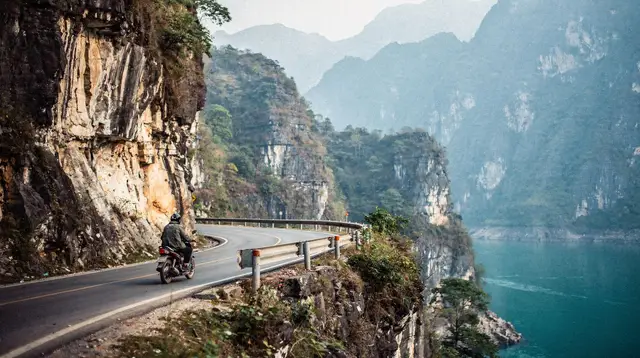
This is how most visitors do the Ha Giang loop, the mountain circuit across the Dong Van Karst Plateau and over the Ma Pi Leng Pass. The roads are narrow, steep and often misty, with landslides in the wet months, and it is not the place to find out how a borrowed bike handles. Our pieces on whether the Ha Giang loop is safe and on Ha Giang loop tours go through what to expect and how to choose an operator, and the Ha Giang destination page gives the lay of the land.
A few practical points apply to any easy-rider trip.
- Ask who the rider is. Reputable operators use experienced local drivers with proper licences and maintained bikes. Be wary of a rider who is a stranger picked up on the street.
- Ask about the helmet. You want a decent one that fits, not a decorative shell.
- Ask about cover. A good operator will tell you what insurance applies to passengers, and you should check your own policy still stands as a passenger.
- Be honest about your comfort. A good rider adjusts to the group. A trip packed into too few days leads to long, tired hours in the saddle.
If you want to see how a packaged option looks, the 3-day Ha Giang loop with an easy rider starting from Sapa is one of the common formats, and a 3 day, 2 night motorbike adventure in Cao Bang goes to the border country around the Ban Gioc waterfall.
Easy riders are not limited to the north. Around Da Lat and across the Central Highlands there are guided motorbike trips as well; see Da Lat easy rider tours for how they work. A longer option is a guided motorbike tour from Da Lat down to Hoi An, which hands the logistics to a local team.
If you do rent: a sensible checklist
Say you ride well, your licence is valid, and your insurer has confirmed cover in writing. Here is how to do it without making things worse.
Choose the rider’s terrain
- Go rural, not urban. Quiet coastal roads, flat countryside and gentle hills are far better than a city centre or a national highway full of lorries.
- Pick the right season and time of day. Heavy rain, fog and typhoon weather turn good roads into bad ones, and the northern mountains and the central coast are the most exposed. Avoid riding in the dark. Livestock, unlit vehicles and potholes appear without warning.
- Be realistic about distance. Distances on a map mislead. Winding roads are slow, and a day of riding is more tiring than it looks.
Choose the shop and the bike
- Pick a shop with a track record and written terms. Reviews from other travellers are more useful than the sign out front.
- Choose a bike you can handle, and one with working brakes, lights, horn and mirrors. If something is wrong, say so before you leave, not after.
- Photograph the bike on all sides, with the date, before you ride away. Do the same on return. Disputes over scratches are common.
- Do not leave your passport as a deposit. Offer a copy, or another deposit, and keep your original document. Leaving it with a shop leaves you stranded if something goes wrong.
- Read the contract. Know what happens if the bike is stolen, or damaged, and who pays for repairs.
Ride defensively
- Wear a proper helmet, fastened, and good shoes, with long clothing in the sun and on gravel.
- Never ride after drinking. Bia hoi is cheap and the roads are unforgiving.
- Keep your speed down on bends you cannot see through. The road ahead may contain a bus on your side of the line.
- Plan fuel and stops. In mountain districts, fuel stations are not frequent.
- Park sensibly and lock the bike. Theft of bikes and of luggage left on them is a risk.
The Hai Van Pass by motorbike guide is a good example of a scenic route that experienced riders choose, with its own conditions to respect. If you prefer to leave the driving to others, the Hai Van Pass tours option puts you on the pass with a local driver.
What to do if something goes wrong
Even careful riders have accidents. Know the basics before you leave.
- Stop and stay safe. Get yourself and others off the road if you can.
- Call for help. The numbers are 113 for police, 114 for fire and 115 for an ambulance. Your hotel or rental shop may help with the language.
- Photograph everything: the scene, the bikes, the plates, injuries and damage.
- Contact your insurer early. Many policies require a prompt report, and ask about the licence you held at the time.
- Keep every receipt and medical record. You will need them for a claim.
- Be calm with the bike owner. Negotiating a damage claim is easier with photographs taken before you rode.
Hospitals in the large cities are used to treating visitors, but standards vary, and rural clinics are basic. That is another reason to keep your riding in places within reasonable reach of care, and to have honest cover.
Alternatives that give you the motorbike feeling
If the licence and insurance questions point to “no”, you can still travel with the wind in your face.
- Pillion tours with a local driver, on city, countryside and mountain routes. A good example is the Hoi An countryside half-day guided bike tour, which takes in rice fields and villages at a gentle pace.
- Ride-hailing motorbike taxis (xe om) for short city hops, booked through an app, with a helmet provided.
- Scooter tours in a city with a guide, where the guide drives and you sit behind. Our Ho Chi Minh City motorbike tours and Sapa motorbike tours pages list options.
- Cycling on flat ground around Hoi An and in the countryside, if you prefer pedalling to riding.
Each of these keeps you out of the licence trap and away from the worst of the traffic. For a wider sense of risk across the country, read is Vietnam safe.
Questions about renting a motorbike in Vietnam
Do I need a special licence to rent a motorbike in Vietnam?
Legally you need a licence that covers motorbikes and is valid for use in Vietnam. Many rental shops will hand over keys without asking, but that does not make you covered. Check the rules with your own government’s travel advice and the official Vietnamese sources before you travel.
Will my travel insurance cover a motorbike accident?
Often not, if you were riding without the correct licence. Many insurers also exclude motorbikes entirely or require a specific add-on. Read the policy wording, and ask the insurer in writing before you ride.
Is it safe for a beginner to ride in Hanoi or Ho Chi Minh City?
No. Traffic is dense, fast-changing and dominated by motorbikes, and the unwritten rules take time to learn. A first ride is better spent on a quiet rural road, or you can skip riding altogether and travel as a passenger.
What is an easy rider?
An easy rider is a local motorbike driver who carries you as a passenger, usually on multi-day routes such as the Ha Giang loop or the road around Da Lat. You do not ride yourself, and most visitors choose this option for the northern loop.
Is bag snatching a real risk in Ho Chi Minh City?
Yes. Thieves on motorbikes grab phones and bags from pedestrians and from passengers on the back of a bike. Carry your phone away from the kerb side, use a cross-body bag worn on the inside, and avoid holding a phone out near the road.
Can I ride a motorbike on the Ha Giang loop myself?
You can, but it is a demanding mountain route with sharp bends, steep drops and heavy fog at times. Most visitors ride pillion with an easy rider, and that is the more sensible choice unless you are an experienced rider.
Should I wear a helmet on a rented motorbike?
Yes, always. Helmets are required by law, and a good one matters more than anything else on the checklist. Many rental helmets are thin and ill-fitting, so inspect yours, and buy a better one if it is poor.
Motorbike Loops and Countryside Excursions
Verified deep-linked GetYourGuide tours. Book through these links and we earn a small commission at no cost to you.
GetYourGuide does not provide a product photo for this activity — the image shows the meeting point, photographed by us.