Sleeper Buses and Limousine Minibuses in Vietnam: An Honest Guide
Are sleeper buses and limousine minibuses worth taking in Vietnam?
Yes, for medium distances where no train or flight fits well, such as Hanoi to Ninh Binh, Ha Long or Sapa. They are cheap and reliable enough, but sleep is mediocre and road safety is the real trade-off. For the very long hauls, the train or a domestic flight is usually the better choice.
Vietnam is a long, narrow country, and its road network does a great deal of the work that railways and airlines do elsewhere. Between the big cities and the mountains, coasts and karst landscapes around them, the bus is often the only scheduled service that goes exactly where you want. This page is about the two forms of road coach that visitors meet most: the sleeper bus and the limousine minibus. It explains how they work, who they suit, and where they are the wrong tool.
For the full picture of how to cross the country, start with the overview in getting around Vietnam. The rail network has its own page in Vietnam train travel, and flights are covered in domestic flights in Vietnam. Here we stay on the road.
What a Vietnamese sleeper bus actually is
A sleeper bus is a full-size coach whose seats have been replaced by reclining berths, usually on two levels with a narrow aisle between them. You take your shoes off at the door, receive a plastic bag to carry them in, and climb into a berth that is part seat, part bunk. The back row is often a long shared bench, which is the least comfortable place on the bus.
The design is clever and a little cramped. Berths are sized for the average local passenger, so anyone over about average height will find their legs angled or curled. Fold-out blankets are common, air conditioning is usually strong, and many coaches have a small light and a charging socket or two per row, although neither can be relied on.
Two things are worth knowing before you board:
- The upper berth is a trade-off. It is quieter and feels more private, but it is harder to climb into, sways more on bends, and is a long way from the toilet stop.
- The coach is not a hotel. Do not expect a washroom on board on every service; many routes use scheduled rest stops at roadside restaurants instead.
What a limousine minibus is
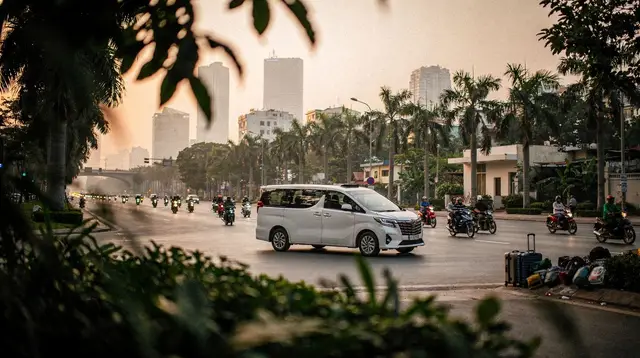
The “limousine” is a smaller, newer idea. It is a van, typically with a dozen or so very wide, heavily reclining seats, sometimes arranged in a pod-like layout with privacy curtains. It is branded as the premium version of the bus and aimed at medium distances.
Its main attractions are practical:
- It often picks up from your hotel or from a central address in the city rather than a distant bus station.
- It is faster to board and less crowded, with a smaller group and an attendant.
- The seat is better suited to a daytime ride than a night one, because you can recline but you cannot truly lie flat.
The main downsides are equally clear. The van is smaller, so it feels every bump on a rough road, and when the driver is in a hurry on a mountain road you feel that too. A limousine minibus is a comfortable seat, not a safer vehicle.
Who they are for
Sleeper buses and limousine minibuses are for people who:
- want a straightforward, inexpensive way to cover a medium distance with a fixed departure,
- are heading to a destination that has no useful rail link or airport, and
- accept that they are trading some comfort and some road risk for flexibility and economy.
They are a good fit for backpackers, flexible travellers and anyone building a loose route. They are less ideal for families with small children, for travellers with back or mobility problems, and for people who need to arrive fresh for a morning appointment. The reasons are the narrow berths, the stop-start rhythm of the road, and the difficulty of moving around the vehicle. If accessibility is a concern, see accessible travel in Vietnam before you commit.
Where the bus really earns its place
The strength of the bus network is that it fills the gaps that trains and planes leave. The three clearest examples are all in the north.
Ha Long Bay. There is no practical rail service to the bay and the nearest airport hops are impractical for most visitors. Most people reach the harbour by road from Hanoi, either on a cruise operator’s own transfer or a scheduled minibus. If you are planning a cruise, our guide to Ha Long Bay cruises explains what the transfer usually includes, and the Ha Long destination page sets out the geography. A cruise such as the overnight cruise on Lan Ha Bay from Hanoi usually bundles the road transfer, which removes the bus question altogether.
Ninh Binh. The town has a train station, but the landscapes you are visiting, Trang An, Tam Coc and Mua Cave, are spread across the countryside and are best explored from a base in the area. A bus or minibus gets you there; a hired bike, a boat or a car does the rest. If you would rather not organise any of it, an arranged excursion like the small-group day trip from Hanoi to Ninh Binh covers the road and the sights in one booking. For the destination itself, see Ninh Binh.
Sapa. The mountain town can be reached by road from Hanoi, and many visitors do exactly that on a coach or a limousine. There is also a night train to Lao Cai, from where a transfer climbs to the town, which some travellers prefer for the sleeping arrangements. Which one suits you depends on whether you value a flat berth or a door-to-door arrival. The comparison lives on the Sapa destination page.
In the same spirit, the buses work well for routes into the highlands, such as the road from the coast to Da Lat or from Ho Chi Minh City to Mui Ne. These are the sort of medium-distance hops that no rail line serves conveniently.
What they are not
It is just as important to be clear about what a sleeper bus is not.
It is not a way to sleep like a bed. The berth is narrow, the road is uneven, and the driver sounds the horn often. Most travellers doze rather than sleep. Arriving in a new city at an awkward hour after a night on the road is a common complaint.
It is not a shortcut across the country. Trying to cross Vietnam from one end to the other by coach is a poor use of your time and body. The very long distances are generally better covered by a domestic flight or by the Reunification Express, which has proper sleeper compartments and a very different level of comfort. If you want to understand that option, the Reunification Express review and the Vietnam train travel guide set it out in detail.
It is not a premium product at every price. Quality varies enormously between operators. A branded coach with a booking system and a named company is a different experience from an unmarked vehicle picked up on a street corner. We come back to this below.
Comfort against economy: an honest verdict
The case for the bus is economy and flexibility. It costs far less than a flight for a medium distance, it runs frequently on busy corridors, and the departure points are usually in the city. For a traveller on a tight budget, this is difficult to argue with, and our Vietnam travel budget guide explains where the savings go.
The case against it is that the savings are paid for in sleep and in risk. You may arrive tired, you may be unable to work or see the scenery, and you will spend part of the journey a little anxious if the driver is aggressive. If a flight costs only a modest amount more and shortens the trip substantially, it is often the better deal for your time. Be honest about your own priorities: if every hour counts and you have a short holiday, fly. If you have time, an appetite for the road and a limited budget, the bus is entirely sensible.
A useful rule of thumb is to ask what the journey is for. If the road itself is part of the trip, such as a scenic highland route in daylight, the bus or a limousine is a good way to see it. If the road is only a gap between two places, a night bus is a poor way to spend a night.
Road safety: the point to take seriously
Traffic is the real risk of travelling in Vietnam, and buses share the roads with a heavy flow of trucks, motorbikes and other coaches. Most journeys end without incident, but accidents do happen, and it would be dishonest to pretend otherwise. Our general guide to safety in Vietnam puts this in context: violent crime is rare, and the traffic is what deserves your attention.
Some practical habits reduce the risk:
- Choose a recognised operator. A company with a visible brand, a booking record and a reputation to protect tends to maintain its vehicles and manage its drivers better than an anonymous one.
- Prefer daylight for mountain roads. Winding mountain sections are tiring and more dangerous in the dark, and fatigue is a factor for drivers as much as for passengers.
- Use the seat belt if there is one. It is not always fitted, but when it is, wear it.
- Pick your position. A seat towards the middle of the vehicle is generally steadier than the very back or the very front.
- Do not hesitate to say something. If the driving feels reckless, you can ask politely to be let off at the next stop or contact the operator. It is better to lose a ticket than to ignore a real worry.
Travel insurance matters here too. Check that your policy covers road travel and that it does not exclude the kinds of transport you plan to use. The travel insurance guide explains what to look for.
Sleep, comfort and the little practicalities
A few simple preparations make a big difference.
- Bring earplugs and an eye mask. The cabin light and the horn are the two things you cannot switch off.
- Dress in layers. The air conditioning is often aggressive, and a thin jacket or scarf is more useful than a blanket you did not choose.
- Use the toilet before you board. On a coach without a washroom you depend on the rest stops, and the timing is not yours to choose.
- Carry a small snack and water. Rest stops can be rushed and the food is often more expensive and less appealing than you would like.
- Keep your shoes with you. The plastic bag is for exactly that; do not leave them on the floor of the aisle.
For a good first night, aim to eat lightly, avoid a large amount of liquid, and settle in as soon as the coach departs, before the lights go off.
Keep your belongings on you
The advice on belongings is simple and consistent: keep what matters on your body. In practice:
- Passport, phone, wallet, cards and any electronics stay in a small bag you can hold or tuck under your arm or against your body.
- Larger luggage goes in the hold or under the seat, but should not contain anything you cannot afford to lose or replace on a trip.
- A small lock on the zip of your main bag is a sensible and cheap deterrent.
- Do not leave your phone charging in the open at the end of the berth, where it is easy to take.
Theft on buses is not widespread, but opportunists exist, and a sleeping passenger is an easy target. The same logic applies to the hold: staff are usually helpful, but a bag with no valuables is simply a bag you can afford to lose. More general warnings about common tourist problems, including overcharging and ticket tricks, are collected in scams to avoid in Vietnam.
How to book, and with whom
The most reliable approach is also the simplest: book with an operator you can identify, either directly or through your accommodation. A hotel front desk or a well-known travel agent can usually tell you which companies are dependable on a given route, and will often handle the booking and the pick-up.
Some points to keep in mind:
- Know the exact pick-up and drop-off point. Some services collect from a central address and drop at a bus station well outside the town. Ask, and take a screenshot of the address.
- Confirm what the ticket includes. Whether it covers a hotel transfer at the other end, a shuttle between stations or just the seat is not always obvious.
- Be wary of door-to-door “deals” sold on the street. These are the typical source of misunderstandings, such as an unannounced change of vehicle or an extra fee at the end.
- Do not pay in full to a stranger. Use a receipt, a confirmation message or a booking platform where possible.
- Book earlier in peak periods. Around Tet and on weekends and public holidays, popular departures sell out. For the dates and what to expect, see our page on Tet in Vietnam.
If you are mixing buses with taxis and ride-hailing for the first and last kilometre, the guide to Grab and taxis in Vietnam explains how to do that without being overcharged.
When another mode is better
Because the bus is cheap and everywhere, it is tempting to use it for everything. Resist this. As a rule:
- For very long distances, a domestic flight or the train is generally more comfortable, more predictable and kinder to your schedule. See the pages on flights and trains.
- For loops through the mountains, a motorbike with a licensed rider or a private driver offers a very different experience from a coach, but with its own rules and risks. The motorbike rental guide deals with the licence and insurance questions, and the Ha Giang destination page describes the loop.
- For short hops around a base, a hired bike, a boat or a local driver is usually more practical than a scheduled coach. On Cat Ba Island, for example, a mountain bike rental on Cat Ba Island is a pleasant way to see the island at your own pace once you have arrived.
If you are still deciding between north and south as a first trip, north or south Vietnam may help you narrow down which routes you will actually need.
A simple way to decide
Ask yourself three questions before you book a seat:
- Is there a better option for this distance? If a flight or train fits and the price difference is small, take it.
- Can I arrive in daylight and in reasonable shape? If not, consider breaking the journey or choosing a daytime departure.
- Do I trust this operator? If you cannot name the company, keep looking.
If the answers are favourable, the sleeper bus or the limousine minibus is a perfectly good way to see the country. It is an honest, unglamorous form of transport that rewards a little preparation, and it will take you to places where the other modes simply do not go.
Sleeper bus and limousine minibus questions answered
What is the difference between a sleeper bus and a limousine minibus?
A sleeper bus is a full-size coach with reclining bunk-style berths, built for overnight or long daytime runs. A limousine minibus is a smaller van, usually with a dozen or so wide seats, used for medium distances and often with hotel pick-up in the city centre.
Are sleeper buses safe in Vietnam?
Most journeys pass without incident, but road accidents are the main risk of travel in Vietnam and buses are not exempt. Choose a known operator, avoid the cheapest unbranded options, wear the seat belt where there is one and be cautious about night driving on mountain roads.
Can I sleep properly on a sleeper bus?
Rarely well. Berths are short, the road is bumpy, and the horn and braking never really stop. Tall travellers struggle most. Earplugs, an eye mask and a light layer help, but expect a rest rather than a real night’s sleep.
Should I book a sleeper bus in advance?
Book ahead on busy corridors and around holidays such as Tet, when seats sell out. Book with a recognised operator or through your hotel, and keep the confirmation on your phone. Outside peak periods, a day or two ahead is usually enough.
Is it safe to leave my luggage in the hold?
Large bags usually go in the hold or under the seats, but valuables should never travel there. Keep your passport, phone, wallet and electronics on you, ideally in a small bag you can hold or lie on while you rest.
When is a train or flight better than a bus?
For very long distances, such as going from the far north to the far south, a domestic flight or the Reunification Express is generally more comfortable and more predictable. The bus makes sense for shorter hops that the rail network and airports serve poorly.
Do I need a visa or special documents to take a bus?
Domestic buses need no special paperwork beyond your normal ID, though operators may ask for your name and phone number when booking. Your entry visa rules depend on nationality, so check the official immigration portal or your government’s travel advice.
Getting Around Vietnam
Verified deep-linked GetYourGuide tours. Book through these links and we earn a small commission at no cost to you.
GetYourGuide does not provide a product photo for this activity — the image shows the meeting point, photographed by us.