Is Vietnamese Street Food Safe? How I Eat on the Street Without Worry
Is it safe to eat street food in Vietnam?
Yes, for most travellers, if you use method rather than fear. The real risks are tap water, which is not drinkable anywhere in Vietnam, and food that has been sitting around. Choose busy stalls, food cooked in front of you, and bottled or filtered water. For any medical condition, ask a doctor before you travel.
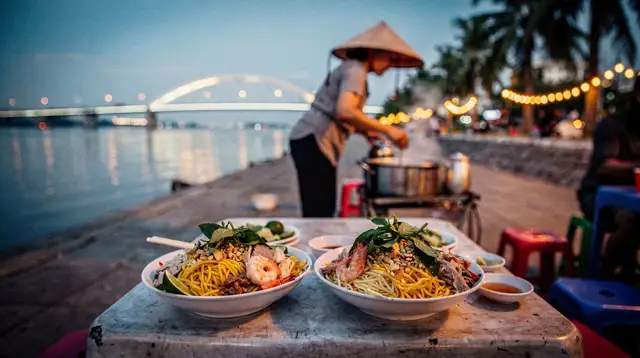
The first time I sat down on a plastic stool at a Hanoi pavement stall, I did the worried-traveller thing: I scanned the bowl, the chopsticks, the cook’s hands, and wondered whether I was about to ruin my week. Ten minutes later the bowl was empty and I was ordering a second one. That small moment is the whole argument of this page: you can eat on the street in Vietnam, and eat well, if you have a method.
Why I would never skip the street
Street food is not a risky side-show in Vietnam; it is the cooking itself. The best bowl of noodles in the north, the most memorable breakfast in the centre, the late-night snack in the south: all of them are usually served within a few metres of the road. If you avoid the street out of fear, you eat in hotel restaurants and miss the country.
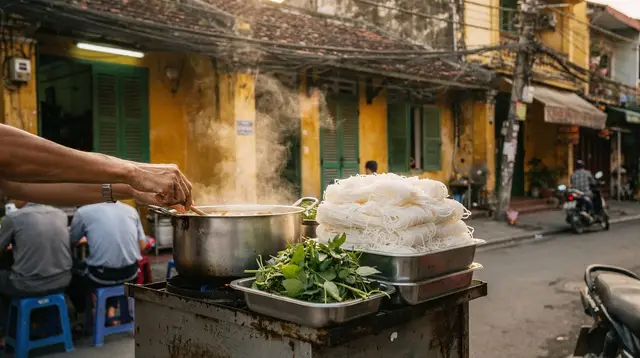
The good news is that the street is also a transparent kitchen. You can see the pot, the grill and the cook. That visibility is your best tool, and it is the opposite of a closed restaurant kitchen where you can see nothing at all.
For the dishes themselves, I leave the details to other pages: the Vietnamese food guide, the list of dishes to try and the comparison of pho and bun bo Hue. Here I only deal with how to eat them safely.
The first rule: water
If there is one thing to remember, it is this: tap water is not drinkable anywhere in Vietnam. Not in Hanoi, not in Ho Chi Minh City, not in a smart hotel. Bottled or filtered water is the norm, and locals treat it that way too. I wrote a short note on it in can you drink tap water in Vietnam.
In practice this is easy:
- Drink bottled or filtered water, and buy it cheaply at any shop.
- Use it for brushing your teeth as well; I keep a bottle next to the sink.
- Be a little wary of raw things that may have been rinsed in tap water, such as a pile of salad leaves at a stall you have not watched.
- In a restaurant or hotel, filtered water is often offered at the table; just ask.
I find that once the water habit is fixed, most of the worry goes away. It becomes automatic within a day or two.
The second rule: freshness
The other real risk is not exotic at all: it is food that has been sitting too long. That is true in Paris or Chicago, and it is true in Saigon. The cure is simple. Pick food that is moving.
Read the stall in thirty seconds
When I walk up to a stall, I check a handful of things:
| What I look at | What I want to see |
|---|---|
| Customers | A steady flow, ideally locals, with people queuing or stools filling up |
| The cooking | Food made or heated in front of me, in a pot that is clearly hot |
| The ingredients | Herbs, meat and noodles covered, tidy and looking fresh |
| The cook’s hands | Money and food kept apart, or at least handled with some care |
| The water | Bottled or filtered water on view, clean bowls and chopsticks |
None of this needs special knowledge, only attention. A stall with a long line at lunchtime is turning its stock over fast, which is exactly what you want. A stall with an empty bench and a pot of something lukewarm is not an adventure worth having.
Order what is cooked in front of you
My favourite choices are the dishes where I watch the final step: a bowl of noodles with broth ladled from a boiling pot, meat grilled over charcoal, pancakes fried to order. Hot food, served fresh, is the easiest path.
I am more careful with things that sit out all day at room temperature, particularly in the heat. That does not mean never; it means I look at how busy the place is and use my judgement.
Cash, small notes and the little details
Cash still matters at street stalls, in markets and in small cafés, while hotels, cruises, tours and larger restaurants take cards. I carry small notes so I can pay immediately and move on. If you want to understand the currency, see money in Vietnam and the short piece on whether you need cash.
Prices are quoted in large numbers of dong, so I always check the figure and the year when I read about a price; the rate drifts. A simple look at the posted menu, or a quick question before you sit, avoids the overcharging that can happen at tourist hubs. You will find more on that in Vietnam scams to avoid.
A day on the street, region by region
In Hanoi, I start with a bowl of noodles at a busy corner in the Old Quarter, then have an egg coffee in the afternoon; see egg coffee in Hanoi. If you are new to the city, a guided evening can show you where locals actually eat; I would suggest a private street food tour of Hanoi as a gentle start, and there is a longer discussion in the Hanoi street food tours guide.
In Ho Chi Minh City, the street scene runs late and spreads across districts. Here the advice is the same: busy stall, hot food, safe water. A guided food tour by scooter is a good way to cover ground, and the Ho Chi Minh City street food tours page gives the wider picture.
In Hoi An and the centre, the cooking is a little spicier and the stalls cluster around the market; see Hoi An street food tours. If you want to understand ingredients rather than just eat them, a cooking tour from Hoi An shows you the market, the herbs and the technique.
When to ask a doctor
I am a traveller, not a medical professional, and I do not want to give health advice beyond common sense. If you have a medical condition, are pregnant, take regular medication or travel with young children, speak to a doctor or a travel clinic before you go. The page on health and vaccinations is a starting point, and it is sensible to take out travel insurance so that care is simple if you need it.
For the broader picture of risk in the country, I keep it in proportion in is Vietnam safe: the real everyday risks are traffic, heat and petty theft far more than the food.
My short checklist
- Drink bottled or filtered water, always.
- Choose busy stalls with a fast turnover.
- Prefer food cooked or heated in front of you.
- Look at the stall: covers, clean bowls, tidy handling.
- Carry small cash.
- Go slowly on your first day, and build up.
That last point is my own habit more than a rule: I start with simple, hot dishes and widen my range as I settle in. By the end of the first week, I stop thinking about it at all.
Frequently asked questions about Vietnamese street food safety
Is street food in Vietnam safe to eat?
Generally yes, if you choose carefully. Pick busy stalls with a fast turnover, watch the food being cooked, and stick to bottled or filtered water. Ask a doctor for advice if you have a medical condition.
Can I drink tap water in Vietnam?
No. Tap water is not drinkable anywhere in Vietnam. Drink bottled or filtered water, and keep that habit for teeth and drinks too.
How do I choose a good street food stall?
Look for a steady stream of customers, ingredients that are covered and fresh, food cooked or reheated to order, and a stallholder who handles money and food with some care.
Should I carry cash for street food?
Yes. Cash still matters at street stalls, markets and small cafés, while hotels, cruises and larger restaurants take cards. Small notes make paying quick and easy.
What should I do if I feel unwell after eating?
Rest, drink safe water and eat plainly. If symptoms are severe or last, see a doctor or pharmacist. The number for an ambulance in Vietnam is 115.
Is a food tour a good way to start?
Yes. A local guide shows you what a good stall looks like and how to order, which builds confidence for eating alone afterwards.
Street Food Tours and Vietnamese Cuisine Tastings
Verified deep-linked GetYourGuide tours. Book through these links and we earn a small commission at no cost to you.
GetYourGuide does not provide a product photo for this activity — the image shows the meeting point, photographed by us.