Hanoi Street Food Tours: How to Eat Local Without Getting Lost
Is a street food tour worth it in Hanoi?
For a first visit, yes. A guide picks stalls that suit your stomach, orders the dishes in a sensible sequence and explains what you are eating, which is hard to do alone in the Old Quarter. Most tours are on foot, with motorbike and evening versions for those who want more ground or a later start.
Hanoi is one of the easiest cities in Vietnam to eat well in, and one of the easiest in which to eat badly by accident. The same street can hold a family who has sold one bowl of noodles for three generations and a stall that has worked out how to charge tourists triple. A street food tour is a way of skipping the guesswork. This guide explains what a tour actually gives you, which dishes anchor the northern table, how the main formats differ and who each one suits.
It covers Hanoi and the cooking of the north only. The spicier food of the centre and the sweeter, herb-heavy food of the south have their own pages, and so do cooking classes and cultural sightseeing circuits.
What a guided food tour does that a solo walk does not
Walking the Old Quarter alone is perfectly feasible, and plenty of visitors do it happily. The streets there were historically organised by trade, and many of the food stalls still specialise in a single dish, which makes ordering simple in theory. In practice a few things get in the way.
Selection. Hanoi has thousands of vendors. A guide who walks the same lanes every week knows which pho stall is on form, which grill is worth the smoke and which dessert corner is only open for a couple of hours in the afternoon.
Order. Eating in a sensible sequence matters more than people expect. A tour usually moves from lighter bites to richer ones, then finishes with something sweet or a coffee, so that you are not defeated by a bowl of noodles at stop two.
Explanation. Northern cooking is understated. A bowl of pho looks plain until someone explains the broth, the cut of beef, the herbs you should add and the ones you should not. A guide also tells you what a dish is when the menu is hand-written in Vietnamese.
Etiquette and logistics. Where to sit, how to pay, what the small plastic stools are for, how to say no politely to a second helping. These are minor points, but they make the difference between feeling like a guest and feeling like an obstacle.
What a tour does not do is guarantee that the food is better than what you could find alone. A well-researched solo walk can match it. The advantage is time and confidence, which is the reason most first-time visitors book one for their first evening or morning.
The northern dishes at the heart of the table
Hanoi’s food has a reputation for subtlety: clean broths, careful grilling, fresh herbs, restrained sweetness. A good route is built around a short list of dishes that define it. If you want the wider picture, the Vietnamese food guide places them in the context of the whole country.
Pho
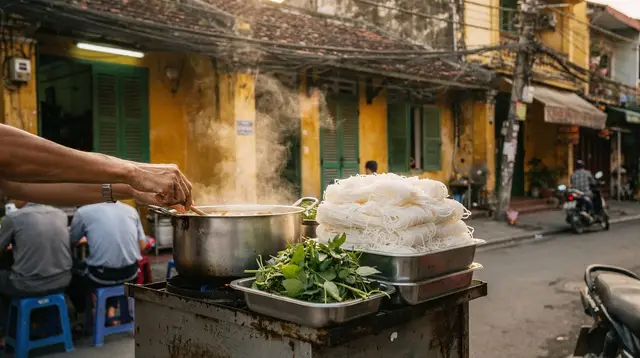
The best-known Vietnamese dish is firmly associated with Hanoi. In the capital, pho is usually served with a clear, restrained broth, flat rice noodles, thinly sliced beef or chicken and a scattering of spring onion. Garnishes are kept simple. A bowl typically costs somewhere around 50,000 to 80,000 VND (roughly 2 to 3 USD) in 2026, depending on the cut and the neighbourhood, and it is eaten at breakfast as often as at any other hour. On a tour you will normally taste a bowl at a stall with a long local following rather than at a restaurant with a laminated English menu.
Bun cha
Grilled pork patties and slices of marinated pork belly served in a bowl of warm, slightly sweet and sour broth, with a mound of cold rice vermicelli and a plate of herbs on the side. It is a lunchtime dish, and you will smell the charcoal before you see the stall. Bun cha is rich, so a guide will usually place it in the middle of a route rather than at the start. It is also the dish that most clearly shows why northern food cannot be separated from its pork.
Cha ca
Turmeric-marinated fish grilled and served with dill, spring onion, noodles, peanuts and a pungent shrimp sauce. It is a Hanoi speciality, and the street in the Old Quarter that carries its name is the traditional place to eat it. It is often sizzled at the table in a pan. Because it is quite filling, many tours offer a tasting portion or a shared pan rather than a full serving.
Ca phe trung, the egg coffee
A cup of strong Vietnamese coffee topped with a thick, sweet cream of whisked egg yolk, sugar and condensed milk. It is said to date from the 1940s, when milk was scarce, and it tastes closer to a dessert than a drink. It is served hot, often in a small bowl of warm water to keep it that way, and is usually the final stop on a route. For its history and for the places that serve it, see our piece on egg coffee in Hanoi.
The supporting cast
Around those four you will often meet banh cuon (steamed rice rolls filled with pork and mushroom), nem rolls, sticky rice with toppings, grilled skewers, bia hoi (the very light fresh beer sold by the glass for a few thousand dong) and sweet soups. Banh mi appears too, though it belongs as much to the south as to the north. If you are curious about the differences between regions, our comparison of pho and bun bo Hue shows how far apart northern and central tastes sit.
Three formats, three kinds of traveller
Most Hanoi food tours fall into one of three formats. They are not rivals; people sometimes book two of them over a longer stay.
| Format | Typical setting | Best for | Watch out for |
|---|---|---|---|
| Walking tour | Old Quarter lanes, on foot | First-timers, small groups, anyone who wants to ask questions | Heat and humidity in summer, pavement crowds |
| Motorbike or Vespa tour | Wider city, pillion or sidecar | People who want variety and a sense of the city beyond the centre | Traffic, helmets, nervous passengers |
| Evening tour | Same streets after dark | Social travellers, couples, those avoiding midday heat | Noise, queues, fewer breakfast dishes |
On foot in the Old Quarter
The default and the most flexible. A walking route keeps you in a small area, usually the Old Quarter and the lanes around Hoan Kiem Lake, with short gaps between stops. This makes it the format that suits the widest range of people: families with older children, people who dislike motorbikes, and anyone who wants to stop and photograph a stall. Pace is slow, so it also suits older travellers, as long as they are comfortable on uneven pavements and low stools.
Some of the best-reviewed options in this format are small-group walks. One example is a route led by women guides, which many travellers pick for the personal storytelling and the chance to hear about food from a local point of view; you can look at the details of the walking street food tours led by women guides if that appeals. A more classic alternative is a standard guided Hanoi street food tour, which follows the same logic and is often a safe first choice.
By motorbike or Vespa
Motorbike formats let a guide reach neighbourhoods that are too far for a walking route: local markets outside the tourist grid, lake-side cafes, a famous bowl of noodles that would take forty minutes to reach on foot. You ride pillion behind a driver, or in the sidecar of a vintage Vespa on some versions. The experience is as much about the city as the food, since you travel through the traffic that defines Hanoi.
It suits people who are comfortable on a motorbike, enjoy the sense of movement and want to see more than the Old Quarter in one evening. It does not suit anyone with mobility problems, people who are anxious in traffic, or very small children. If you are unsure, our guide to Vespa and cyclo tours in Hanoi explains how these rides work in more detail, and the category page for Vespa and cyclo tours lists the wider choice.
In the evening
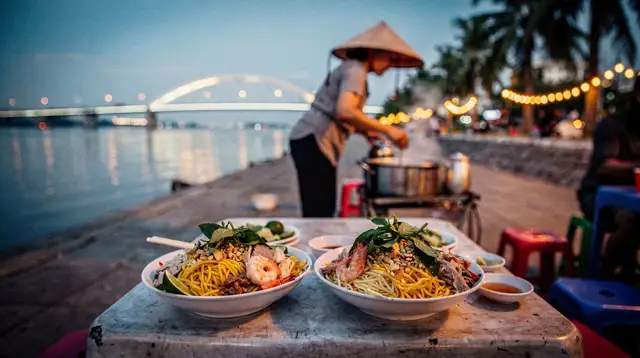
Evening is when the city eats. Temperatures drop, workers leave their offices, plastic stools fill the pavements and the grill smoke thickens. Evening tours combine the atmosphere of a night out with the food, and they often include a stop for beer or a cooled-down dessert. They suit younger travellers, couples and groups of friends, and anyone who spent the day in the heat and prefers to eat later.
The downsides are practical. Streets are noisier, queues are longer at popular spots and some breakfast-only dishes (a good bowl of pho is not at its best late at night) are less likely to feature. If you want to pair a food route with an evening show, see our guide to water puppet shows and nightlife in Hanoi.
Special diets: what is realistic
Northern street food is built around pork, beef, fish and fish sauce. That makes dietary requirements worth taking seriously, and worth raising when you book rather than at the first stall.
Vegetarian and vegan. A standard route needs adapting, because fish sauce and meat broths are everywhere. There are dedicated vegan routes, including a vegan local street food tour that ends near Train Street. Note that access to Train Street is restricted and is periodically closed by the authorities, so do not treat that part of any route as guaranteed. Read our note on Hanoi’s Train Street before you plan around it.
Allergies. Peanuts, shellfish, fish sauce and shrimp paste are common, and there is rarely a way to remove them from a communal pan. Tell the operator in advance, in writing, and ask what is realistic. A guide can usually steer you away from the problem stalls, but cross-contact at a street grill is hard to rule out.
Gluten. Rice noodles are naturally gluten-free, but soy sauce, some marinades and banh mi are not. This is manageable with a guide and harder alone.
Pork-free and halal. Pork is central to many northern dishes, and halal options are limited. Ask the operator directly whether a pork-free route can be arranged rather than assuming one exists.
Spice and heat. Hanoi’s food is usually milder than the dishes of the centre. Chillies are normally added at the table, so you control the heat.
The principle is simple: a tour is more flexible than a restaurant because the guide can swap stalls, but only if they know in advance.
Cash, water and other practical points
Cash. Tours are usually paid for online in advance, so you do not need much on the day. But if you stay on after the tour, shop at a market or pay for a coffee, small notes in dong matter. Street stalls, markets and small cafes mostly take cash only. Hotels, larger restaurants and tour operators take cards. Our guide to money in Vietnam and the article on whether you need cash in Vietnam cover denominations and ATMs.
Water. Tap water is not drinkable anywhere in Vietnam. Bottled or filtered water is the norm, and a guide will usually provide some. Ice in a restaurant is generally made from filtered water, but be careful with unfamiliar vendors. More on this in can you drink tap water in Vietnam.
Food safety. The general rules are simple: eat where it is busy, where the food is cooked in front of you and where the kitchen turns over ingredients quickly. A guide helps with all three. Our piece on street food safety in Vietnam goes through what to look for if you eat alone.
What to wear. Comfortable shoes and light clothes. Stools are low, pavements are uneven and you will likely get a splash of broth on yourself.
When to book. A food tour is a good first-day activity because it orients you in the city. If your flight lands late, an evening route can be a gentle way to end a long day. Early morning routes lean towards pho and sticky rice, while later ones lean towards grilled dishes and desserts.
Combining food with other things
A food tour sits well alongside other things. A morning of sightseeing on a Hanoi city tour followed by an evening food walk is a classic pairing. If you want to learn to cook what you ate, cooking classes in Hanoi are a separate topic.
Some half-day and day trips also fold food into a wider outing. The small-group incense and conical hat village tour with Train Street is a mix of craft and city, and not a food tour in the strict sense, though local snacks sometimes feature. As with any route that includes Train Street, treat that stop as dependent on what the authorities currently allow.
If your trip extends beyond the capital, the other half of the country eats very differently. See our guide to Ho Chi Minh City street food tours for the southern version, and the street food tours category for every city. For the city itself, start with the Hanoi destination page.
How to choose between the options
If you are on a first visit with a few days in Hanoi, start with a walking route. It is the most forgiving format, it fits most diets with a little notice and it leaves you with enough knowledge to eat alone the next day.
If you have been to Hanoi before, or you are a confident rider, consider a motorbike or Vespa route for a new angle on the city.
If you are travelling as a couple or with friends and enjoy a lively atmosphere, pick an evening time slot.
If you follow a plant-based diet, book a dedicated vegan route early rather than hoping to adapt a standard one.
Whichever you choose, look for small groups, a clear list of stops and honest information on what is included. Good operators say what food is covered, how many stops there are and what they cannot do. Cancellation terms and durations vary by operator, so read the description before paying.
Hanoi street food tours: questions travellers ask
Is a street food tour worth it in Hanoi or can I just walk around?
You can eat very well alone, especially if you stick to busy stalls that sell one dish. A tour adds stall selection, a planned order of dishes, explanations and a lower risk of ordering the wrong thing. It pays off most on a first visit or when time is short.
Which dishes will I eat on a Hanoi street food tour?
Expect northern classics: pho, bun cha, cha ca, banh cuon, nem rolls, sticky rice, fresh-fruit desserts and ca phe trung, the egg coffee. Exact stops vary by operator and by the day, so check the tour description.
Can vegetarians and vegans join a street food tour in Hanoi?
Yes, but tell the operator when booking. Northern street food leans on pork, beef and fish sauce, so a standard route needs adapting. A dedicated vegan route exists, and many operators can adjust a standard one if warned in advance.
Is it safe to eat street food in Hanoi?
Generally yes if you choose busy stalls with high turnover and food cooked in front of you. Guides pick stalls with that in mind. Tap water is not drinkable anywhere in Vietnam, so avoid ice or drinks of unknown origin from unfamiliar vendors and stick to bottled water.
Do I need cash on a Hanoi food tour?
Usually the tour is paid in advance, but if you eat or shop beyond the route you will need small notes. Street stalls and small cafes mostly take cash in Vietnamese dong, and the US dollar is not legal tender.
Which format is best: walking, motorbike or evening?
Walking suits most people and keeps you in the Old Quarter. A Vespa or motorbike format covers more of the city and suits those who enjoy riding pillion. Evenings are cooler and livelier, but busier and noisier.
How much should I eat before a tour?
Arrive hungry and skip a large breakfast or lunch. Tasting portions are small, but there are many of them, and a good tour is built around eight to ten stops.
Street Food Tours and Vietnamese Cuisine Tastings
Verified deep-linked GetYourGuide tours. Book through these links and we earn a small commission at no cost to you.
GetYourGuide does not provide a product photo for this activity — the image shows the meeting point, photographed by us.