Why Hanoi, and why not Saigon
Hanoi is the capital of Vietnam. It sits in the north of the country on the Red River, the seat of government of a single-party socialist republic, and the city where most visitors either begin or end a trip through the country. People often assume the capital is Ho Chi Minh City, still widely called Saigon. It is not. Saigon is the largest city and the economic engine, but it lies roughly 1,100-1,150 km further south as the crow flies and about 1,700 km by road or rail.
That gap shapes every plan. Going from one to the other is a domestic flight of about two hours, or more than thirty hours on the Reunification Express, which is a journey in its own right. It is never a day trip, and it is worth knowing before you book a “capital and Saigon in a weekend” itinerary that cannot work. Hue, for its part, was the imperial capital of the Nguyen dynasty until 1945 and is a different city again, in the centre of the country.
Hanoi itself is a city of lakes, tree-lined French avenues, thousand-year-old temples and a tangle of narrow commercial streets that still carry the names of the goods once sold there. It is older and quieter in tone than Saigon, more layered, and, for many travellers, easier to love on foot. This page frames the city as a base: what to see, how long to give it, how to arrive, and how it connects to the rest of northern Vietnam.
What you actually see in Hanoi
The city’s highlights fall into a handful of districts. None is far from the others, and the central ones can be linked on foot or by a short ride-hailing trip.
The Old Quarter and Hoan Kiem Lake
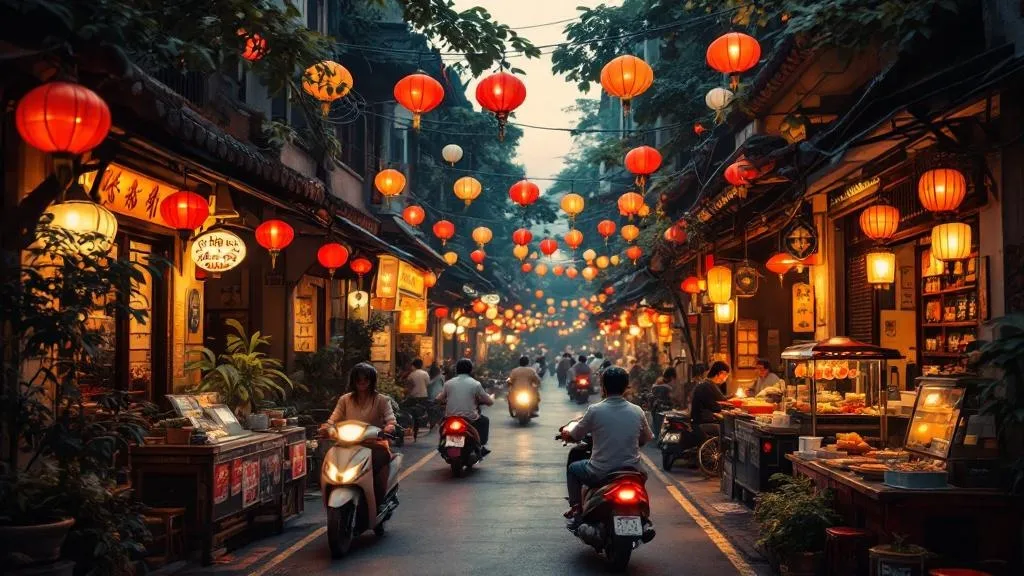
The Old Quarter is the reason most people come. Its streets, historically grouped by trade, are a dense mesh of shophouses, motorbikes, street kitchens, temples hidden behind shopfronts and tiny cafés on upper floors. It is noisy, chaotic and absorbing, and best taken in at walking pace, ideally early in the morning or in the evening when the pavements fill with plastic stools. Our Old Quarter guide maps the streets and the best loops.
On its southern edge lies Hoan Kiem Lake, the city’s living room. Locals exercise around it at dawn, couples sit on its benches at night, and at weekends the surrounding streets are closed to traffic for walking. The small Ngoc Son Temple sits on an islet reached by a red bridge, and a small tower rises from another islet in the lake. Give it an early morning and an evening; it feels like two different places.
The French Quarter and the Opera House
South and east of the lake, the grid opens out into the French Quarter: wide boulevards, colonial villas, the Opera House and grand hotels from the early twentieth century. It is a calmer, more formal Hanoi, with galleries, bakeries and good restaurants. The architecture is a reminder of the colonial period, and the area is a pleasant contrast after the Old Quarter’s density. You can see most of it in a single easy half day.
Ba Dinh: the Mausoleum and the Imperial Citadel
West of the centre, Ba Dinh is the political heart of the country. This is where Ho Chi Minh read the declaration of independence in 1945, and where the Ho Chi Minh Mausoleum stands in a large square. Visits are tightly managed, with dress rules and queues, and the mausoleum closes for maintenance for a period each year, so check the current schedule before planning around it.
Nearby, the Imperial Citadel of Thang Long was inscribed on the UNESCO World Heritage list in 2010. It is the archaeological trace of more than a thousand years of royal and political power on this site. The most striking parts are a mix of excavated foundations, a few surviving gates and a 19th-century flag tower. It is less grand than the imperial city in Hue, but it explains why Hanoi has been a capital for so long, and it pairs well with the Ba Dinh walk.
The Temple of Literature
The Temple of Literature, founded in 1070, is Vietnam’s first national university in spirit: a sequence of courtyards, gates and gardens dedicated to Confucius and to scholarship. It is a place of quiet, with stone steles standing on turtle bases that record the names of successful examination candidates. Go early; it is among the most photographed places in the city and gets busy by mid-morning.
West Lake and the north of the city
West Lake (Tay Ho) is the capital’s largest lake and a different pace again: lakeside cafés, a handful of temples and pagodas on its shores, wide cycle-friendly roads and a residential, slightly more international feel. It is a good place for a slow sunset, and many long-stay visitors base themselves in this district. Tran Quoc Pagoda, on a small peninsula, is among the oldest Buddhist sites in the city.
Train Street
Hanoi’s Train Street, where houses stand a metre or so from the tracks, has become a famous photograph. Be aware that access is restricted and periodically closed by the authorities. It has been fenced and patrolled on and off for safety reasons, and cafés there have been shut or limited. Do not treat it as a freely accessible attraction, do not plan a day around it, and never stand on the tracks. The page Hanoi Train Street: what to know explains the current situation and the safer alternatives for seeing a train pass.
How long to stay
Two to three days is the honest answer for the essentials, and it is enough to feel the city rather than just tick it off.
| Days | What fits |
|---|---|
| 1 day | Old Quarter, Hoan Kiem Lake, a food walk. Enough for a layover, not for the city. |
| 2 days | Add Ba Dinh, the Imperial Citadel of Thang Long, the Temple of Literature and the French Quarter. |
| 3 days | Add West Lake, a museum or two, a cooking class or a craft village, and an unhurried evening. |
| 4 days or more | One or two excursions: Ha Long Bay, Ninh Binh, Sapa or the craft villages. |
A day of walking in the Old Quarter plus a day for Ba Dinh and the Temple of Literature gives most people what they came for. If you can give a third day, spend it slowly rather than adding more sights. Pairing the city with an excursion is where Hanoi becomes a base, which is why most itineraries allow four to five nights in total. For help with the number of days across the whole trip, see how many days in Vietnam.
Getting to Hanoi and getting around
Arriving at Noi Bai
Hanoi’s international airport is Noi Bai (HAN), roughly 25-35 km north of the centre. Allow 45 to 70 minutes by road, depending on traffic and your final address; at rush hour it takes longer. There is no rail or metro link to the airport, so you are choosing between a metered or ride-hailing car (Grab, Be, Xanh SM), a shared shuttle bus and a pre-booked private transfer. A pre-booked transfer is the least stressful option after a long flight; our airport transfers guide lays out the options.
From elsewhere in Vietnam
- By air: Hanoi to Ho Chi Minh City is about 2 hours; to Da Nang or Hue about 1 h 15. See domestic flights in Vietnam.
- By rail: the Reunification Express runs the length of the coast, with sleeper berths. It is slow, atmospheric and an experience rather than a shortcut.
- By road: sleeper buses and limousine minibuses cover the medium distances to places like Ninh Binh and Sapa.
Moving around the city
The Old Quarter and the lake are walkable. For longer hops, ride-hailing apps are the simplest option and take away the haggling. Motorbike taxis (xe om) are quick but not for the nervous. Hanoi has a small metro, Line 2A and the elevated section of Line 3, useful for a couple of specific journeys but not a network that replaces taxis. A cyclo is a sightseeing ride rather than transport; agree the price and the route before you get in.
Traffic drives on the right and is overwhelmingly motorbikes. Crossing the street is done at a steady, predictable pace: do not stop or run, and let the flow bend around you. Our Hanoi city tours are a gentle way to learn the rhythm on your first day.
What to eat
Hanoi is a food city, and the northern kitchen is subtler and less sweet than the south. The essentials are pho, the beef noodle soup served for breakfast; bun cha, grilled pork with rice noodles and herbs; cha ca, turmeric fish with dill; and the city’s invention, ca phe trung, egg coffee, a whipped custard-like drink that is closer to dessert than to coffee. Everywhere, banh mi and bia hoi, the fresh draught beer served on plastic stools, are part of the day.
You can eat very well for little money, and the best places are often a single dish served from a pavement kitchen. Tap water is not drinkable in Vietnam, so stick to bottled or filtered water. For a first evening, a guided walk is an easy way in: see our Hanoi street food tours and the short read on egg coffee in Hanoi.
Excursions from Hanoi
Hanoi is the gateway to some of the country’s best-known landscapes. This page does not go into detail on them; each has its own page, and they are best planned as separate days or nights.
- Ha Long Bay, roughly 150-180 km east, is a UNESCO World Heritage Site and the classic overnight cruise. Our Ha Long Bay page covers the choices. A one-night trip, such as a two-day cruise among the limestone islands, is the usual compromise; a day trip is possible but long.
- Ninh Binh, about 100 km south, offers river caves and karst scenery around Trang An and Tam Coc; see Ninh Binh. A day trip works, and a night is better.
- Sapa and the northern mountains are a night or more away; read Sapa before deciding between a short and a long trip.
- The craft villages, such as Bat Trang for ceramics and Van Phuc for silk, are an easy half day. A pottery and cooking class in a village near the city is a hands-on way to see one.
For a fuller list of ideas that fit in a day, see day trips from Hanoi.
When to go
Hanoi has four seasons, which surprises many first-time visitors who assume Vietnam is tropical all year.
- October to November is the best period: warm, dry and clear, with comfortable evenings.
- March to April is mild, often with light drizzle and some haze.
- May to September is hot, very humid and rainy, with a typhoon risk roughly from July to September.
- December to February is cool and grey, typically 13-20 °C in the city, and can feel cold in unheated rooms. Bring a layer.
Tet, the lunar new year, falls between late January and mid-February, on a different date each year. Many businesses close for several days, transport is fully booked and prices rise, although the city itself is atmospheric and calm. Plan around it in advance. There is no single best time for the whole of Vietnam, which is one reason Hanoi is not always the right place to begin in every season.
Where to stay
Most first-time visitors choose between three areas. The Old Quarter puts you in the middle of the action, with noise to match. The area around Hoan Kiem Lake and the French Quarter is more polished, quieter and still walkable. West Lake is calmer, more residential and a short ride from the centre. Our guide to where to stay in Hanoi compares them with budgets and what each suits.
Money, entry and practicalities
- Currency: the Vietnamese dong (VND). In mid-2026 it is roughly 28,000 VND to 1 EUR and 26,000 VND to 1 USD, drifting slowly downward, so always check the year of any price you read. Cash still matters for street food, markets and small cafés; hotels, cruises and larger restaurants take cards.
- Daily budget (2026): a frugal day of street food, a simple room and walking can come in well below the range quoted above; a comfortable day with a good hotel, taxis and a tour sits towards the upper end.
- Entry: requirements depend on nationality and change. Vietnam issues an e-visa valid for up to 90 days to a broad list of countries and gives limited visa exemptions to some. Always confirm on the official immigration portal or your government’s advice. Our visa guide shows where to check.
- Power: sockets are mainly Type A and Type C, 220 V / 50 Hz.
- Time: UTC+7 all year, with no daylight saving.
- Emergency numbers: 113 police, 114 fire, 115 ambulance.
Is Hanoi safe, and what to watch
Violent crime is rare. The practical risks are traffic, overcharging around the lake and the Old Quarter, and the occasional pushy tout or fake taxi. Use ride-hailing apps or metered taxis from reputable companies, agree prices before a cyclo ride, and count your change. English is common in hotels and tourist restaurants and less so in everyday places; a few Vietnamese phrases go a long way and are met with warmth.
Hanoi: answers to common questions
Is Hanoi the capital of Vietnam, or is it Ho Chi Minh City?
Hanoi is the capital. Ho Chi Minh City, still called Saigon by most people, is the largest city and the commercial centre, but it is not the capital. Hue was the imperial capital until 1945.
Can I visit Hanoi and Ho Chi Minh City in one day trip?
No. They are roughly 1,100-1,150 km apart in a straight line and about 1,700 km by road or rail. The flight takes about two hours, and the train takes more than thirty hours.
How many days do I need in Hanoi?
Two to three days cover the essentials: the Old Quarter, Hoan Kiem Lake, Ba Dinh with the Imperial Citadel of Thang Long, the Temple of Literature and West Lake. Add one or two days for an excursion such as Ha Long Bay or Ninh Binh.
How far is Noi Bai airport from the centre?
Noi Bai is roughly 25-35 km north of the centre. Expect 45 to 70 minutes by road, longer at rush hour, and no rail or metro link.
Can I visit Train Street?
Access is restricted and periodically closed by the authorities, so it should never be counted on. Check the latest situation locally, follow any instructions and never stand on the tracks.
What is the best time to visit Hanoi?
October and November are the best months, with dry, mild and clear weather. March and April are also pleasant. Summer is hot, humid and wet with typhoon risk, and winter is cool and grey.
Can I drink the tap water in Hanoi?
No. Tap water is not drinkable anywhere in Vietnam. Use bottled or filtered water, including for brushing teeth if you have a sensitive stomach.


