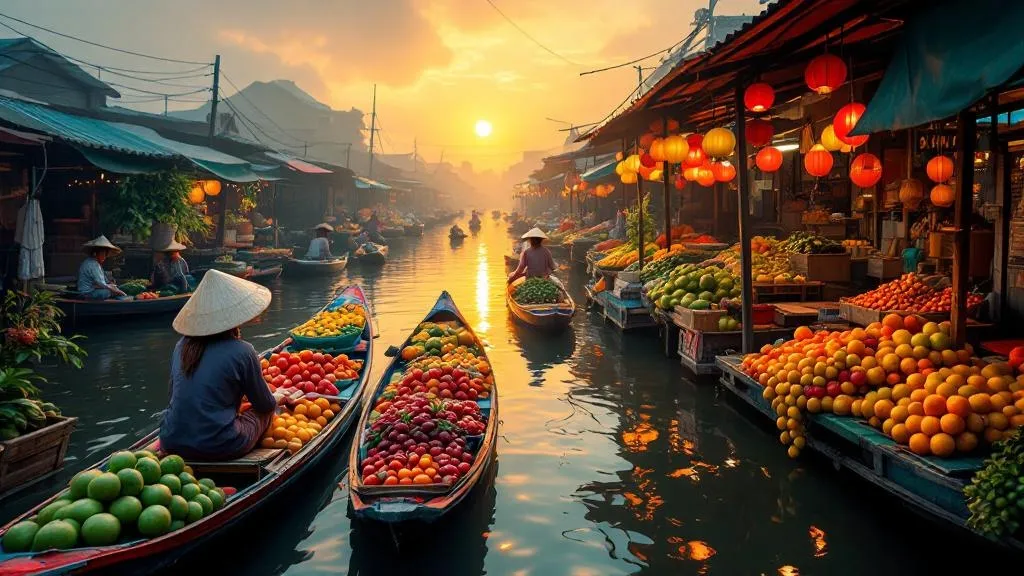
Can Tho is the biggest city of the Mekong Delta, a river port of canals, fruit markets and riverside cafés roughly 170 km from Ho Chi Minh City. It is the delta’s natural base, and the reason most travellers come: the Cai Rang floating market, a short boat ride from the city waterfront.
Start here: Cai Rang is in Can Tho, and it trades at dawn
One confusion is worth clearing up before anything else. The Cai Rang floating market is at Can Tho, not My Tho. My Tho is a different town much closer to Saigon, and its boat trips are about orchards, workshops and quiet channels, not a wholesale market. The day-trip itineraries sold from the south’s largest city often blur the two.
The second point matters even more for planning: Cai Rang is a working wholesale market, and it is at its liveliest at dawn. Boats loaded with pineapples, watermelons, sweet potatoes and pumpkins gather around sunrise, each hanging a sample of its cargo from a tall pole so buyers can see what is on offer. By mid-morning the crowd has thinned out and the heat has set in.
That is why the honest advice is to sleep in Can Tho. A day trip from Ho Chi Minh City, however early the coach leaves, tends to reach the water after the best of the trading, and you spend most of the day on the road. One night, with a boat booked for first light, is the minimum that does the market justice.
Where Can Tho sits in the delta
Can Tho is only one piece of the Mekong Delta. The delta stretches across the whole south-western corner of the country, a patchwork of rivers, islands, rice fields and orchards, with several towns that each deserve their own visit.
- My Tho and Ben Tre, about 70 km from Saigon, are the easy first taste: coconut groves, small canals and short boat rides.
- Cai Be and Vinh Long lie in between, with a smaller floating market and homestays among the fruit gardens.
- Can Tho, about 170 km out, is the biggest city and the best base for the largest floating market.
- Chau Doc, near the Cambodian border, is the gateway for people continuing overland.
For the overview of the whole region, including the nearer towns and the Cambodian border end, read our Mekong Delta guide. For the logistics of getting out of Saigon, start from the Ho Chi Minh City page. This page stays with Can Tho itself. If you are weighing the whole region against the big sights elsewhere, is the Mekong Delta worth it answers that directly.
How long to stay
| Plan | What you get | Our verdict |
|---|---|---|
| Day trip from Ho Chi Minh City | A late arrival at the market, a lot of road time | Possible, but not what we recommend for Cai Rang |
| 1 night in Can Tho | Dawn market, a canal or village morning, onward travel the same day | The honest minimum |
| 2 nights | Market, cooking class, a cycling or motorbike day, an unhurried evening | The best balance |
| 3 nights | Add Soc Trang or Bac Lieu, or a national park | For the curious or those with time to spare |
We have deliberately not put journey-time figures in the table: they depend on the road, the operator and the day of the week. Ask the operator for their current schedule when you book.
Getting to Can Tho
By road. The city is roughly 170 km from Ho Chi Minh City. Coaches, limousine minibuses and private cars with a driver all do the run. If you are choosing between a seat and a car, sleeper buses in Vietnam explains how the long-distance coaches work, and a private car is the easiest option with luggage or children.
By air. Can Tho has its own domestic airport. It is useful if you are coming from elsewhere in the country, for example from the north or the centre, and want to avoid a long day in a vehicle. Our domestic flights guide covers booking, baggage and airline choices. Like most Vietnamese airports, it has no rail or metro link, so you finish the trip by taxi or ride-hailing app.
On an organised tour. Many visitors prefer to book a packaged delta stay that handles transport, the boat and the accommodation. Browse the options in our Mekong Delta tours from Ho Chi Minh City and the day trips from Ho Chi Minh City guides.
What to do in Can Tho
The Cai Rang floating market
The headline sight. Plan for sunrise, wear light layers (the water is cooler than the town), and bring small notes for breakfast. Boats serving noodle soup, coffee and fruit weave among the wholesale vessels, and this is the best place to eat on the water. Keep your phone and camera strapped, since the boats rock when they bump together.
Photographers often ask whether the market is “authentic” given the visitors. It is: the wholesale trade is real, and it is the tourist boats that are the visitors. That said, the number of traders has declined over the years as roads and shops take over the work of the river, so go with calm expectations. Our dedicated Can Tho floating market tours guide compares the main ways to see it.
A one-night format is easy to arrange. The one-night floating market stay with a homestay is built around exactly this dawn start, so there is no scramble on the morning.
The smaller markets and canals
Beyond Cai Rang, you can visit quieter markets such as Phong Dien, which is smaller and tends to feel more local. The canals and small waterways between orchards are the other half of the delta experience: wooden bridges, stilt houses, coconut palms and bicycles. Ask your boatman to include a narrow canal where motor traffic cannot go; the change of pace is the point.
For the broader range of boat options, see the Mekong Delta boat tours guide.
Cycling and hidden villages
The flat terrain around the city is ideal for slow travel. A good ride follows the dykes and tracks past fruit orchards, with stops for tea, local fruit and a rest in the shade. If you want to stay overnight in a village house, the two-day hidden villages cycling homestay pairs the cycling with a night with a host family, which gives you a quieter, more local evening than the city.
Cooking classes
The delta has a distinctive kitchen: fresh river fish, coconut, herbs and fruit, with a gentler, sweeter edge than northern cooking. A class usually starts at a market, then moves to a kitchen where you cook several dishes and eat them for lunch. One that combines the water and the stove is the floating market, canals and cooking tour, which fits well into a single morning. For other classes in the region, see our cooking classes category, and for a wider picture of what you will be eating, the Vietnamese food guide.
The riverside, in the evening
Back in town, the Ninh Kieu waterfront is where the city goes to walk, eat and drink at the end of the day. It is not a sight so much as a pleasant hour: street snacks, a beer by the river, a cafe with a view of the lights on the water. If you want an evening with a local at the handlebars, the guided night motorbike tour with a local guide shows the city’s food stalls and back streets after dark, with the driving left to the guide.
Further afield
With a third day you can leave the river for something different: a day trip to the Khmer pagodas and the coast at Soc Trang and Bac Lieu, or a visit to the U Minh Thuong wetland national park. Both are long days and are better for those who already have the market done. The Can Tho things to do page lists the activities in one place.
When to go
The south has two seasons, no winter. The dry season, roughly December to April, gives the clearest mornings and the most comfortable boat rides, with March and April the hottest. The wet season, roughly May to November, usually arrives as short downpours in the late afternoon; mornings are often fine, which suits a dawn start. The delta is greener in the wet months and a little cheaper. The market runs all year.
Read more on the best time to visit Vietnam and on the rainy season and typhoons if you are combining Can Tho with the north or the centre, where the weather works differently.
Budget
Prices are in Vietnamese dong, quoted for 2026, and drift slowly, so always check the year. A rough day for a traveller who eats local food and takes organised boat trips runs from about 1,000,000 to 2,500,000 VND (roughly 400 to 1,000 NOK), depending on the hotel and the tour. Cash still matters for breakfast on the water, market stalls and small cafés; hotels and larger restaurants take cards. Tap water is not drinkable anywhere in Vietnam, so drink bottled or filtered water.
Practical tips
- Book the boat the evening before. Your hotel or homestay can arrange a dawn departure. Agree the price, the length of the trip and whether it includes the smaller canals.
- Avoid unlicensed touts at the waterfront. The usual risk in the delta is overcharging, not danger. A price agreed in advance solves most of it.
- Dress for mornings and sun. Light layers at dawn, a hat and sun cream later. Insect repellent is useful, especially in the wet season.
- Eat on the water, but sensibly. Choose busy boats and stalls. Our street food safety post has the basics.
- Respect the traders. It is a working market, not a stage. Ask before photographing people at close range.
For general safety, see is Vietnam safe.
Fitting Can Tho into a trip
Can Tho pairs naturally with a few days in Saigon before or after. The Mekong Delta in three days itinerary sequences the nearer towns and Can Tho in a sensible order. If you are heading to the beach after the delta, the south offers Phu Quoc by air, or Mui Ne on the coast, which, to repeat, is not part of the delta. The overview of the whole region sits on the Southern Vietnam page.
Questions about visiting Can Tho
Is the Cai Rang floating market in Can Tho or My Tho?
It is in Can Tho. My Tho is a different delta town, about 70 km from Ho Chi Minh City, known for orchards, coconut candy workshops and boat trips, not for the dawn wholesale market. Mixing the two up is the most common planning mistake in the delta.
How many days do you need in Can Tho?
One night is the minimum, because the Cai Rang market is busiest around dawn and a late day trip from Ho Chi Minh City misses it. Two nights give you the market, a cooking class, a village by bicycle and a slower evening by the river.
How do you get from Ho Chi Minh City to Can Tho?
The city is about 170 km away. Most visitors take a coach or a limousine minibus, or hire a car with a driver; there are also domestic flights into Can Tho airport. Check current timetables with the operator, as road times vary with traffic.
What time should you go to the floating market?
Go at or just before sunrise, when the wholesale boats are most active. By mid-morning the trade thins out and the light is flat and hot. Most hotels and homestays organise a boat for the early slot the evening before.
Is Can Tho the whole Mekong Delta?
No. It is the delta’s largest city and a good base, but the delta is a vast region of provinces, rivers and islands. My Tho and Ben Tre are nearer to Ho Chi Minh City, and Chau Doc lies by the Cambodian border.
When is the best time to visit Can Tho?
The dry season, roughly December to April, gives the most comfortable mornings. March and April are the hottest months. In the wet season, roughly May to November, rain usually comes as short afternoon downpours, and the markets keep trading.
Is Can Tho safe for tourists?
Violent crime is rare. The practical risks are motorbike traffic, heat, and overcharging by unlicensed boat touts at the waterfront. Agree the boat price and duration before you step on board, or book through your accommodation.


