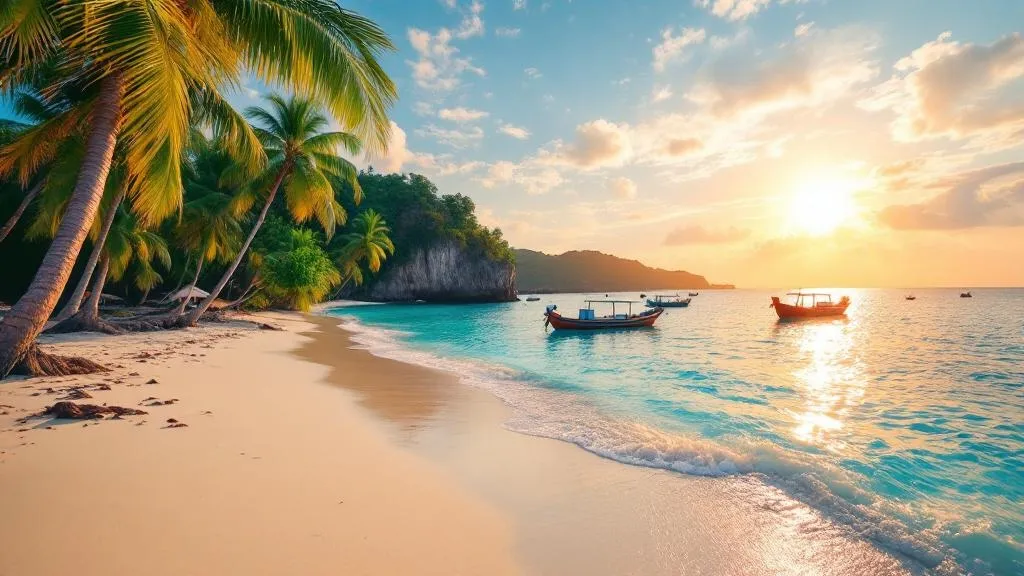
Phu Quoc is the largest island in Vietnam, and it sits where many people do not expect it: in the Gulf of Thailand, a few dozen kilometres off the Cambodian coast, and well away from the long Vietnamese shoreline that faces the South China Sea. Two mistakes come up again and again in trip planning. The first is to put Phu Quoc in the South China Sea; the second is to treat it as part of the Mekong Delta, because it belongs to the same southern region on a map. Neither is right. The island is its own place, with its own international airport (PQC), its own seasons and its own pace.
That has a practical consequence. Phu Quoc is a destination you build a few days around, reached by air or by boat. It is never an improvised excursion from Ho Chi Minh City. If you are choosing between southern sea destinations, the south Vietnam overview places it next to the Delta, the dunes of Mui Ne and the other islands.
Why Phu Quoc suits a slow beach stop
The island is roughly fifty kilometres from north to south, with a forested interior, a long run of beaches on the west coast, quieter coves on the east and a scatter of small islands off the southern tip. Much of the interior is protected forest, which is why the island feels greener and less built-up than most coastal resorts in the region, even though the west coast has seen heavy resort development in recent years.
What it offers is simple and honest: warm, usually shallow water in the dry season, sunsets over the sea, fresh seafood, a night market, boat days and not much else you must do. It works well at the end of a long trip across Vietnam, after the heat and noise of the cities. It is also a good fit for couples, families and anyone who wants to read on a beach without a plan.
If you are weighing it against other coasts, the guides comparing Phu Quoc and Nha Trang and Phu Quoc and Con Dao set out the trade-offs, and the best beaches in Vietnam puts the island in the wider picture.
Getting there: by air or by boat
Flying
Phu Quoc has its own international airport, PQC, on the southern half of the island. From Ho Chi Minh City the flight takes about an hour; from Hanoi, roughly two hours. Several Vietnamese carriers operate the routes, and some international flights land directly. Flights are the fastest and, for most visitors, the sensible choice; the domestic flights guide covers booking and baggage basics.
There is no train or metro link to the airport, so you will take a taxi, a ride-hailing car or a hotel transfer to your resort. Distances on the island are modest, but allow 10 to 40 minutes depending on where you sleep.
By boat
The mainland ports are Rach Gia and Ha Tien, on the south-western coast of the country. Fast boats run from both, with crossings of roughly an hour and a half to two and a half hours depending on the port and the sea. Ha Tien is the shorter crossing and sits near the Cambodian border, which is why some travellers combine the island with an overland route; the Vietnam to Cambodia overland guide explains that side of things.
From the Delta, the usual approach is to travel to Rach Gia by road and cross from there. If you want the boat leg arranged, the Rach Gia to Phu Quoc express speedboat is the straightforward way to book the crossing in advance. Whichever you choose, a boat day should be treated as a travel day, not squeezed between other plans. Sea conditions can delay or cancel departures.
When to go: November to April
The south has two seasons rather than four. Phu Quoc follows that pattern, with a dry season that runs roughly December to April and a wet season roughly May to November. For the island, the best season is roughly November to April: the sea is calm and clear, snorkelling is rewarding and the rain is rare.
The wet season brings short, heavy downpours, often in the afternoon, plus rougher seas. Most of Phu Quoc’s best-known beaches lie on the west coast, which becomes rough and choppy in the wet season. Water can be churned up, red flags may be flown and some boat trips are reduced or cancelled. The island is not shut, and prices drop, but it is a different holiday: more cloud, more green, fewer swimmers.
| Period | What to expect | Good for |
|---|---|---|
| November to April | Calm sea, sun, hot (hottest around March and April) | Beaches, boat trips, snorkelling |
| May to October | Wet season, afternoon downpours, rough west coast | Quiet stays, lower prices, spas |
For a wider look at the weather picture across the country, the rainy season and typhoons guide explains how the three regions differ. As a reminder, prices in this guide are 2026 figures and the dong drifts slowly, so always check the year on anything you read.
Beaches and where to stay
The island’s character changes from one coast to another.
- Long Beach (Bai Truong) is the long west-coast strip running south from the main town, Duong Dong. It has the biggest choice of hotels, restaurants and bars, and it is the easiest base for a first visit.
- Ong Lang is a smaller, calmer stretch just north of town, favoured by travellers who like a quieter, more relaxed feel.
- Sao Beach (Bai Sao) in the south-east is the classic postcard beach, with pale sand and clear water, and it is the one people go out of their way to see.
- The north is the least developed part of the island, with forest, scattered resorts and large-scale leisure complexes.
- An Thoi, at the southern tip, is the port from which most island-hopping boats leave and the end of the island’s famed cable car line.
For most travellers, Long Beach or Ong Lang is the simplest choice, because you are within reach of food, transport and boats without needing a car every day. If you want a pure resort stay, sea-facing rooms in the south or north cost more but give a greater sense of retreat.
Things to do
Island hopping and snorkelling
The island’s southern archipelago is the most popular day out. Boats leave from An Thoi and visit small islands with coral, white-sand shores and shallow water that is calm in the dry season. Choices range from budget group boats to private speedboats. A day on the southern islands by speedboat with lunch is a good first outing, and if you prefer to go at your own pace, a private snorkelling trip in the south keeps the time short and the group small.
Our Phu Quoc island hopping and snorkelling guide compares the routes and explains how to judge a good operator, and the Phu Quoc island tours guide covers the land and sea day tours.
Do not expect Maldives-grade reefs. Coral quality varies, and visibility depends heavily on the weather and the day. What the trips give you is a pleasant, easy day on the water.
The cable car and Sunset Town
At An Thoi, a sea-crossing cable car runs across the water to Hon Thom island, one of the longest of its kind in the world. It is a spectacle in itself and the heart of a tourist complex on the island, with a water park, a beach and the staged streets of Sunset Town. It suits families and those who like a big, polished leisure day more than a wild one. Most visitors treat it as a half-day or full-day activity and go early to avoid queues.
Fish sauce, pepper and the interior
The island is known across Vietnam for its fish sauce (nuoc mam) and its pepper. Small factories and farms open their doors to visitors; they are an easy way to see something other than beach life, and a bottle makes a useful souvenir. The interior forest and a few modest waterfalls and trails are best in the early part of the dry season, when there is still some water.
Night market and evening seafood
The night market in Duong Dong is the usual evening outing, with grilled seafood, fruit, snacks and souvenirs. Prices are posted or negotiated in advance, and it pays to check the weight and price of live seafood before it is cooked. Squid fishing trips after dark are offered by some boats and give a different angle on island life.
How many days you need
Three days is a comfortable minimum: one for arrival and the beach, one for a boat day and one for the cable car or the interior. Four or five days give you time to slow down, do nothing and take a second boat trip if the weather turns. A multi-day option such as the three-day, two-night package with a boat bundles the logistics for those who prefer it, though many independent travellers simply book a hotel and add single boat days as the weather allows.
A common pattern is to put Phu Quoc at the end of a south-focused route: Ho Chi Minh City, the Mekong Delta and Can Tho, then the island. The Delta and Phu Quoc are different experiences, so do not count a Delta day trip as having seen the island.
Money, getting around and practicalities
Cash and cards. Resorts, larger restaurants and tour operators take cards. Cash is still needed for the night market, small cafés, motorbike taxis and local shops, and ATMs are common in Duong Dong and on Long Beach. See the money guide for the basics of dong and exchange.
Getting around. Ride-hailing apps work in the main areas, though availability is thinner than in the big cities and prices can be higher late at night. Metered taxis, hotel transfers and scooter rentals fill the gaps. If you rent a motorbike, you need the right licence and insurance; many insurers refuse claims otherwise. The grab and taxis guide explains the options.
Visas. Phu Quoc has its own visa exemption scheme for travellers who arrive directly on the island. The details depend on your nationality and change from time to time, so check your situation on the official Vietnamese immigration portal or with your government’s travel advice before you book. The visa guide explains how the main routes work.
Water and health. Tap water is not drinkable anywhere in Vietnam, and Phu Quoc is no exception. Use bottled or filtered water. Sun, heat and sea urchins on rocky shallows are the most common nuisances; carry reef-safe sunscreen and water shoes.
Emergency numbers. Police 113, fire 114, ambulance 115.
Leaving the other southern islands alone
Phu Quoc is often discussed next to other coastal stops, but each has its own character and logistics. Con Dao, reached by air or ferry, is a quieter, more remote island with a very different history; Mui Ne is a dune-and-kitesurf coast, not an island and not part of the Delta; and Vung Tau is a seaside town near Ho Chi Minh City. Treat them as separate trips rather than add-ons.
For travellers weighing whether the island is worth the journey at all, the blog covers it directly in is Phu Quoc worth visiting.
Phu Quoc questions travellers ask
Is Phu Quoc in the Mekong Delta or the South China Sea?
Neither. Phu Quoc lies in the Gulf of Thailand, off the Cambodian coast, and it is a separate island with its own airport. The Mekong Delta is a mainland river region, and the South China Sea lies along Vietnam’s eastern shore.
What is the best time to visit Phu Quoc?
The best season is roughly November to April, when the sea is calm and the weather mostly dry. The wet season, roughly May to November, brings afternoon downpours and a rough west coast, where most beaches are.
How do you get to Phu Quoc?
Fly to the island’s international airport (PQC), about an hour from Ho Chi Minh City and roughly two hours from Hanoi, or take a fast boat from Rach Gia or Ha Tien. Boats are subject to sea conditions, so leave slack in your schedule.
Can you visit Phu Quoc as a day trip from Ho Chi Minh City?
It is not practical. Getting there and back by air or boat takes most of the day, and the island is worth at least three nights. Treat it as its own destination.
Do you need a visa for Phu Quoc?
Phu Quoc has a visa exemption scheme of its own for direct arrivals, but the rules depend on nationality and can change. Check the official Vietnamese immigration portal or your government’s travel advice before you travel.
Is Phu Quoc good for snorkelling?
It is pleasant rather than spectacular. The southern islands offer calm water and easy snorkelling in the dry season, but coral and visibility vary. A guided boat day is the simplest way to go.
How much does a day on Phu Quoc cost?
Plan roughly 1.2 to 2.5 million VND per day in 2026, or about 500 to 1,000 NOK, excluding flights, covering a mid-range room, meals, transport and one activity. Resorts and private boats push that figure higher.


