Hoi An Ancient Town and My Son Sanctuary: Two UNESCO Sites, One Excursion
Are Hoi An Ancient Town and My Son the same site?
No. Hoi An Ancient Town is a former merchant port and My Son is a Cham Hindu temple sanctuary roughly 40 km inland, each inscribed separately by UNESCO in 1999. Many tours combine them, but you can also visit My Son alone at dawn or see the old town at your own pace.
Two places near the central coast share one year of UNESCO inscription and a lot of confusion. Hoi An Ancient Town and the My Son Sanctuary were both added to the World Heritage list in 1999, they sit less than a day’s outing apart, and tour companies love to sell them as a pair. But they are different kinds of place, built by different peoples, in different centuries, for entirely different reasons. Knowing the difference before you book will change which excursion you choose.
This page is about the heritage side of the area. It helps you decide whether to take the combined trip, go to My Son alone early in the morning, or give the old town a slow day of its own. For the wider destination, start with the Hoi An destination page.
Two sites, two inscriptions, two stories
Think of it this way: one is a town, the other is a ruin in a valley.
Hoi An Ancient Town is a living, walkable port. From roughly the 15th to the 19th century it was a stop for merchants from Japan, China and Europe who came for silk, ceramics and spices, and who waited here for the seasonal winds. The town was inscribed because so much of that trading settlement survived in one piece: low tile-roofed merchant houses, assembly halls built by Chinese communities, narrow lanes and a Japanese Covered Bridge that has become the town’s emblem. People still live and work in these buildings.
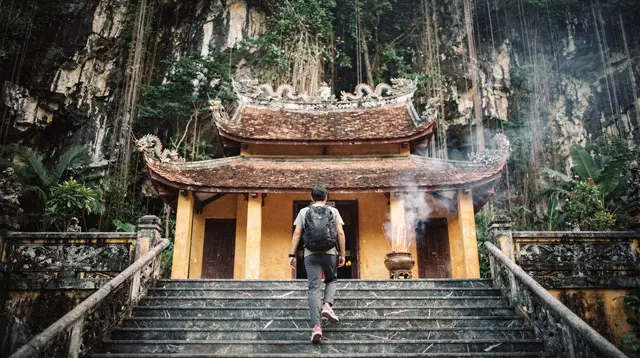
My Son Sanctuary is an abandoned religious complex built by the Champa kingdom, a Hindu civilisation that ruled much of Vietnam’s central coast for well over a thousand years. It sits in a green valley ringed by hills roughly 40 km inland from the coast. Its brick towers and temples were raised over many centuries, mostly to honour Shiva and to commemorate Cham kings. Parts of the site were badly damaged during the war in the late 1960s, which is why some sections are rubble and others still stand.
The two inscriptions were granted separately. That matters for expectations: you will not find one ticket, one gate or one guide that covers both.
The Cham, not the Khmer
A common mistake is to describe My Son as Khmer, or to treat it as Vietnam’s answer to Angkor. It is neither. The Cham are a distinct people with their own language, script and Hindu-derived religious tradition, and the Cham architecture of the central coast uses fired brick with carved sandstone details rather than the laterite and sandstone masonry of the Khmer.
Why it matters on the ground:
- The towers at My Son are brick, tall and relatively slender, topped with stepped roofs that echo the shape of a mountain. They are not the heavy sandstone galleries of Cambodia.
- The imagery is Hindu, centred on linga and yoni forms and on Shiva. It is not Buddhist the way much of Vietnam’s later temple architecture is.
- The Cham kingdom was a rival of both the Khmer and the Vietnamese for centuries. Its people are still present in Vietnam today, and you can see living Cham culture further south, including the towers of Po Nagar at Nha Trang.
If you want the full background, including the groups of towers and what survives, the My Son Sanctuary guide covers it in more depth than a tour page can.
What the old town is like to visit
The old town is small. You can cover its main heritage buildings in a few unhurried hours, and many visitors come back several times on a longer stay because the character changes through the day. Early morning is quiet, with locals at the market and light on the yellow-washed walls. By late afternoon it fills up with day-trippers and lights begin to go on over the river.
The main things to look for are practical rather than dramatic:
| What | Why it matters |
|---|---|
| Japanese Covered Bridge | The best-known landmark and the town’s symbol, with a small temple built into it |
| Merchant houses | Wooden houses built by trading families, with courtyards, carved beams and ancestor altars |
| Assembly halls | Built by Chinese communities from different regions, still used for worship and gatherings |
| Riverside lanes | The old harbour front, where boats still leave from the quay |
A ticket scheme has operated for a number of the heritage buildings, and some streets in the old town centre have vehicle restrictions at certain hours. Rules change, so confirm the current arrangement locally or with your guide rather than relying on an old blog post.
The night side of the old town, the lanterns and the tailors in particular, has its own pages. Read Hoi An lantern making and craft workshops and Hoi An tailors and ao dai photoshoots for those, and leave them out of your heritage day if you want to keep the focus.
What My Son is like to visit
My Son is quieter, hotter and more demanding of imagination. The site sits in a forested valley, and the towers are spread across several clearings connected by paths. Some buildings are standing and carved, others are low mounds of brick and fallen stone. A short walk takes you between clusters, and a guide earns their fee here by explaining what each ruin was.
A few honest points:
- Heat and shade. The site has little cover in the open clearings. Go early, carry water and wear a hat.
- Modest scale. It is not enormous. Expect a morning, not a full day, on site.
- War damage. Bomb craters and collapsed towers are part of the story, and a good guide will show you where.
- Cultural performances. Some visits include a short dance performance. Whether it is worth it is a matter of taste and of the time you have.
My Son is one of several UNESCO sites you can plan around in the country. The UNESCO sites in Vietnam guide places both of these in the national picture, and the temples and heritage category lists related visits.
Combined, My Son alone, or old town only
This is the real decision. Here is how the three options compare.
| Option | Best for | Trade-off |
|---|---|---|
| Combined My Son and old town day | First-timers with limited time who want both ticked | Long day, and the old town is often rushed |
| My Son alone, early start | Travellers who want cooler air and fewer people at the temples | Needs an early start and leaves the old town for another day |
| Old town only, at your own pace | People who want to wander, eat and sit by the river | Skips the Cham heritage altogether |
The combined excursion
A combined trip suits you if you have a single full day for heritage and do not want to arrange transport yourself. The usual pattern is My Son first, then the old town afterwards, but check the itinerary for the exact order and timings on the booking page, since operators differ. The luxury option on this list, a My Son Sanctuary trip finishing with a sunset tour, is built around that pairing. Book it through the My Son luxury trip with a sunset tour if you prefer a single organised day with transfers handled.
The downside is that two UNESCO sites in one day means neither gets much time. If you are the sort of traveller who reads every sign, the combined trip may frustrate you.
My Son alone at dawn
Going to My Son on its own, early, is the choice for photographers and anyone who dislikes crowds and midday heat. The early light on the brick is the reason people do it. You are also back in Hoi An before the day’s worst heat, which leaves the afternoon free for the old town or for resting.
If you like a more active start, a half-day My Son Sanctuary bike tour is listed for exactly this kind of morning. Read the itinerary on the booking page to see where the cycling happens, since a road to a remote site is not always a road you want to ride.
If you would rather go independently, ask your hotel to arrange a driver for the early slot and tell them you want to arrive when the gates open. Confirm opening hours directly; they are not something this page should guess.
The old town at your own pace
If you prefer your heritage unhurried, skip the tour and walk. A good half-day guide gives you the story behind the houses and halls, which are otherwise easy to walk past. A half-day guided old town tour covers the main buildings in a few hours, and the private version of the half-day old town tour is useful if you want to set the pace, ask questions and skip the shops.
Then stay out for dinner. The old town is at its best in the early evening, when the heat drops and the day-trippers have left. If you plan to stay overnight, see where to stay in Hoi An. For a general walking and sightseeing overview, Hoi An city tours gives you more options.
Seasons, floods and when to go
Central Vietnam does not follow the same weather pattern as the north or the south. Roughly February to August is hot and mostly dry, which suits both sites. The rainy season runs roughly September to December, with typhoons and floods most likely in October and November.
That has two practical consequences.
- The old town can flood. Hoi An sits on a river near the coast, and in some years the riverside streets go under water for a few days. Boats sometimes replace walking. It is not every year and not every street, but it does happen, and it is worth knowing before you book anything non-refundable in October or November. The typhoon season in central Vietnam post and the rainy season and typhoons guide explain how to read the forecast.
- My Son gets slippery and sometimes closes. After heavy rain the paths can be muddy, and a storm warning may stop visits.
If you are flexible, the drier months are the safer bet. If you are not, build a spare day into the schedule so a washed-out morning does not cost you a site.
Practical tips for both sites
- Dress for temples. Covered shoulders and knees are expected at religious buildings in the old town and respectful at My Son.
- Bring cash and a card. Small purchases and some ticket windows are cash-only, while tours and larger restaurants take cards.
- Water. Tap water is not drinkable in Vietnam. Carry bottled or filtered water, especially at My Son.
- Sun protection. Both sites are hot and bright, and My Son has little shade.
- Time. My Son is roughly 40 km from Hoi An. Allow about an hour each way, and more in traffic.
- Check dates. Opening hours, ticketing and road access change. Verify them close to your date.
- Crowds. Weekends and holidays are busier, and Tet, whose date moves each year between late January and mid-February, closes many businesses for several days.
What belongs on other pages
This page keeps to the two heritage sites. The neighbouring pages cover what sits next to them:
- Food and cooking lessons: see Hoi An cooking classes.
- The Cham Islands, an offshore Biosphere Reserve and a different excursion entirely: see Cham Islands snorkeling tours.
- The imperial monuments of the former capital, which have their own UNESCO listing: see Hue Imperial City tours.
- The big-city alternative base: see Hoi An or Da Nang.
- More outings from the area: day trips from Hoi An and Da Nang.
If you only want a quick answer on whether the town is worth the stop at all, the is Hoi An worth visiting post gives a direct view. For the nearby city and its beaches, see the Da Nang destination page, and for the imperial capital further north, the Hue destination page.
Hoi An and My Son: your questions answered
Are Hoi An Ancient Town and My Son Sanctuary the same UNESCO site?
No. Both were inscribed in 1999, but as two separate listings. Hoi An Ancient Town is a preserved trading port, while My Son Sanctuary is a group of Cham Hindu temples in a valley roughly 40 km inland.
Is My Son Khmer or Cham?
It is Cham. The temples were built by the rulers of Champa and dedicated mainly to Hindu deities, above all Shiva. They are often confused with Angkor, which is Khmer and lies in Cambodia.
Is it better to see My Son at dawn or combine it with the old town?
Going to My Son on its own early in the day usually gives cooler air and fewer people. A combined excursion is simpler to organise and cheaper in effort, but it makes for a long day and a rushed old town. Check the departure time on the booking page rather than assuming one.
How far is My Son from Hoi An?
Roughly 40 km inland, which is about an hour each way by road depending on traffic. It is reached by car, minibus or organised tour, not on foot.
Does the old town of Hoi An flood?
In some years, yes. The rainy season in central Vietnam runs roughly from September to December, with typhoons and floods most likely in October and November, and the riverside streets of the old town can be underwater for a few days. Check the forecast before you travel.
Can I visit both sites independently without a tour?
Yes. The old town is compact and best explored on foot. My Son needs transport, so people hire a driver, take a taxi or ride a rented motorbike if they hold the right licence. A tour mostly buys you a guide and the logistics.
Do I need a guide at My Son?
It helps. The brick towers are weathered and many carry little signage, so a guide explains what each building was for and what the war damage was. Reading ahead is a reasonable alternative if you prefer to go alone.
Temples, Museums and Heritage Sites
Verified deep-linked GetYourGuide tours. Book through these links and we earn a small commission at no cost to you.
GetYourGuide does not provide a product photo for this activity — the image shows the meeting point, photographed by us.