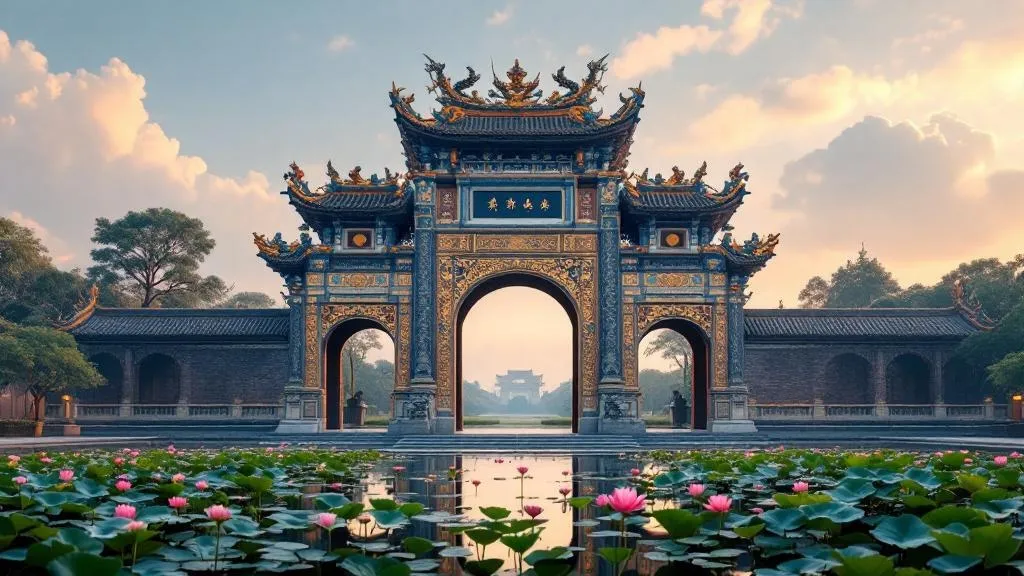
Hue is a city many travellers assume is the capital of Vietnam, and it is not. The capital is Hanoi, about 1 h 15 away by air. Hue was the imperial capital of the Nguyen dynasty, the last royal house of Vietnam, until 1945, and what it kept from that role is the reason to come: a moated citadel, a palace complex, royal tombs hidden in pine forests, an elegant river and a cuisine that was refined in the court kitchens and survives in humble street stalls.
This is not a beach town or a party town. It is a calm, slightly melancholic city of wide boulevards, school kids in white ao dai on bicycles, and quiet mornings along the Perfume River. For the sea, you head south to Da Nang. For the old merchant town and lanterns, you go on to Hoi An. Hue sits in the middle of Central Vietnam and does one thing better than anywhere else in the country: it tells you how Vietnam was ruled.
A short history of the Nguyen capital
Hue became the seat of power in the early 19th century, when the Nguyen emperors built a new capital on the Perfume River, modelled loosely on the Forbidden City of Beijing but with its own Vietnamese reading of geomancy: the river in front, a low hill as a natural screen, the mountains behind. Thirteen Nguyen emperors reigned here, ending with Bao Dai, who abdicated in 1945.
The city then lived through heavy fighting, above all during the Tet Offensive of 1968, when much of the citadel was damaged. Restoration has been going on for decades, and you will still see roofless halls and empty foundations next to freshly repainted gates. The Complex of Hue Monuments was inscribed on the UNESCO World Heritage list in 1993, the first Vietnamese site to receive the honour on the mainland of the country’s heritage list.
What to see in Hue
The Imperial City and the citadel
The citadel is a vast square fortress with walls, moats and gates on the north bank of the river. Inside it sits the Imperial City, itself containing the Forbidden Purple City where the emperor lived. You enter through the Ngo Mon Gate, climb to the upper platform where the emperor appeared on ceremonial days, and cross courtyards to the Thai Hoa Palace, the throne hall.
Count a good half-day. Many halls are partly rebuilt, and the site is large and exposed to the sun, so go early or late and carry water. A guide helps a great deal, since without one the empty courtyards are easy to walk past; see our Imperial City tours for the choices, or city tours of Hue if you want a broader first look.
Beyond the Imperial City walls, the citadel is also a living neighbourhood, with homes, cafés, a flag tower and shady lanes. Evenings are pleasant for a cycle ride.
The royal tombs
The emperors built their tombs during their lifetimes as places of retreat and, finally, as monuments to themselves. Three are the standard visits:
| Tomb | Character | Why go |
|---|---|---|
| Tu Duc | Romantic, a lake, pavilions and a garden | Most atmospheric; the emperor wrote poetry here |
| Minh Mang | Symmetrical, formal, set on axis | The most harmonious layout, with bridges and courtyards |
| Khai Dinh | Late, ornate, concrete with mosaics of porcelain and glass | A striking blend of Vietnamese and European taste |
The tombs lie several kilometres south of the citadel and apart from each other, which is why a single day is tight. Many visitors choose Tu Duc and Khai Dinh for contrast, or Minh Mang if they want the most orderly composition. Entrance is paid per site, usually a few hundred thousand dong, so check current prices on the day.
Thien Mu Pagoda and the Perfume River
Thien Mu Pagoda stands on a bluff above the Perfume River, its seven-storey tower the symbol of Hue. It is one of the oldest and most photographed pagodas in the country, and the setting is lovely at the end of the afternoon. It is also a place with a recent history: a car displayed in the grounds recalls the monk who drove to Saigon in 1963.
The easiest way to reach Thien Mu is by water. A half-day boat trip on the Perfume River usually combines the pagoda with a couple of tombs and a glimpse of river life, and is a more relaxing way to see the sights than the road. If you prefer a single booking, a half-day Perfume River boat trip covers the pagoda and riverbank views without the logistics.
In the evening, the river is also the setting for dinner cruises with music and lanterns. A combined citadel, tombs and dinner cruise is the one-ticket option if you only have a short stay.
Other sights worth the detour
- Dong Ba Market, on the north bank, for sweets, conical hats and a taste of daily life.
- Thanh Toan Bridge, a covered tiled bridge in the countryside east of the city, best by bicycle.
- Garden houses (nha vuon) in the Kim Long district, where families still serve small dishes in a courtyard garden.
- Tam Giang Lagoon, the large brackish lagoon northeast of the city, for fishermen, nets and a slower side of the region.
Eating in Hue: imperial cooking
Hue’s cooking is the most distinctive of central Vietnam: spicier than the north, more refined and fussier in presentation than the south, and built around small portions. You come here to eat in a different mode, moving from stall to stall.
Bun bo Hue is the anchor: a bright red, lemongrass-scented beef broth with thick round noodles, slices of beef shank and pork. It is not the same as pho, and the difference is worth understanding, which is why we wrote pho versus bun bo Hue. Then come the court snacks:
- Banh beo, tiny steamed rice cakes in saucers with dried shrimp and scallion oil.
- Banh nam and banh loc, steamed parcels in banana leaf or translucent tapioca.
- Com hen, a rice and baby clam dish with herbs and crisp pork skin.
- Che, sweet dessert soups, an essential end to the evening.
In the gardens of Kim Long and in the old part of the citadel, a number of family-run restaurants serve multi-course imperial meals. They can be touristy, but the best ones cook the dishes properly. For a hands-on version, Hue cooking classes are a good rainy-day plan, and a market-and-kitchen cooking class in Hue is one of the most popular.
How long to stay and how to plan it
An honest estimate: one to two days is the right amount of time for the monuments, with two days far more comfortable.
- One day: Imperial City in the morning, one or two tombs by car in the afternoon, Thien Mu Pagoda and dinner. It is full and rushed.
- Two days: Day one for the citadel, a long lunch and an evening walk. Day two for Tu Duc, Minh Mang, Khai Dinh and the pagoda, by boat or car, then a cooking session.
- Three days or more: add the DMZ or Phong Nha, or use Hue as a base while crossing the country.
Because Hue is a mid-point on the coast, many itineraries put it between Hanoi and Da Nang. Our five days in Central Vietnam route is one way to fold it in.
Day trips from Hue
The DMZ. The former demilitarised zone around the 17th parallel, north of Hue, was the dividing line between North and South Vietnam from 1954 to 1975, and the area holds Vinh Moc’s tunnel village and other war sites. It is a full day, usually done by organised tour; read about DMZ tours from Hue, or book a DMZ-only day tour from Hue if the war history is your main interest.
Phong Nha. The caves of Phong Nha-Ke Bang, a UNESCO World Heritage site since 2003, lie a few hours north. A day trip is long but possible by car; staying overnight is far more comfortable.
Getting to Hue and around
By air, rail and road
- By air: domestic flights land at Phu Bai Airport, roughly 15 km from the centre. From Hanoi it takes about 1 h 15. See domestic flights in Vietnam for airlines and tips. There is no rail or metro link to any airport, so taxis, ride-hailing apps and pre-booked transfers are the standard options.
- By train: Hue is a major stop on the Reunification Express. The ride from Hanoi is long, an overnight sleeper in practice; the Hue to Da Nang section along the coast is the best-known scenic stretch. Our guide to train travel in Vietnam explains classes and booking.
- By road: the route south to Da Nang climbs over the Hai Van Pass, a mountain road with views of the bay, either by car, by motorbike with a driver or by a scenic tour; see Hai Van Pass tours. Buses and “limousine” minibuses also run between Hue, Da Nang and Hoi An.
In town
Hue is spread out. The centre and citadel can be explored on foot or by bicycle, but the tombs need a car, a motorbike taxi or a boat. Ride-hailing apps work, and metered taxis are easy to find. Cyclos give a nice slow sightseeing ride around the citadel; agree on the price before you climb in.
When to go and what to expect from the weather
Central Vietnam has its own calendar, and Hue is among its wettest places.
- February to August: hot and mostly dry; the best months for visiting the outdoor monuments. July and August can be very hot.
- September to December: the rainy season, with typhoons and floods most likely in October and November. Rain can be heavy and prolonged, and the river can rise. Boat trips and some outdoor sights are sometimes cancelled.
- Winter can be cool, grey and drizzly, a mood some travellers like for the old tombs but not for photography.
If you travel at the edge of the season, read Vietnam’s rainy season and typhoons and keep a spare day in the schedule. The weather matters more here than in the south of the country.
Where Hue fits: Hue, Da Nang or Hoi An?
Hue is not where you swim or shop for tailored clothes. Da Nang is the beach and the modern city, and Hoi An is the lantern-lit old town. Many first-time visitors ask whether they should choose one or the other; our comparison of Hue or Hoi An goes through it in detail. The short answer: if you care about history, imperial architecture and the cooking, Hue deserves its two days, then you move on to the coast.
Practical tips
- Money: the currency is the Vietnamese dong, and in 2026 the rate is roughly 28,000 VND to 1 EUR and 26,000 VND to 1 USD. Carry cash for street food, small cafés and tombs; hotels and tours take cards.
- Dress: shoulders and knees covered for pagodas and tombs, and a hat and sunscreen for the open courtyards.
- Water: tap water is not drinkable in Vietnam. Buy bottled or filtered water.
- Language: English is common in hotels and tourist restaurants, much less so at stalls. A few words of Vietnamese go a long way.
- Tet: the lunar new year falls between late January and mid-February, on a different date each year. Many businesses close for several days and transport is full.
- Entry: visa rules depend on your nationality; always check the official immigration portal or your government’s advice before you book.
Frequently asked questions about visiting Hue
Is Hue the capital of Vietnam?
No. The capital is Hanoi, in the north. Hue was the imperial capital of the Nguyen dynasty until 1945 and is today a quiet city in central Vietnam on the Perfume River. Ho Chi Minh City, also called Saigon, is the largest city but not the capital either.
How many days do you need in Hue?
One full day lets you see the Imperial City and one or two tombs; two days is the comfortable answer, because the royal tombs lie several kilometres apart along the river and a boat trip or a food session fits better with a second day. Add a day if you want the DMZ or Phong Nha.
What is the best time to visit Hue?
Roughly February to August is hot and mostly dry. The rainy season runs from about September to December, and typhoons and floods are most likely in October and November, when some outdoor sites and boat trips can be disrupted. Winter can be grey and drizzly.
How do you get from Hue to Da Nang and Hoi An?
The road over the Hai Van Pass is the scenic route, and the Reunification Express train also runs along the coast, with the Hue to Da Nang section being the pretty one. Private cars, shuttle buses and transfers reach Da Nang in a couple of hours and Hoi An a little later.
Is Hue good for food?
Yes, it is one of the best food cities in Vietnam. Hue is the home of bun bo Hue, a spicy beef and lemongrass noodle soup, and of imperial small dishes such as banh beo, banh nam and banh loc. Eat them at local stalls rather than at tour-bus restaurants.
Can you visit Hue’s tombs on foot?
Not realistically in one go. The main royal tombs of Tu Duc, Minh Mang and Khai Dinh are spread along the river and the hills south of the city, several kilometres from each other and from the citadel. Most visitors go by car, motorbike taxi, bicycle or on a river boat trip.
Is Hue safe for tourists?
Yes. Violent crime is rare. The practical risks are traffic, heat in summer, overcharging at tourist spots, and floods and typhoons in autumn. Tap water is not drinkable, so use bottled or filtered water.


