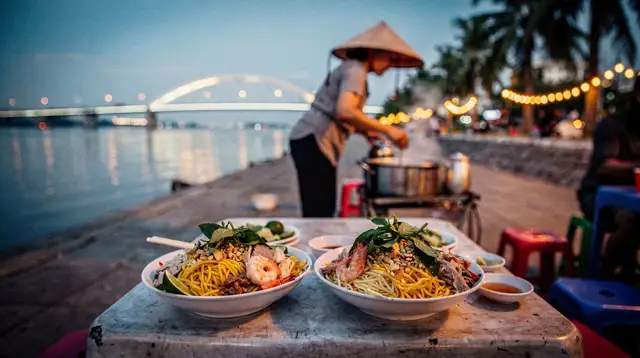
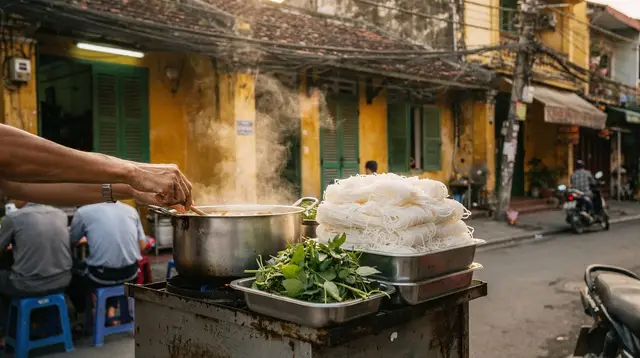
Banh Mi: More Than a Sandwich, and How to Order a Good One
Is banh mi just a Vietnamese sandwich?
Not quite. Banh mi is Vietnam's all-day, eat-on-the-move snack, found from north to south, but it is not one standard recipe: it changes from city to city and from shop to shop. The quality depends far more on the stall you pick than on the town you are in, and you pay in cash on the spot.
A roll you eat on the move, not a recipe you memorise
On my first trip I filed banh mi under “sandwich” and moved on. That was a mistake. The word describes a whole habit: a crisp roll, a few things inside, a quick payment, and you are already walking again. It is breakfast, a lunch break, a mid-afternoon snack or the last thing you grab before a night bus. Nobody in Vietnam asks what time it is before ordering one.
That is the one idea I would keep from this page. Banh mi is food for the gap between other things, and it fits any hour of the day.
If you want the full map of dishes, the Vietnamese dishes to try article does that job, and the Vietnamese food guide goes deeper by region. Here I stay on the roll itself.
Why there is no single “banh mi”
The first thing travellers get wrong is expecting one standard version. Ask three people in Hanoi, Hoi An and Saigon what a proper banh mi is and you will get three confident, slightly different answers. The bread, the filling, the sauces and the way it is put together change from shop to shop, and from city to city.
I do not think this is a flaw. It is why eating them is fun. The country runs north to south over roughly 1,650 km, and food follows the land and the habits of whoever is behind the counter. Hanoi in the north, Hue and Hoi An in the centre and Ho Chi Minh City in the south each have a different food culture, as the north or south Vietnam comparison explains. The same is true of this small roll.
So when someone tells you “the best banh mi is in X”, treat it as an opinion, not a fact. Mine is the same: it is an opinion, and the next section is why.
The shop matters more than the city
After enough trips, I stopped asking which city had the best banh mi and started asking which counter did. A good stall in a small town beats a weak one in a famous street every time.
What I look for, in order:
- A steady local queue. Office workers, schoolchildren, motorbike riders who stop without switching off the engine. Locals do not wait for bad bread.
- Bread that is warm and crackles. If the roll is soft and tired, I walk on.
- Assembly in front of you. The seller builds it to order, quickly and without fuss.
- Turnover. Ingredients that are constantly being used are not sitting around.
For the safety angle, from stomach worries to what to look for at a stall, I would send you to the Vietnamese street food safety article rather than repeat it here.
How to order without a language in common
You do not need much Vietnamese. In my experience, most orders work like this:
- Walk up and look. Most stalls show their fillings on the counter. Pointing is entirely normal.
- Say “banh mi”, then hold up a finger for how many. One, two, done.
- Mention what you want left out. If you want no chilli, say it or show a short note on your phone. Sellers are used to it.
- Wait. It takes under a minute at a busy stall. That speed is part of the charm.
A few phrases help and are worth learning, which is what the Vietnamese phrases for travellers page is for. But a smile and a pointing finger have never failed me.
If you want to be shown rather than work it out yourself, a guided session takes the guesswork out. I have seen travellers get a lot out of a private street food tour in Hanoi style outing, because a local picks the stops and explains what is in front of you.
Paying: bring cash, keep it small
Banh mi is a cash business. Stalls and small shops are built for fast notes, not terminals, and a seller with a queue will not thank you for a large note. Keep a few small bills in a pocket where you can reach them without opening your bag.
I would not quote prices here, because they change and I would rather you check on the spot. What I will say is to look at the sign or ask before they start building, and pay once you have your roll. If cash is new to you, the do you need cash in Vietnam article and the money in Vietnam guide cover notes, ATMs and what cards still do not work for.
Hoi An: a food stop in its own right
Hoi An is where banh mi became a destination for me. The old town is a small, walkable place, and eating there is a constant series of stops: one for a roll, one for noodles, one for a coffee. Banh mi has a firm place on that list, and visitors tend to treat it as a small pilgrimage between sights.
I say this without claiming Hoi An has the best one. It does not need to. What it has is a concentration of shops, an easy pace, and a food culture where tasting is the main activity. That makes it a good place to compare two or three versions in one afternoon.
If you are planning a stay there, the Hoi An destination page and the Hoi An street food tours guide are the places to start. For a half-day that mixes eating with the town itself, a cultural tour of Hoi An with textiles, temples and coffee gives you stops in between the bites.
Eating it: practical habits
- Eat it fresh. Do not carry it around in a bag for hours. The crust is the point.
- Take it with you or sit down. Plenty of shops have a few plastic stools. Standing at the kerb is equally fine.
- Keep a napkin handy. It gets messy.
- Do not turn it into a ceremony. Nobody photographs their lunch in a queue longer than a few seconds.
Banh mi pairs naturally with a coffee, but the coffee has its own story. The Vietnamese coffee guide and the egg coffee in Hanoi article handle that, and the pho versus bun bo Hue piece covers the soups I am deliberately leaving out here.
Learning more than you can taste
If you like understanding what you eat, a cooking class is a good next step. A session like the cooking class and lantern-making workshop in Hoi An lets you see how the pieces of a Vietnamese meal fit together, and you leave with a little more confidence at the counter.
Elsewhere, my own food stops shifted with each city. In the capital, the Hanoi street food tours give a structured route, and the Hanoi destination page covers the rest. In the south, the Ho Chi Minh City street food tours and the Ho Chi Minh City page do the same job. For a broader look at guided food outings across the country, the street food tours category is the starting point.
Banh mi questions I hear most
Is banh mi the same everywhere in Vietnam?
No. The idea is the same, a crisp roll filled to order, but each region and each shop has its own habits. Compare two or three stalls in the same city and you will taste the difference.
When do people eat banh mi?
At any hour. It works as a quick breakfast, a lunchtime bite, an afternoon snack or a late-evening stop. That flexibility is the whole point of it.
Do I need cash to buy banh mi?
Yes, plan on cash. Stalls and small shops are set up for quick notes-and-coins payments, and card terminals are rare at this level. Carry small notes.
How do I choose a good banh mi shop?
Look for a steady stream of local customers, a counter where the roll is assembled in front of you, and bread that is warm and crackles. The shop matters more than the city.
Can I eat banh mi in Hoi An?
Yes. Hoi An treats banh mi as one of its signature food stops, and you will find it both in the old town and on the quieter streets around it.
Can I ask for changes to the filling?
Usually, yes. Point to what you want or leave out, or show a short note on your phone. Keep the request simple and polite.
Is banh mi a good option for a quick meal on a travel day?
It is one of the easiest. It is wrapped quickly, held in one hand and eaten walking or at a pavement table, so it fits around buses, trains and flights.
Street Food Tours and Vietnamese Cuisine Tastings
Verified deep-linked GetYourGuide tours. Book through these links and we earn a small commission at no cost to you.
GetYourGuide does not provide a product photo for this activity — the image shows the meeting point, photographed by us.