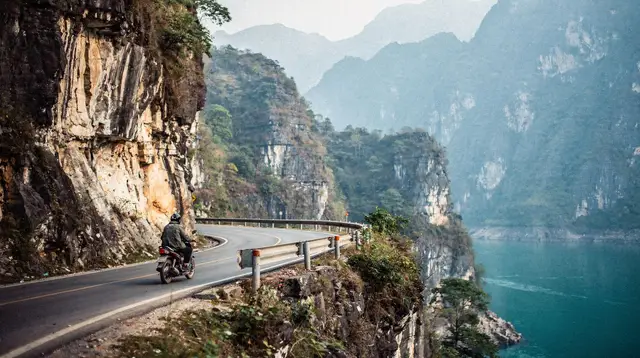
Hai Van Pass Tours: Riding the Coast Road Between Hue and Da Nang
Is a Hai Van Pass tour worth it compared with a normal transfer?
Yes, if the weather is clear. The pass is a roughly 21 km mountain road above the sea between Hue and Da Nang, and a tour adds viewpoints, the old gate at the summit and lagoon stops that a direct transfer skips. Go with a local rider or driver, because riding without the right licence often voids insurance, and avoid October and November, when rain and typhoons spoil visibility.
The Hai Van Pass, whose name means “ocean cloud”, is the mountain road that climbs over a spur of the Truong Son range where it drops straight into the sea, between Hue and Da Nang. On a map it is a short hop. On the ground it is the most celebrated stretch of coast road in Vietnam, and the reason many travellers choose a tour rather than a bus or a plain transfer. This guide explains what the ride actually involves, how to do it safely, and when to avoid it.
What the Hai Van Pass is, and why it is more than a connection
Hue and Da Nang are roughly 100 km apart, and the fast way between them today is not the pass at all: since 2005 a tunnel of about 6 km takes most trucks, buses and cars underneath the mountain in minutes. That is exactly what makes the old road worth riding. With the heavy traffic gone, the pass is a quiet, winding mountain route of around 21 km, rising to roughly 500 m above the sea, with the bay of Lang Co to the north and the sweep of the Da Nang coastline to the south.
Historically the ridge was a frontier. It separated the Vietnamese lands of the north from the Cham kingdoms of the south, and the old gate at the summit still carries inscriptions from the imperial era, with French-built and wartime bunkers scattered around it. The weather also changes at the top: the ridge often catches cloud from the sea, and a bright morning in Hue can turn to mist on the bends. Locals say the pass divides two climates, and it does, in the sense that the northern side is often greyer and wetter than the southern one.
So the pass offers three things a simple transfer does not:
- Views: the whole lagoon-and-peninsula coastline in one frame, from a road that hugs the cliff.
- Pace: on two wheels or in an open car you smell the sea, the wood smoke and the brake dust of the occasional lorry.
- Context: the summit gate, the old bunkers and the lagoon villages at the foot explain why the road mattered.
None of this is hidden from view, but all of it is easier to enjoy with someone who knows where the safe pull-offs are.
The route, stop by stop
Most tours cover the same corridor, in one direction or the other. Heading south from Hue the sequence is usually:
- Leave Hue along the coast, with a first break by the lagoon landscape of Lap An, where oyster and fish farms sit on stilts in shallow water.
- Lang Co village and bay, a long sandy spit between lagoon and sea, usually a coffee or snack stop with a view back at the mountain you are about to climb.
- The climb itself: a sequence of tight hairpins through scrub and forest, with the road narrow enough that horns are used constantly and politely.
- The summit gate, with a small cluster of souvenir stalls and a viewpoint. This is where most photographs are taken and where the cloud is most likely to roll in.
- The descent towards Da Nang, with the long beach and the Son Tra peninsula appearing below.
- Optional extras: a stop at the Marble Mountains, the beach at My Khe, or the Golden Bridge at Ba Na Hills, depending on the package.
Tours that end at the Golden Bridge combine the pass with a commercial resort in the hills west of Da Nang. It is a very different kind of day, crowded and carefully managed, so decide whether you want a quiet coast road or a theme-park finish. The bridge is part of a resort, not a heritage site, and you can read more on Ba Na Hills and Golden Bridge tours.
Hue to Da Nang by train: the other way to see this landscape
The pass is not the only way to see this coast. The Reunification Express, the railway that runs the length of the country, follows the shoreline below the mountain between Hue and Da Nang, and this section is widely regarded as the most beautiful of the whole line. The trip takes roughly three hours, runs close to the beach and crosses the lagoon, and a window seat on the right-hand side as you go south gives the best view.
How do the two compare?
| Motorbike or car tour over the pass | Train, Hue to Da Nang | |
|---|---|---|
| Time | Most of a day with stops | Roughly three hours |
| View | From above, with viewpoints and the summit gate | From the shoreline, through the window |
| Control | You choose the stops | Fixed route, no stops |
| Weather sensitivity | High, since fog hides the view | Lower, still best in clear light |
| Luggage | Needs a support vehicle on a tour | Carried with you |
The sensible plan for many travellers is to do one each way: the pass in one direction, the train in the other. More on the network in Vietnam train travel.
Tour with a driver, easy rider or self-ride?
This is the most important decision, and it is a safety one more than a convenience one.
Riding yourself. You need a motorbike licence valid in Vietnam and valid for the class of bike you are riding, which for many visitors means an international permit that recognises motorbikes, or a Vietnamese licence. Without the right licence, many insurers will refuse a claim after an accident, and the bill for hospital treatment can be large. That is the central risk, not the road itself. Rental shops in Hue and Da Nang rarely ask for a licence, and the absence of a check does not make you covered. Read renting a motorbike in Vietnam and Vietnam travel insurance before you decide.
Riding pillion with a local driver or easy rider. This is the option most visitors should choose. An easy rider is a local motorbike driver who also acts as your guide. You sit behind them, they handle the traffic and the bends, and you spend the ride looking at the scenery rather than at the road. Drivers know where the clean toilets are, where the best viewpoints are, and which stalls at the summit are worth a stop. The same logic applies on other long routes, and you can see it in the way Da Lat easy rider tours are organised.
Car with driver. The same road, with air conditioning and luggage space, which is a good choice for families, older travellers or anyone nervous on two wheels. You still stop at every viewpoint, so you lose very little.
My view is simple: unless you ride regularly at home, hold the proper licence and have insurance that explicitly covers it, ride pillion. A day of scenery is not worth an uninsured accident.
Safety on the road
Violent crime is rare in Vietnam, and the real risks are traffic, weather and road conditions. The general picture is covered in is Vietnam safe. On the pass specifically:
- Fog and wet surfaces are the main danger. The hairpins near the summit are slick after rain and visibility can drop in seconds.
- Trucks and buses still use the road in places, particularly when the tunnel is congested or closed, and they take the middle of the road on bends.
- Helmets are compulsory on motorbikes. Ask for a proper full-face or good half-shell helmet if you have a choice, not the thin cap offered by some rental shops.
- Sun and heat are significant in the dry season. Wear sunscreen, a long-sleeved light layer and sunglasses.
- Clothes: closed shoes, not flip-flops, and trousers rather than shorts if you can, in case of a fall.
A good driver will refuse to go in dangerous conditions. If a company insists on the ride in a storm, that is a reason to choose another company.
Weather and the best time to ride
This part of the country has its own weather, quite different from Hanoi in the north or Ho Chi Minh City in the south. On the central coast, the dry and sunny months run roughly from February to August. The rainy season runs roughly from September to December, with typhoons and floods most likely in October and November. Sea cloud, mist and drizzle can hide the view entirely in the wet months, and some operators cancel or reschedule tours when conditions are poor.
| Period | Conditions on the pass | Verdict |
|---|---|---|
| February to April | Warm, drier, often clear | Excellent, and the best all-round choice |
| May to August | Hot and mostly dry, strong sun | Very good, start early |
| September | Rain beginning, variable | Possible, with a flexible plan |
| October and November | Heaviest rain, typhoon risk, poor visibility | Avoid if you can |
| December to January | Cooler, drizzle and cloud | Variable, bring a rain layer |
If you are travelling in the peak of the rainy season, read the rainy season and typhoons guide and the typhoon season in central Vietnam before you book, and choose a tour with a free rescheduling policy. Many operators will move the day if a typhoon warning is issued, but do not assume it.
Choosing a tour
Hai Van Pass tours vary less in route than in package, and the right one depends on where you are sleeping that night.
One-way, Hue to Hoi An or Da Nang. The classic. You are picked up in Hue, ride or drive over the pass, and end in Hoi An or Da Nang, with your bags carried by a support vehicle. It replaces a transfer and costs not much more than a private car. Tours such as a Hue to Hoi An day tour over the Hai Van Pass follow this pattern, and the same logic applies to the broader Hue to Hoi An transfers.
Round trip from Hue. A day trip that goes over the pass and returns to Hue the same evening, which suits travellers based in the old imperial capital. A one-day Hai Van Pass tour that also explores Hue is one version of this, with city stops added.
Coast and lagoon variant. Some tours add the An Bang beach, a quiet stretch of sand near Hoi An, and the lagoon scenery along the way, as in a Hai Van Pass tour with lagoon and beach stops. This is a good fit for those who want a slower, more relaxed day.
Private day trip with a Golden Bridge finish. For small groups or families who want a fixed schedule and their own vehicle, a private Hue day trip over the pass to the Golden Bridge is the straightforward option, at a higher price per person than a group departure.
When comparing, check these points:
- Who is driving: a local driver or guide, or a self-ride rental in disguise.
- Insurance: whether the operator’s cover applies to passengers, and what it excludes.
- Luggage: whether bags travel in a support vehicle and where they are dropped.
- Weather policy: what happens if fog or a storm hits.
- Group size: small groups give more freedom to stop.
- What is included: entry fees, lunch, drinks, helmets and rain ponchos.
Prices change with the season and the package, so check the current price on the booking page rather than relying on a figure printed in a guide.
How to fit the pass into a central Vietnam trip
The pass sits naturally between three of the country’s best-known stops. In most itineraries you will spend a night or two in Hue for the citadel and tombs, then cross the mountain to Da Nang or straight on to Hoi An. The ride is the link, and it works best when you give it a whole morning rather than squeezing it between a hotel checkout and a flight.
A sample sequence for a short central coast trip:
- Day 1 and 2: Hue, with the imperial city and a boat on the Perfume River.
- Day 3: the pass, either by motorbike or car, ending in Hoi An.
- Day 4 and 5: Hoi An and the nearby beach, with a day trip to the My Son Sanctuary if you want.
The central Vietnam in five days itinerary lays this out in more detail, and the motorbike loops category lists comparable routes elsewhere in the country. If you want the full account of what the ride feels like from the saddle, the Hai Van Pass by motorbike article covers it in detail.
For the cities at either end, other guides do the work better: see Hue city tours for the imperial sites and Da Nang city tours for the beach and the bridges. This page stays on the road between them.
Practical tips for the day
- Start early. The light is better, the summit is less crowded and the cloud tends to build later in the morning.
- Carry cash. Small stalls at the summit, at Lang Co and at the lagoon only take notes, and the amounts are quoted in thousands of dong.
- Bring a light rain layer even in the dry season, as the ridge produces its own weather.
- Protect your phone and camera. Use a strap or a secure pocket, as a drop on the bends is costly.
- Drink bottled water. Tap water is not drinkable anywhere in Vietnam.
- Tell the driver your limits. If you want fewer stops, more stops, or a break from the sun, say so, as good drivers adapt.
Hai Van Pass tours: common questions
How long is the Hai Van Pass and how long does a tour take?
The pass itself is roughly 21 km and takes under an hour to ride with a few photo stops. A full Hue to Hoi An or Hue to Da Nang tour usually lasts most of a day, because of the coast, lagoon and lunch stops on either side.
Do I need a motorbike licence to ride the Hai Van Pass?
To ride yourself you need a valid licence for the correct motorbike class, recognised in Vietnam. Many insurers refuse claims when the licence is wrong, which is why most visitors ride pillion with a local driver or easy rider.
When is the best time to ride the Hai Van Pass?
The central coast is mostly dry and hot from roughly February to August, which gives the clearest views. The rainy season runs roughly September to December, with typhoon and flood risk highest in October and November.
Is the Hai Van Pass dangerous?
The road is well surfaced but winding, with trucks, buses and fog on the upper bends. Riding pillion with an experienced local driver, wearing a helmet and avoiding wet or foggy days keeps the risk low.
Can I see the Hai Van Pass without a motorbike?
Yes. Cars with a driver use the same road, and the Reunification Express train between Hue and Da Nang follows the coast below the pass, which many travellers consider the most scenic rail section in the country.
Can I do the Hai Van Pass as a transfer between Hue and Hoi An?
Yes. Several tours run one way from Hue to Hoi An or Da Nang over the pass, often with luggage carried in a support vehicle, so the ride doubles as your transfer between the two towns.
Motorbike Loops and Countryside Excursions
Verified deep-linked GetYourGuide tours. Book through these links and we earn a small commission at no cost to you.
GetYourGuide does not provide a product photo for this activity — the image shows the meeting point, photographed by us.