Temples and Heritage Around Da Nang: What Is Listed and What Is Not
What are the main temples and heritage sites to visit from Da Nang?
From Da Nang you can reach My Son Sanctuary, a Cham Hindu temple site about 40 km inland (UNESCO, 1999), the Marble Mountains with their cave pagodas, the Museum of Cham Sculpture and several city pagodas. Hoi An and Hue are also UNESCO-listed but have their own pages. Only My Son is inscribed among the sites in this guide; the Marble Mountains and Ba Na Hills are not.
Da Nang is better known for its beaches and its skyline than for its monuments, and that is exactly why heritage visits from the city need a little care. Several places that look ancient are modern, several that look modest are genuinely old, and the label “UNESCO” gets attached to sites that were never inscribed. This guide sorts it out: what is listed, what is simply worth seeing, and how to build a sensible cultural day from a Da Nang base.
The short version: what is listed and what is not
Three of the places people mention together are quite different in status.
| Place | Distance from Da Nang | Status |
|---|---|---|
| My Son Sanctuary | About 40 km inland from Hoi An, roughly an hour or more by road | UNESCO World Heritage Site, 1999 |
| Hoi An Ancient Town | Roughly 30 km south, about 45 minutes | UNESCO World Heritage Site, 1999 |
| Complex of Hue Monuments | Over the Hai Van Pass, to the north | UNESCO World Heritage Site, 1993 |
| Marble Mountains | On the southern edge of the city | Not listed; local landmark |
| Museum of Cham Sculpture | In the city centre | Not listed; museum |
| City pagodas | Within Da Nang | Not listed; active places of worship |
| Ba Na Hills and the Golden Bridge | In the hills west of the city | Not listed; commercial resort, opened 2018 |
Only the first three carry World Heritage status. For the wider picture of what is and is not inscribed across the country, see the guide to UNESCO sites in Vietnam.
My Son: Cham, not Khmer
The most common mistake is to describe My Son as a Khmer site, usually because the red brick towers resemble Angkor in the reader’s mind. My Son is Cham. It was built over many centuries by the kingdom of Champa, whose rulers followed Hinduism and honoured Shiva in particular. The sanctuary sits in a green valley about 40 km inland, and UNESCO inscribed it in 1999, the same year as Hoi An.
What you actually see is a set of brick towers, some restored, some half ruined, with carved sandstone fragments and lintels. Part of the site was heavily damaged during the Vietnam War, and the gaps between the surviving groups are as telling as the towers themselves. It is a quiet place rather than a spectacular one, and it rewards an early start before the heat and the coach groups build up.
Note the practical side: My Son is not in Da Nang itself. Most visitors reach it by a half-day tour or by a driver, often combined with Hoi An. If you want detail on the temples, the layout and the visit, the My Son Sanctuary guide covers it, and Hoi An and My Son tours explains how the two are usually combined.
The Cham story does not stop at My Son. Along the south-central coast, the towers of Po Nagar at Nha Trang are another Cham site that is still used for worship, which is a useful way to see Champa as a living tradition and not only as ruins.
Hoi An and Hue have their own pages
Hoi An Ancient Town and the Complex of Hue Monuments are both inscribed, and both are easy to reach from Da Nang. They deserve more than a paragraph here, so this page keeps its focus on what lies around Da Nang itself and points you onward:
- Hoi An is covered on the Hoi An destination page, with its Japanese Covered Bridge, merchant houses and lantern-lit evenings.
- Hue is covered on the Hue destination page and in the guide to Hue Imperial City tours: the citadel, the royal tombs and the Perfume River.
If you are choosing between them for a limited trip, Hue or Hoi An compares the two honestly.
The Marble Mountains: a landmark, not a listed site
South of the city centre, five rocky hills rise suddenly from the flat coastal plain. They are known as the Marble Mountains, and the individual hills are named after the five elements. Thuy Son, the water hill, is the one most visitors climb.
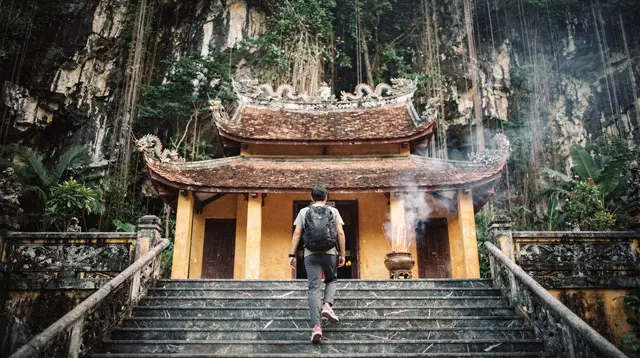
Inside and around them you will find cave pagodas, Buddhist shrines set into natural chambers, carved stone doorways and several viewpoints over the coast. The caves are atmospheric, with shafts of daylight falling on incense smoke and statues. Some of the paths are steep and the steps uneven, so wear shoes with grip.
At the foot of the hills a village of stone carvers makes statues and ornaments. The craft is real and the marble is worked locally, though the souvenir trade is aimed at tourists. Be clear-eyed about it: this is a pleasant, atmospheric visit, and an important one for the religious life of the city, but it has no UNESCO status. A longer look at the hills and the nature around them is in the Marble Mountains and Da Nang nature tours guide.
The Museum of Cham Sculpture
Of everything in the city, the Museum of Cham Sculpture is the best preparation for My Son. It is housed in a building from the French colonial period and holds one of the world’s finest collections of Cham stone carving: altars, deities, dancers and guardian figures, many recovered from sites such as My Son itself.
Here is why it matters for a heritage day. At My Son you mostly see brick towers; the sculpture that once decorated them has often been moved. The museum lets you see that sculpture up close and read the Hindu symbolism in a way the ruins alone do not allow. It is not inscribed by UNESCO, and it does not need to be: it is simply the right place to understand what you will see in the valley.
A visit is short compared with the sites outside the city, so it fits easily into a morning or an afternoon. Going before My Son, rather than after, tends to make the temples make more sense.
Pagodas and temples inside the city
Da Nang’s pagodas are working places of worship rather than monuments, and none of them is listed. They are still worth a visit if you want to see local religious life without a long drive. Two of the best known sit on the Son Tra peninsula and in the city centre, where the Linh Ung Pagoda has a very large white statue of Guan Yin facing the sea, and a number of smaller temples serve their neighbourhoods.
Some practical notes for any pagoda visit:
- Dress modestly, with shoulders and knees covered.
- Take off shoes where asked and speak quietly.
- Do not point your feet at altars or photograph worshippers at prayer without asking.
- Many pagodas have set opening hours and may close around midday.
More general guidance on conduct is in Vietnam etiquette and customs.
Ba Na Hills and the Golden Bridge: a resort, not heritage
The Golden Bridge is probably the single most photographed object in the Da Nang area: a curved walkway held up by two giant stone hands, high in the hills west of the city. It opened in 2018 and belongs to the Ba Na Hills resort, a commercial development with a cable car, a French-style village built for the purpose, gardens and attractions.
It is worth knowing exactly what it is. It is a modern attraction, built to be photographed, and it carries no heritage status of any kind. That is not an argument against going; the cable car ride and the views can be impressive, and the site draws large crowds. But it is a different kind of day from My Son or a pagoda, and it is best planned as one. See the dedicated Ba Na Hills and Golden Bridge tours guide for how visits are organised.
Who is this kind of day for?
Two kinds of travellers get the most from a heritage day around Da Nang.
History lovers who want to place Champa, the Nguyen dynasty and the war years in their landscape. For them the sequence of museum, My Son and then Hoi An builds a coherent picture.
Travellers in a hurry who are staying in Da Nang for a short time and want one cultural thread without moving hotels. A single well-planned outing can give them a Cham site, a pagoda and a sense of local religion.
If your main interest is beach time, nightlife or cruises, this page is probably not the right one. The Da Nang beaches, river cruises and shore excursions have their own pages, and this guide deliberately leaves them to the neighbouring Da Nang guides.
What a realistic day looks like
Duration is where heritage plans most often go wrong, so here is an honest order of magnitude instead of precise timings.
- A half day can hold My Son alone, with the drive in and out taking a large share of the time. Starting early matters.
- A city half day can hold the Museum of Cham Sculpture and the Marble Mountains, as both are close to the centre.
- A full day can combine the city sites with Hoi An, or My Son with Hoi An, but not all of it. Trying to fit My Son, the Marble Mountains, the museum and Hoi An in one outing leaves little time to look at anything.
A sensible rule is to pick one inland site and one city site per day and to leave the evening free. For a wider look at how a day trip fits into a stay, see day trips from Hoi An and Da Nang.
Booking options
Organised tours handle transport and a guide who can explain what you are looking at, which counts for a lot at My Son, where the interpretive signs are limited. A flexible option is the Da Nang heritage tour in a half-day or full-day format, which suits visitors who want to decide how much to take on.
If you are travelling between Da Nang and Hue, there is also a heritage train ticket over the Hai Van Pass, which uses the scenic coastal section of the railway. For the road version, read about Hai Van Pass tours.
For an evening, a heritage show in Da Nang with a drink included is an easy, undemanding way to see something of local performing arts after a day on the road.
Independent travellers can combine a hired car or driver with their own timing; the Da Nang airport transfers guide helps if you are arriving the same day, and Da Nang city tours gives other ways to structure time in the city.
When to go
Heritage visits are outdoors, and the weather decides how pleasant they are.
- Hot and mostly dry (roughly February to August): easier for My Son and the Marble Mountains, but the middle of the day can be punishing. Go early.
- Rainy season (roughly September to December): typhoons and floods are most likely in October and November. The caves and steps at the Marble Mountains become slippery, and My Son’s paths turn muddy. Check forecasts and keep your plan flexible.
For the whole country picture, see when to visit Vietnam and the rainy season and typhoons guide.
Common mistakes to avoid
- Calling My Son Khmer. It is Cham and Hindu, not Khmer.
- Assuming the Marble Mountains are UNESCO-listed. They are not.
- Counting the Golden Bridge as heritage. It is a resort attraction from 2018.
- Packing too much in. Choose one inland site and one city site per day.
- Leaving My Son until midday. The heat and the crowds are at their worst then.
- Wearing unsuitable clothes in pagodas. Cover shoulders and knees and bring shoes that come off easily.
- Treating Hoi An and Hue as add-ons. They are listed sites in their own right and each deserves its own day.
Frequently asked questions about temples and heritage around Da Nang
Is My Son Khmer or Cham?
My Son is Cham, not Khmer. It is a group of Hindu temples built by the Champa kingdom, mostly dedicated to Shiva, in a valley about 40 km inland from Hoi An and Da Nang. Khmer temples such as Angkor are in Cambodia and belong to a different culture.
Are the Marble Mountains a UNESCO World Heritage Site?
No. The Marble Mountains are a cluster of limestone and marble hills with cave pagodas and viewpoints, but they are not inscribed by UNESCO. They are a local landmark and a sensible half-day stop, not a protected World Heritage property.
Is the Golden Bridge at Ba Na Hills a heritage site?
No. The Golden Bridge opened in 2018 as part of the Ba Na Hills commercial resort. It is a modern attraction, popular and photogenic, but it has no heritage status and should not be mixed up with the temple and monument sites in this guide.
Can I see My Son and the Marble Mountains in one day from Da Nang?
It is possible to combine them, but the day is full. My Son is best seen early, before the heat and the crowds, and the Marble Mountains fit well on the way back or on another morning. Many visitors prefer to split them across two shorter outings.
Which UNESCO sites are close to Da Nang?
Hoi An Ancient Town (1999) and My Son Sanctuary (1999) are the nearest. The Complex of Hue Monuments (1993) lies further north over the Hai Van Pass. Each of these has its own detail pages on this site.
Who is a temple and heritage day from Da Nang for?
It suits history lovers who want to understand Champa and the Nguyen dynasty region, and travellers short on time who want one cultural thread from their Da Nang base. Anyone who mainly wants beaches or nightlife will find the other Da Nang pages more useful.
For the full list of activities of this type, browse temples and heritage across Vietnam.
Temples, Museums and Heritage Sites
Verified deep-linked GetYourGuide tours. Book through these links and we earn a small commission at no cost to you.
GetYourGuide does not provide a product photo for this activity — the image shows the meeting point, photographed by us.