Da Nang Street Food Tours: What a Local Guide Adds
Is a street food tour worth it in Da Nang?
Yes, if you want to taste several central Vietnamese dishes in one evening without guessing which stalls are worth the queue. A local guide reads the stalls, orders in a sensible sequence and keeps you away from tourist-trap menus. Da Nang is not Hoi An, about forty-five minutes away, so expect its own seafood and noodle cooking rather than lanterns.
Da Nang is the easiest city in central Vietnam to eat well in. It is large enough to have a street on every corner serving something different, yet compact enough that a good evening’s eating fits into a few kilometres between the river, the Dragon Bridge and the beach. The difficulty is not finding food. It is knowing where to sit, what to order and in which order, and that is exactly the gap a local guide fills.
This page explains what a street food tour in Da Nang actually gives you, how the city’s eating is organised, which dishes genuinely belong here and which belong somewhere else, and how to avoid the handful of traps that catch visitors who simply follow the brightest sign.
What a local guide changes about eating in Da Nang
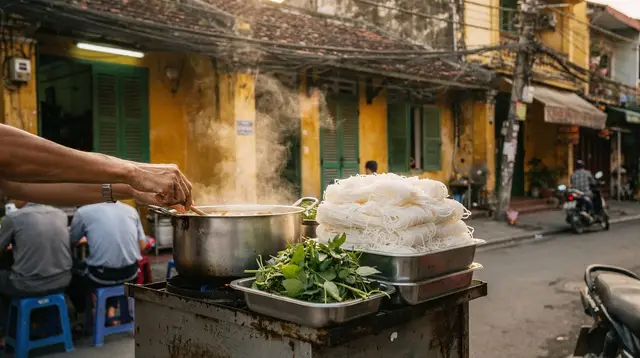
A street food stall rarely has a menu you can read, and the best ones do one dish and nothing else. You are expected to sit on a low plastic stool, say what you want, and be served within minutes. For a first-time visitor this is both the charm and the obstacle.
A good guide solves four specific problems.
- Reading the stalls. Locals queue where the turnover is fast, the broth is simmering in view and the ingredients are visibly fresh. A guide spots these signs in seconds and walks past the stall with the laminated English menu and no customers.
- Tasting in the right order. Eating three heavy bowls in a row ends the evening early. Guides sequence the evening, light first, noodles in the middle, grilled and fried food next, dessert and coffee last.
- Portion control. Many tours order small shared plates so that you can taste six or seven things rather than finishing one large portion.
- Context. Knowing that a dish is eaten with a particular herb, dipped in a specific sauce or rolled in rice paper by hand is half the pleasure, and it is rarely written down.
If you are comfortable ordering on your own, you can still eat well without a guide. A tour simply compresses the learning curve into one evening, and it is most useful on your first night in the city.
The food of Da Nang: what actually belongs here
Central Vietnamese cooking is saltier, spicier and more intensely seasoned than the food of the north or south, and Da Nang sits in the middle of that tradition. It also has a long coastline, so seafood is a daily fact rather than a treat.
Mi quang
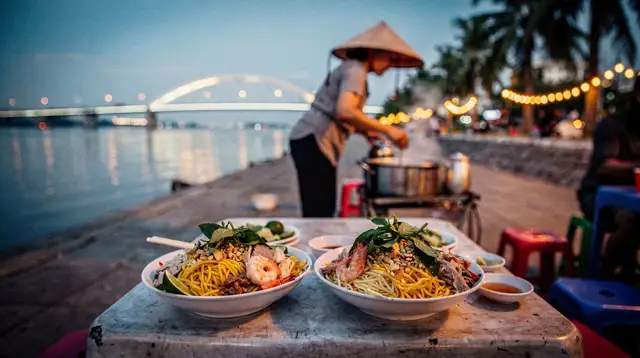
If one dish defines eating in Da Nang, it is mi quang: turmeric-yellow rice noodles served in a small amount of rich broth rather than a soup, topped with pork, shrimp or chicken, peanuts, fresh herbs and a crisp rice cracker. It is eaten mixed, not sipped. Locals have it for breakfast and lunch, and it is a good first order because it is filling without being heavy.
Banh mi
The Vietnamese baguette sandwich is everywhere, but the central coast has its own habits. Expect a crisp roll, pâté, cold cuts or grilled pork, pickles, chilli and fresh herbs. Quality varies enormously from one cart to the next, and a guide will take you to the one with the right bread. For the background on the sandwich, see our banh mi guide.
Coastal seafood
Squid, clams, snails, prawns and fish come off boats along the coast, and they are grilled, steamed or served in small dishes with salt, lime and chilli. Seafood eating is a social affair here, with beer, shared plates and long evenings.
Rice paper rolls, banh xeo and snacks
Central cooking loves the do-it-yourself roll: you assemble grilled meat or seafood, herbs, vegetables and rice paper into a parcel and dip it in a peanut or fermented sauce. Crisp savoury pancakes, small steamed rice cakes and skewers fill the gaps between bigger dishes.
Sweet things and coffee
Vietnamese desserts, known as che, are sweet puddings of beans, jelly, coconut milk and ice, usually sold in a glass. They are a refreshing way to end an evening. Coffee, hot or iced, is served on every street, and you can learn how it is made in the Vietnamese coffee class in Da Nang style of workshop described below.
Two dishes that are not from Da Nang
Visitors often assume every famous central dish originates in Da Nang. It does not, and a guide who knows the region will say so.
- Bun bo Hue is the spicy beef and lemongrass noodle soup of Hue, the old imperial capital. You can eat it in Da Nang, and some bowls are very good, but it belongs to Hue first. If you are going there, our pho versus bun bo Hue article explains the difference and the Hue destination page covers the city.
- Cao lau is the thick, chewy noodle dish of Hoi An, traditionally associated with that old town. Eat it there, among the yellow walls, rather than expecting it to define a Da Nang evening.
The point is not to avoid these dishes in Da Nang, only to be honest about where they come from. A tour that sells cao lau as the city’s signature is a tour that has not done its homework.
Two ways to eat: the evening in town and the meal at the beach
Da Nang offers two quite different formats, and they suit different moods. Choosing between them is the most useful decision you will make.
| Format | Where | Feel | Best for |
|---|---|---|---|
| Evening street food walk | Central streets, near the river and the Dragon Bridge | Many small tastings, stools, crowds, lights | Variety, first night, guided tasting |
| Beach meal | Along My Khe beach | Slower, seated, seafood with a view | Relaxed lunch or sunset dinner, groups |
The evening in town, near the river and the Dragon Bridge
The city centre sits on the Han River, and the Dragon Bridge is its landmark, lit in changing colours after dark. The streets near the riverside and the bridge are where an evening food walk makes the most sense: the stalls are close together, the pavement is lively, and you can move between them on foot. A walk here is about variety, with one stop for noodles, another for grilled skewers, another for a sweet drink, with a few minutes at each.
Wear comfortable shoes and expect to eat standing or perched on small stools. The Dragon Bridge is a good orientation point, and the river breeze helps in the warm months.
The meal at My Khe beach
My Khe beach is the city’s long urban beach, and the eating there is a different experience. Rather than a string of small stops, you sit down in one place, usually with a table and a menu, and order shared seafood dishes. It is slower and more suited to a group or a family. Without a guide you may find yourself choosing from a long menu of live tanks and unfamiliar names, and this is where overcharging is most likely, so ask the price of anything sold by weight before it is cooked.
A sensible plan is to treat these as separate outings. Do the walking tour on one evening and the beach meal on another, or do the beach at lunch and the town in the evening. Trying to do both in one night is too much food and too much movement.
Choosing a tour
Several formats exist, and the right one depends on how you like to eat.
For a classic introduction, a walking street food tour in Da Nang style experience on foot is the simplest choice. The Da Nang street food walking tour moves between stalls with a guide who explains each dish as you taste it, which is the format most visitors want for a first evening.
If you prefer a smaller, more neighbourhood-flavoured route, the local street food walking tour leans towards the places residents actually use. It suits travellers who have already had a few tourist meals and want something less polished.
If you would rather understand the drink that fuels the city, the Vietnamese coffee class in Da Nang teaches you how the local brew is made and served, and pairs well with a food day.
Whichever you pick, check what is included, how many tastings there are, how long the walk lasts, whether drinks are covered and what happens with dietary requirements. Read the current listing rather than relying on a general description.
How to read a stall without a guide
If you go alone, a few habits will keep you out of trouble.
- Look for the queue of locals. A stall that is busy with residents at an ordinary mealtime is almost always a good sign.
- Watch the cooking. Food made to order in front of you is more reliable than food sitting out.
- Check that the stall does one or two things. Specialists tend to do their dish well. A stall offering forty dishes does none of them particularly well.
- Ask the price before you order when there is no printed menu, and point at what you want.
- Be wary of a menu with no prices, of a staff member pulling you off the pavement, and of prices that jump after you sit down.
- Trust your eyes on hygiene. Clean bowls, covered ingredients and a tidy workspace tell you more than any rating.
For wider advice on eating safely, read our guide to Vietnamese street food safety.
Tourist traps and how to avoid them
Da Nang is not a hard city to eat in, but a few patterns catch visitors.
- Seafood sold by weight with no price quoted. This is the classic trap. Ask for the price per kilo or per portion, and agree before cooking.
- Restaurants with staff outside calling you in, especially on the busiest beach and riverfront strips.
- Menus with different prices for the same dish depending on who is reading.
- Cyclo or taxi drivers offering a food stop that earns them a commission.
- Overpriced drinks and “cover” charges for wet towels, peanuts or other things you did not ask for.
None of these is dangerous. They are simply expensive and disappointing, and a guide or a little caution avoids almost all of them.
Practicalities: water, cash and timing
Water
Tap water is not drinkable anywhere in Vietnam. Drink bottled or filtered water, and be careful with ice from unknown sources, although commercial ice in restaurants is usually made from treated water. Our article on whether you can drink tap water in Vietnam goes into detail.
Cash
Small stalls and market vendors are paid in cash, in Vietnamese dong. Hotels, larger restaurants and booked tours usually take cards, but for the evening walk you want small notes. The dong is quoted in big numbers, which can feel confusing at first, so check your notes before you hand them over. Our guide to cash in Vietnam explains what to carry.
Timing and weather
Evening is the main street food time, once the day cools. The central coast has its rainy season roughly from September to December, with typhoons and floods most likely in October and November, so a food walk can be rained off in those months. Plan a covered alternative or choose a seated beach meal. The typhoon season in central Vietnam article describes the pattern, and the best time to visit Vietnam guide helps you plan the wider trip.
Da Nang is not Hoi An
Visitors often combine the two, which is sensible, but they are different places. Da Nang is a modern coastal city with a riverfront, a long beach and wide boulevards. Hoi An is a small, preserved trading town roughly forty-five minutes away by road, known for lanterns, tailors and its own cooking. If you are choosing between them for your base, our Hoi An or Da Nang comparison helps.
Keep the food outings separate. Do Da Nang’s noodles, banh mi and seafood in Da Nang, and leave the lantern-lit streets and the local specialities to Hoi An. Our Hoi An street food tours guide covers that side. If you want a single tour that crosses over, the Hoi An street food tour by Ao Dai riders is the one that stays in the old town.
Building a food day around Da Nang
A simple day looks like this.
| Time | What | Notes |
|---|---|---|
| Morning | Mi quang or banh mi, then coffee | A local breakfast, light and cheap |
| Midday | Rest, a swim or a visit to a sight | Avoid the heat; see our Da Nang city tours |
| Late afternoon | Seafood at My Khe, or a cooking class | See Da Nang cooking classes |
| Evening | Guided street food walk near the river | Finish with dessert and the Dragon Bridge |
If you arrive late, airport transfers in Da Nang can have you in town in time for a first bowl of noodles, because the airport is only a few minutes from the centre. For a broader list of options across the country, browse street food tours.
Frequently asked questions about Da Nang street food tours
What should I eat first on a Da Nang street food tour?
Start light and savoury: a small plate of rice paper rolls or a banh xeo, then noodles such as mi quang, then grilled seafood or skewers, and finish with a sweet dessert or a coffee. Guides order in this sequence so that strong flavours do not flatten the delicate ones.
Is bun bo Hue or cao lau a Da Nang dish?
No. Bun bo Hue belongs first to Hue and cao lau to Hoi An. You will find both in Da Nang, but the local specialities to look for are mi quang, banh mi and coastal seafood. A guide will usually point you to the original city for the others.
Do I need cash for street food in Da Nang?
Yes. Small stalls and market vendors are paid in cash, in Vietnamese dong, and cannot take cards. Restaurants, hotels and booked tours may accept cards, but bring small notes for everything you eat on the street.
Is it safe to eat street food in Da Nang?
In general yes, if you choose busy stalls with fast turnover, food cooked in front of you and a queue of local diners. Tap water is not drinkable anywhere in Vietnam, so drink bottled or filtered water and be cautious with ice of unknown origin.
Is a Da Nang food tour the same as one in Hoi An?
No. Da Nang is a modern coastal city with riverside and beach eating, while Hoi An is a small old town about forty-five minutes away with its own dishes and lantern-lit streets. They are best treated as two separate food outings.
When is the best time of day for street food in Da Nang?
Evening is the main street food time, once the heat eases, with the riverside near the Dragon Bridge busy after dusk. Breakfast noodles and coffee are good early options, and seafood at My Khe beach suits a relaxed late lunch or sunset meal.
Can vegetarians do a street food tour in Da Nang?
It is possible but limited, because fish sauce and pork stock are everywhere. Tell the operator in advance so the guide can plan stalls, and expect rice paper rolls, vegetable noodle dishes and desserts rather than the full local menu.
Street Food Tours and Vietnamese Cuisine Tastings
Verified deep-linked GetYourGuide tours. Book through these links and we earn a small commission at no cost to you.
GetYourGuide does not provide a product photo for this activity — the image shows the meeting point, photographed by us.