Ha Giang Loop Tours: Easy Rider, Self-Ride or Car?
What is the best way to do the Ha Giang loop?
Most visitors ride pillion with a local easy rider for three days and two nights, or take a car or jeep with a driver if they dislike motorbikes. Riding yourself without a valid motorcycle licence can void your insurance cover. October to November is the best season; winter is cold and misty.
The Ha Giang loop is a circuit of mountain roads in the far north of Vietnam, close to the Chinese border. It climbs through limestone karst, terraced valleys and small ethnic-minority villages, and it has become one of the country’s best-known road trips. The scenery is the draw. The real decision is how you travel it: on the back of an easy rider’s bike, on your own motorbike, or in a car with a driver. This guide helps you choose, explains what the route actually covers, and says plainly where the risks lie.
If you are still deciding whether the north’s mountains are right for you at all, the Ha Giang destination page gives the wider picture, and Sapa or Ha Giang compares the two regions side by side.
What the loop actually is
The loop is not a single official route. It is a well-worn circuit starting and ending in Ha Giang town, usually around 350 km in total depending on the variant and the side trips you add. It runs north to the district towns of Quan Ba, Yen Minh, Dong Van and Meo Vac, then returns through the Nho Que river valley. Many operators also offer the reverse direction, which changes the order of the sights rather than the sights themselves.
Three things make it distinctive:
- The Dong Van Karst Plateau. This is a high, rocky landscape of grey limestone, stone-walled fields and villages built from the same rock. It is a UNESCO Global Geopark. It is not a World Heritage Site, and the two designations are often confused. A geopark recognises geological significance and local development; it does not carry the same status as the sites listed in our UNESCO guide.
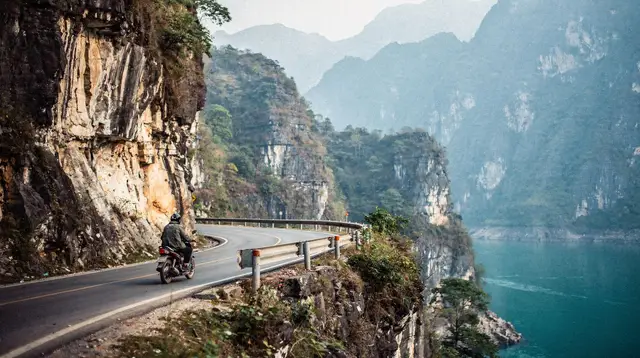
- The Ma Pi Leng Pass. The road climbs along a steep escarpment above the Nho Que river gorge. It is the most photographed stretch of the loop, with long drops on one side and a river far below. Stops at the viewpoints are short but memorable.
- The people. The area is home to several ethnic groups, including the Hmong, Tay, Dao and Lolo. Markets, houses and daily life look quite different from the lowlands. Respect for photography and for private homes matters; see etiquette and customs in Vietnam.
Do not expect a single “attraction”. The experience is the road itself, interrupted by viewpoints, a few cafés, a market if your timing is right, and homestays in valley villages.
Three ways to do it
Riding pillion with an easy rider
This is how most visitors do the loop. A local rider drives your bike and your luggage travels strapped on behind. You sit back, look around and take photographs. It removes the single largest risk of the trip, which is an inexperienced rider on steep, wet, gravelly roads.
Easy riders are not just drivers. They tend to know the villages, the best stops and which homestays are worth the night. Group tours often run with a guide on a separate bike and a small group of pillion riders.
Pros: safest motorbike option, no licence needed, you can enjoy the scenery. Cons: you are a passenger for several hours a day, which is hard on the back, and you will not control the pace.
Riding yourself
Riding your own motorbike gives you freedom, but the terrain is not forgiving. The roads are narrow, with sharp switchbacks, livestock, landslide debris, fog and trucks taking the middle of the road. This is not a place to learn.
The most important point is the licence. A valid motorcycle licence for the engine size you ride, recognised for Vietnam, is the legal basis for riding. Many insurers refuse a claim if you were riding without the correct licence, which can leave you paying for hospital treatment and repatriation out of pocket. Read your policy, and see travel insurance in Vietnam before booking. For rentals in general, renting a motorbike in Vietnam covers the practical side, and the Ha Giang safety question is discussed in more detail on our blog.
If you do ride yourself, be honest about your experience. Semi-automatic or manual bikes on steep descents are quite different from a scooter in a city.
Car, jeep or SUV with a driver
For travellers who dislike motorbikes, who are travelling with older relatives or children, or who simply want to keep warm and dry, a car is a solid choice. A private vehicle lets you stop for photographs without negotiating with a group, and it works in the cooler months when a day on a motorbike can be unpleasant.
You see the same landscape. You lose some of the open-air feel, but you gain a comfortable seat, luggage space and shelter from drizzle. Options range from a standard car to a jeep or pickup truck. As an example, an Ha Giang loop by car with a driver follows the same route without the bike.
Which option suits you?
| Your situation | Most sensible choice |
|---|---|
| No motorcycle licence, want the classic experience | Pillion with an easy rider |
| Experienced rider with a valid licence and cover | Riding yourself, with caution |
| Travelling with children or older relatives | Car or jeep with driver |
| Visiting in winter | Car or jeep |
| Short on time | Two-day tour, accepting a rushed pace |
| Photographers who want to stop often | Private car or jeep |
How long to allow
The honest range is two to four days.
- Two days, one night. This is mostly road time. It is possible but you will see the headline sights quickly, and the rhythm is exhausting. A two-day reverse-route tour suits people with limited time who accept the compromise.
- Three days, two nights. The standard format and the best balance. It gives you time to stop at viewpoints and spend an evening in a village. Many three-day, two-night loops from Hanoi include transport from the capital, typically a night bus or a limousine minibus.
- Four days or more. Allows slower days, a side valley, a short walk or a visit to a market. Some itineraries extend towards Cao Bang and the Ban Gioc waterfall, which is covered separately in our Cao Bang loop guide.
Getting to Ha Giang takes time. The town is roughly 300 km from Hanoi, and the trip takes about six to seven hours by road. Many tours include a sleeper bus or minibus in the price; see sleeper buses in Vietnam for how those work. Add that travel to your calculation when you plan the number of days in the north.
Best season and weather
Ha Giang is in the northern mountains, so the north’s four-season pattern applies, with colder weather than the lowlands.
- Autumn (October to November) is the best season. Skies are generally clearer, temperatures are comfortable and the plateau can be covered with buckwheat flowers. Rice on the terraces turns golden in September and October; our rice terraces guide has more on timing.
- Winter (December to February) is cold, grey and often misty. Mornings can be close to freezing in the mountains, and views from the Ma Pi Leng Pass can disappear into cloud. A car or jeep becomes more attractive.
- Spring (March to April) is mild with drizzle and flowering fruit trees in the valleys.
- Summer (May to September) is hot, humid and rainy, with a typhoon risk roughly from July to September. Landslides can close roads. See the rainy season and typhoons before booking.
For a broader comparison with the rest of the country, read the best time to visit Vietnam.
What to expect day to day
A typical three-day loop looks something like this, although every operator varies:
Day one. Leave Hanoi early or arrive in Ha Giang in the morning, then ride north through the Quan Ba pass and the “Heaven’s Gate” viewpoint. Overnight in Yen Minh, Dong Van or a nearby village.
Day two. The big day: the Dong Van plateau, the old town area and Ma Pi Leng Pass, continuing towards Meo Vac. Some itineraries include a boat trip on the Nho Que river, where the gorge is spectacular but the boat ride is short and busy.
Day three. Return through the valleys to Ha Giang town, then transport to Hanoi in the late afternoon or evening.
Accommodation is basic to comfortable. Homestays with shared dormitory rooms are common on group tours, and private rooms are available on higher-priced versions. Expect simple meals with rice, vegetables, tofu, pork or chicken, and rice wine offered in many places.
Price in perspective
Prices vary with format, season and group size. As an order of magnitude in 2026, a shared easy-rider group tour from Hanoi sits at the lower end, a private car or jeep costs noticeably more per person unless the vehicle is shared by several people, and a premium private itinerary costs more again. Prices in dong drift, so always check the current figure. For wider budgeting, see the Vietnam travel budget guide.
What to compare when you look at listings:
- Whether transport from and back to Hanoi is included.
- The number of nights and the type of accommodation.
- Group size and whether the rider is a licensed local.
- Whether meals, entry fees and the boat ride are included.
- Insurance, helmets and whether luggage is carried.
Choosing a tour sensibly
A few signals separate good operators from poor ones:
- Small groups. Large groups slow everything down.
- Clear itineraries. A good listing names the overnight stops and the sights.
- Local riders with experience. Riders should know the roads in all weather.
- Honest descriptions. Be wary of any listing that promises a perfect weather window.
If you prefer a four-wheeled option with a local at the wheel, a three-day jeep tour with a local driver guide gives you the full loop with shelter and luggage space. For those who want a shorter private option, a pickup or SUV two-day tour appears in the motorbike-loops listings.
Packing and practicalities
- Layers. Even in autumn, mornings and high passes are cool. A windproof jacket is worth carrying all year round.
- Rain protection. Showers can arrive without warning.
- Sunscreen and sunglasses. The sun is strong at altitude.
- Cash. Small villages rarely accept cards, and ATMs are only reliable in Ha Giang town and Dong Van. Read money in Vietnam.
- Mobile signal. Coverage is patchy in the valleys.
- Luggage. Leave the bulk of your bags in Ha Giang town or Hanoi and take a small bag.
Our packing list guide covers general kit, and the northern Vietnam one-week itinerary shows where a loop can fit in a trip.
Fitting the loop into a northern trip
The loop works best as the mountain chapter of a northern itinerary rather than a standalone trip. If you have only a week in the north, you might combine it with Hanoi, Ninh Binh and Ha Long Bay. With ten days you can build a more relaxed circuit; see the northern mountains loop in ten days for a model.
Questions about the Ha Giang loop
How many days do you need for the Ha Giang loop?
Three days and two nights is the usual minimum to enjoy the scenery without rushing. Two days works but is mostly time on the road. Four days adds slower mornings, a side valley or a longer walk.
Is the Ha Giang loop dangerous?
The roads are narrow, steep and often wet, and accidents involving inexperienced riders are common. Riding pillion with a local easy rider, or travelling by car, lowers the risk considerably. Wear a helmet and avoid riding in fog or at night.
Do I need a licence to ride the Ha Giang loop myself?
You need a motorcycle licence valid for Vietnam and for the engine size you ride. Many insurers refuse a claim if you ride without the correct licence, so read your policy before you decide. Check the official rules and your own insurer’s wording.
What is the best time of year for the Ha Giang loop?
Autumn, roughly October and November, is the best season, with clearer skies and buckwheat flowers on the plateau. Winter from December to February is cold and often misty. Summer is green but rainy, with landslide risk on the mountain roads.
Is the Ha Giang loop a UNESCO World Heritage Site?
No. The Dong Van Karst Plateau is a UNESCO Global Geopark, which is a different programme from World Heritage. The distinction matters if you are building a heritage-focused itinerary.
Should I book a Ha Giang tour in advance or on arrival?
Booking ahead is simpler in the busy autumn season and lets you compare itineraries, pickup points and what is included. Arranging a tour in Ha Giang town is possible but gives you less time to check the details.
Is it better to go as a solo traveller or in a group?
Both work well. Group tours are sociable and economical, while a private car or jeep gives you control over stops and pace. Solo travellers often join a small group departing from Hanoi.
Motorbike Loops and Countryside Excursions
Verified deep-linked GetYourGuide tours. Book through these links and we earn a small commission at no cost to you.
GetYourGuide does not provide a product photo for this activity — the image shows the meeting point, photographed by us.