Sapa or Ha Giang: Which Northern Vietnam Mountain Trip Suits You?
Should I choose Sapa or the Ha Giang loop?
Choose Sapa if you want to walk, sleep in a town with proper hotels and reach it by night train from Hanoi. Choose Ha Giang if you want a long road journey across the Dong Van karst plateau and the Ma Pi Leng Pass, usually as a pillion passenger with an easy rider. Neither is a UNESCO World Heritage Site.
Northern Vietnam has two mountain trips that people argue about, and they are not really the same kind of trip. Sapa is a hill town below Fansipan where you walk between villages and terraces and come back to a hot shower. The Ha Giang loop is a long ride around a remote karst plateau on the Chinese border, usually as a passenger on the back of a motorbike, sleeping in family homestays.
Both give you the mountains, the minority villages and the cool air that Hanoi lacks. What differs is how you move, how much comfort you get and what you are tired of by the end. This page helps you choose; the detailed routes sit on the destination pages for Sapa and Ha Giang.
The short answer
| Sapa | Ha Giang loop | |
|---|---|---|
| Main activity | Walking, trekking, village visits | Riding or being driven along mountain roads |
| Getting there from Hanoi | Night train to Lao Cai or road, then a transfer up the hill | Long road journey, often a sleeper bus or minibus |
| Typical stay | Town hotels, plus village homestays | Rural homestays, basic but warm |
| Physical demand | Moderate, you choose the distance | Long days of sitting, cold, dust and vibration |
| Comfort level | Relatively high | Simple |
| Best for | Walkers, families, first-timers, short trips | Road lovers, photographers, those who want immersion |
| UNESCO status | Not inscribed | Dong Van plateau is a Global Geopark |
If you like to walk and sleep well, pick Sapa. If you would rather watch a mountain pass unfold hour after hour and do not mind a thin mattress, pick Ha Giang.
Two different mountain landscapes
Sapa: terraces below Fansipan
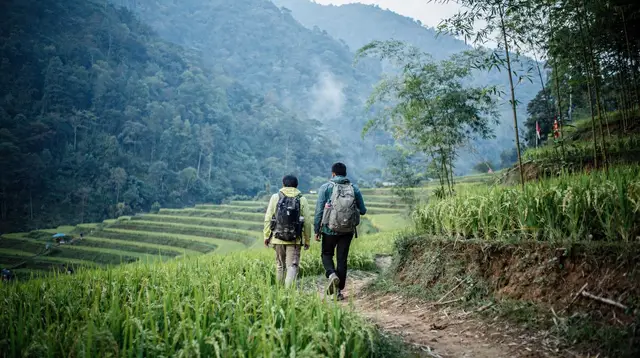
Sapa sits in a high valley in the Hoang Lien range, with Fansipan (3,147 m, the highest peak in the country) overhead on a clear day. The signature scene is the terraced rice fields that step down the valley sides, with villages of the Hmong, Dao and other ethnic groups strung between them. You can reach the summit of Fansipan on foot, a hard multi-day or very long day effort, or by cable car and a final staircase, which is how most visitors do it.
The town itself is busy and heavily built up, and the weather can hide everything in fog, which is why people reach for guides such as is Sapa worth visiting. The reward is out in the valleys: paths between villages, buffalo in the paddies, and a landscape that is gentle enough to walk without technical skills. For route ideas, see the Sapa trekking guide.
Ha Giang: the karst plateau and the pass
Ha Giang is a different geography altogether. The loop crosses the Dong Van Karst Plateau, a high, rocky country of limestone peaks, narrow valleys and stone houses, and drops through the Ma Pi Leng Pass, a cliff road above a very deep gorge. The distances are long, and the scenery changes with the road rather than with the walking pace.
The detailed route and day-by-day stops live in the Ha Giang destination page and the loop tours guide. What matters for the comparison is the experience: you spend hours moving, stopping at viewpoints, markets and small towns, and the cultural contact comes mostly in the evenings, in the homestays.
The UNESCO confusion
A lot of travel writing blurs the labels, so it is worth being precise.
- Sapa is not a UNESCO site. Neither the town nor the Hoang Lien valleys are inscribed.
- The Dong Van Karst Plateau is a UNESCO Global Geopark. This is a recognition of geological heritage and local management, not World Heritage status.
- A Geopark and a World Heritage Site are different programmes with different rules.
If heritage inscription matters for your list, the actual northern sites are Ha Long Bay, Trang An and the Imperial Citadel of Thang Long, covered in the UNESCO sites in Vietnam guide.
Getting there
Sapa
The classic way up is the night train from Hanoi to Lao Cai, followed by a road transfer of around an hour into the hills. Sleeper berths, early arrival and a day that starts at dawn make it a well-worn route, and it suits travellers who would rather sleep than watch the road. You can also go by bus or private car; the Vietnam train travel guide explains how the sleeper cars work, and a sleeper train ticket between Hanoi and Lao Cai can be booked ahead for the busy periods.
Ha Giang
Ha Giang is a longer trip from the capital, often six hours or more by road, and most visitors take a sleeper bus or a minibus to the town of Ha Giang, then start the loop the next morning. There is no train. Many people also begin from Sapa or Hanoi through organised packages: a four-day Ha Giang loop starting from Sapa is one example that includes a bus transfer, handy if you already have time in the Sapa area.
How the days feel
A Sapa day
You wake in a hotel or village homestay, have breakfast with a view if the cloud allows it, and walk for three to six hours between villages, usually on an established path. Lunch is in a village, and in the afternoon a car or a short walk brings you back. You can do it independently, with a local guide, or on an organised outing such as a two-day Sapa trek with train and meals. If your legs are tired, you stay in town.
The point is control: you decide the distance, you can rest, and in bad weather you can swap a walk for a cafe, a spa or a market.
A Ha Giang day
The day starts early and the schedule is set by the road. Several hours of riding, a stop for a viewpoint, a roadside lunch, then more riding until the homestay. Evenings are communal, often with shared dinners and rice wine, which is why many people remember the people more than the scenery.
You have less control. A rainy day on the loop is a wet, cold day on the loop, with a rider who has to decide whether a pass is safe. If you have a bad back, motion sickness or a dislike of heights, this is where you notice it.
Season and weather
The north has four seasons, and both places feel the difference sharply. The best time to visit Vietnam page covers the whole country; for these two mountain areas the pattern is:
- Autumn (October to November) is the best season in the north. The air is clearer and the days are mild.
- September and October are when the rice terraces turn golden, though the exact timing shifts each year. Terraces are green from around June. The rice terraces guide and the Mu Cang Chai page go deeper on the harvest look.
- Winter (December to February) is cool, grey and damp in the mountains. Sapa can come close to freezing, and the loop is cold enough that you will want serious layers and gloves.
- Spring (March to April) is mild with drizzle, and flowers, particularly on the plateau, can be a draw.
- Summer (May to September) is hot, humid and rainy, and the typhoon season can disrupt travel. Landslides can close mountain roads.
Because the best conditions overlap, the autumn rule is simple: if you want the golden terraces, aim for the early autumn window, keep dates flexible and ask locally just before you go. Month-by-month detail is in Vietnam in September and Vietnam in October.
Safety, licences and insurance
The loop is the part of this comparison that needs honesty. It is a mountain road with sharp bends, rain, loose gravel, trucks and occasional landslides. The question of how risky it is gets its own treatment in is the Ha Giang loop safe, but the practical points are these:
- Most visitors ride pillion with a local easy rider. That moves the driving risk onto someone who knows the road, and it is the sensible option unless you have real mountain riding experience.
- Riding yourself without the right licence is a problem. Vietnam expects a licence valid for the size of the bike, and many insurers will refuse a claim when it is missing, even for a minor accident. Read your policy before you go, and see renting a motorbike in Vietnam for the practical side.
- Check your travel insurance covers motorbike passengers. Some policies exclude them, or exclude mountain roads. Our travel insurance guide explains what to look for.
- Wear a proper helmet, and decline a rider who has been drinking.
Sapa carries its own, smaller risks: slippery paths after rain, touts, cold fog and altitude if you attempt Fansipan on foot. These are the ordinary hazards of walking in hills, and they are easier to manage because you can stop whenever you like.
Which one fits your temperament
This is the choice that actually decides it, more than the scenery.
Choose Sapa if you:
- prefer walking to riding, and want to set your own pace;
- like to end the day in a proper bed with hot water;
- have a short trip, with only two or three days to spare;
- are travelling with children, older parents or anyone who dislikes long journeys;
- want a night train as part of the experience.
Choose Ha Giang if you:
- care more about the road itself, the passes and the changing landscape;
- are happy with simple homestays and shared meals;
- have at least four days, and ideally five including the journey;
- do not mind cold, rain or dust;
- want contact with the communities you pass, even if briefly.
Hesitating between them? Think about what you will regret. People who pick Sapa and wanted adventure often say the town felt crowded and commercial. People who pick Ha Giang and wanted rest sometimes say the days were too long. Match the trip to the tiredness you can enjoy.
Doing both
It is possible, and some operators sell it as a single journey, for example a five-day Sapa and Ha Giang tour with transfers. The geography is the problem: the two areas are far apart and the road between them is long, so the combined version spends a lot of time in vehicles and shortchanges both.
If you have ten days or more, a looser mix works better: walk in the Sapa area, then travel on to Ha Giang, or add the quieter valleys of Mai Chau and Pu Luong for a gentler pace. The northern mountains loop in 10 days sketches one way to string the north together without rushing, and Cao Bang is the natural extension if you continue towards the border and the Ban Gioc waterfall.
Practical notes
- Book ahead in autumn. Homestays and the best guides fill up around the harvest season.
- Bring cash. Villages and small towns on both trips rely on cash.
- Pack for cold. A fleece, a rain shell and warm socks are not optional in winter, and useful all year at altitude. The packing list has the longer version.
- Respect the villages. Ask before photographing people, and learn what to expect from the ethnic minorities of northern Vietnam.
- Do not rush the pass. Ma Pi Leng deserves daylight and a pause, not a sprint.
- Tap water is not drinkable in either place; carry bottled or filtered water.
Sapa or Ha Giang: frequently asked questions
Is Sapa or Ha Giang better for a first trip to northern Vietnam?
Sapa is the easier first choice. It has a night train from Hanoi, a range of hotels, short walks as well as long ones, and little physical commitment. Ha Giang rewards travellers who accept long days on the road and basic homestays.
Is Sapa a UNESCO World Heritage Site?
No. Sapa is not inscribed by UNESCO. The Dong Van Karst Plateau around the Ha Giang loop is a UNESCO Global Geopark, which is a different programme from World Heritage.
Do I need a motorbike licence for the Ha Giang loop?
If you ride yourself, you need a licence valid for motorbikes of that size, and many insurers refuse claims when it is missing. Most visitors avoid the issue by riding pillion with a local easy rider.
When are the rice terraces golden?
Around September and October in the north, depending on the year and the valley. Terraces are green from about June. Check recent local reports before fixing dates, because the harvest moves.
Is it cold in Sapa?
In winter, from about December to February, Sapa is cold, damp and often foggy, and temperatures can come close to freezing. Pack layers and a waterproof jacket even in autumn.
Can I combine Sapa and Ha Giang in one trip?
Yes, but they are far apart by road, so allow a full day of travel between them and at least a week for both. Some organised itineraries link the two, but they are tiring and rushed.
Which one is more expensive?
Costs depend on style. Sapa can be done cheaply or in comfortable hotels. Ha Giang is usually sold as a package that includes the rider, bike, homestays and most meals, so the per-day price is easy to compare.
Trekking and Hiking in the Northern Mountains and Beyond
Verified deep-linked GetYourGuide tours. Book through these links and we earn a small commission at no cost to you.
GetYourGuide does not provide a product photo for this activity — the image shows the meeting point, photographed by us.