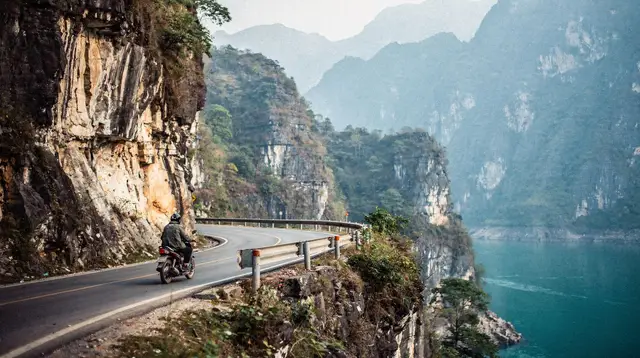
Cao Bang Loop Tours: Ban Gioc and the Quiet Border Country
Is the Cao Bang loop worth doing instead of the Ha Giang loop?
Cao Bang is a quieter, less visited loop on the Chinese border, built around the Ban Gioc waterfall, villages and karst valleys. It suits travellers who want space rather than a famous route, and it works either as an alternative to Ha Giang or as a second loop. Go with a local rider or driver, and aim for autumn, outside the typhoon months.
Most travellers who plan a motorbike trip in the north of Vietnam have heard of one loop: Ha Giang. Fewer have heard of the one next door, along the Chinese border, where the road follows a river valley, rice fields and limestone hills towards a wide, thundering waterfall. That is the Cao Bang loop, and this guide explains what it is, who it suits, how the tours work and when to go.
It is deliberately honest about one thing: Cao Bang is a quieter and less visited region. For some travellers that is the whole appeal. For others it means fewer bars, fewer hostels and a gentler, more rural pace than they expected. Both are fair reactions, and knowing which one is yours will decide whether this is the right trip.
Where the Cao Bang loop sits in northern Vietnam
Cao Bang is in the far north of the country, up against the Chinese border, in the same mountainous belt as Ha Giang but on its own side of it. The area is covered in more detail on the Cao Bang destination page, and it belongs to the wider northern Vietnam region that also holds Hanoi, Ha Long Bay, Ninh Binh and Sapa.
Everything here starts from Hanoi. Vietnam is a long, narrow country, and the north is a self-contained trip: you reach the mountains by road, usually by minibus or by a tour that collects you in the capital. From the capital you can combine Cao Bang with other northern stops, and the 10-day northern mountains itinerary shows how a longer route can be assembled.
The loop is not a single famous road in the way Ha Giang’s is. It is a circuit of valleys, small towns, ethnic minority villages and viewpoints, with Ban Gioc waterfall at its heart. Operators string those pieces together slightly differently, which is why the tours below vary in length and style.
Ban Gioc: the star, and what it is not
Ban Gioc is a broad waterfall that tumbles down in several tiers on the border between Vietnam and China. The river is the frontier itself, and you will see boats and rafts on the water and, on the far bank, the Chinese side. It is photogenic, easy to understand and quite different from the cliff-hugging road drama of Ha Giang.
A few clarifications keep expectations accurate:
- It is not a UNESCO World Heritage Site. Vietnam’s inscribed sites in the north are Ha Long Bay, the Imperial Citadel of Thang Long in Hanoi and the Trang An landscape near Ninh Binh. The guide to UNESCO sites in Vietnam lists them all.
- It is not the Dong Van karst plateau. The Dong Van plateau is a UNESCO Global Geopark, a separate programme from World Heritage, and it belongs to the Ha Giang area. Ban Gioc is a different place with a different character. Do not expect the two to overlap on one itinerary unless you deliberately plan both.
- Its appearance changes with the season. The flow tends to be fuller after the summer rains and thinner in the dry months. Neither is wrong; they simply look different, and the surrounding fields and hills change colour with the year.
If the waterfall is your main reason for coming, the dedicated Ban Gioc waterfall tours guide goes into the site itself. This page is about the loop that leads there.
Cao Bang or Ha Giang: alternative or complement?
This is the question most readers arrive with, so here is a straight answer.
Cao Bang is a good alternative if you have limited time in the north and would rather spend it somewhere calmer, you dislike the party atmosphere that Ha Giang can have in high season, or you simply want to see a part of Vietnam that fewer travellers reach.
Cao Bang is a good complement if you have already done Ha Giang, or you are planning a longer northern trip and want a second, different taste of the border mountains. The two regions share a mood but not a script.
Choose Ha Giang instead if the dramatic mountain passes and the well-known loop experience are the reason you are coming. The Ha Giang loop guide covers that route, including the famous pass, and it is the right page if that road is what you want. If you are still undecided between the two borders of the north, the comparison of Sapa and Ha Giang helps frame the choice between the better-known mountain bases.
No honest comparison reduces to a number. Cao Bang is quieter and less visited, and that is both its strength and its limitation. You will find fewer facilities, fewer English speakers and a slower rhythm. You will also find more space, more genuine village life and less of a tourist circuit.
How a Cao Bang loop tour works
The basic principle is the same as on other northern loops: you travel from place to place over two or three days, sleeping in small guesthouses or homestays, with a local who knows the roads.
On a motorbike-style loop, that usually means one of two arrangements:
- Riding pillion with a local rider. A professional rider drives and you sit behind. This is how most visitors do the northern loops, and it is by far the lowest-stress way to cover mountain roads you do not know.
- Riding your own bike with a guide. This is for experienced riders who hold the correct licence and want control. It is not a place to learn.
Not every tour is on a motorbike. Some use a car with a driver, and at least one option on this page is a bicycle tour. Bicycles and cars suit travellers who do not want to ride pillion, who are travelling with older relatives, or who simply dislike two wheels on mountain roads.
A typical tour includes accommodation, most meals, a local guide or rider and the entry to the main sights, but read each listing carefully because inclusions differ. Hanoi pick-up and drop-off is common, which makes the trip a straightforward add-on to a time in the capital. For longer packages that combine several regions, the multi-day tours from Hanoi guide is a useful companion.
Licence, insurance and the honest risk picture
This is the part many visitors skip, and it is the part that matters most.
Licence. To ride a motorbike yourself in Vietnam, you need the right licence for the category of bike you are on. A car licence or an ordinary home-country licence without the motorcycle category is not enough. The guide to renting a motorbike in Vietnam explains the practicalities.
Insurance. Many travel insurers refuse a claim if you were riding without the correct licence, and some exclude motorbikes entirely above a certain engine size. Read your policy wording before you leave, and see the travel insurance guide for what to look for. If you ride pillion with a professional rider, check that your policy still covers you as a passenger.
Real risks. Violent crime is rare. The dangers on a northern loop are traffic, wet and slippery roads, fatigue, mountain weather and over-confidence. A local rider takes most of that off your hands, which is why pillion riding is the sensible default. The Ha Giang safety article makes the same point about the neighbouring route, and the logic carries across.
Wear a proper helmet, keep your phone and valuables zipped in a secure bag, and tell the rider early if you are uncomfortable with the pace. A good rider will adjust.
The safest season: autumn, outside the typhoon months
The north has four seasons, and the loop is very much affected by them.
| Season | Months (approx.) | What to expect |
|---|---|---|
| Spring | March–April | Mild, with drizzle and often low cloud |
| Summer | May–September | Hot, humid and rainy; typhoon risk roughly July–September |
| Autumn | October–November | The best and most reliable season; clear days and comfortable temperatures |
| Winter | December–February | Cool and grey; much colder in the mountains |
Autumn is the safest and most pleasant window, and it is the one this guide recommends. Roads are drier, visibility is better and the typhoon season has passed. The rice fields are also at their best in the north around September and October, when terraces and valley paddies turn golden; the rice terraces guide explains where to see them.
Avoid the summer months if you can. Typhoons and heavy rain can trigger landslides, close roads and cancel tours at short notice. The rainy season and typhoons guide explains how the risk works across the country. If you must travel in summer, build slack into your plans and choose a flexible booking.
Winter is possible but cold, and the mountains can feel much colder than Hanoi. Pack layers, and treat any early-morning ride as a cold one.
Tours worth looking at
The options below cover different lengths and styles. Names are as listed by the operators; check each page for exact inclusions and dates.
For a longer, slower circuit. The three-day loop by bicycle is the one to consider if you want to travel under your own power and see the valleys at walking-plus pace. It suits reasonably fit travellers who like quiet roads and do not mind earning the views.
For a compact motorbike-style loop. The two-day loop with meals is the straightforward option for someone with limited time who wants the main sights without logistics to sort out. Meals included keeps decisions simple in places where you may not have much choice.
For a relaxed pace. The Cao Bang loop chilling tour from Hanoi is pitched at travellers who want a lighter, less rushed experience. If you are the sort who stops at every viewpoint, this style tends to suit.
Other tours on the same theme worth checking include a two-day loop focused on the waterfall and villages, a two-day nature escape and a two-day stay in a stone village. They overlap with the three above, so compare itineraries and accommodation rather than names.
If you are short of time, a one-day Hanoi tour that combines Ninh Binh and Cao Bang also exists. It is a very long day, and it covers two very different places in a single pass, so treat it as a taster rather than a proper visit. The Ninh Binh tours guide is worth reading if you would rather give Ninh Binh the time it deserves.
What else to do around Cao Bang
The loop is not only the waterfall. Expect a mix of:
- Villages and markets. Ethnic minority communities live throughout the region, and stone-built houses are a feature of some villages. Visit with respect: ask before photographing people, and remember you are a guest. The article on ethnic minorities of northern Vietnam gives helpful background.
- Caves and karst scenery. The limestone landscape is typical of the northern border country, with caves and viewpoints that operators tend to include on the loop.
- Local food. Cao Bang has its own cooking, different from Hanoi’s, and some operators run evening food walks and self-cooking experiences. If you are interested, look at the evening walking food tour and the local food tour with a self-cooking session as an addition rather than the main event.
- Slow evenings. There is little nightlife. Plan for early nights, a bowl of something hot and a long sleep before the next day’s ride.
Practical tips before you go
Getting there. Tours usually leave from Hanoi, and most include transport. If you are arranging things yourself, the getting around Vietnam guide and the sleeper buses guide show what the long-distance options look like. For a first trip north, a tour is far simpler than trying to piece together buses and local transport.
Visas. Entry rules depend on your nationality and change. Check the official immigration portal or your government’s travel advice, and read the Vietnam visa guide for the general picture.
Money. Bring cash in dong, in small notes. Cards work in Hanoi and larger hotels but are unreliable in the countryside. Prices change, so always check a price against the year it was quoted.
What to pack. Layers, a waterproof jacket, closed shoes with grip, sun protection and a small daypack. The packing list covers the basics, and you should add warm clothing for winter and a rain cover for the rest of the year.
Water. Tap water is not drinkable anywhere in Vietnam, so drink bottled or filtered water.
Border. Ban Gioc sits on a frontier, and the Chinese bank is a short distance away. Follow the guide’s instructions about where you may and may not go, and carry your passport or a copy as advised.
Who should and should not book
The Cao Bang loop suits:
- Travellers who have done Ha Giang or want something calmer.
- People who value scenery and village life over nightlife.
- Cyclists and slow travellers who enjoy quiet roads.
- Anyone who wants a short, contained trip from Hanoi without crowds.
It is probably not the right choice if:
- You want a social, party-oriented trip with a large group.
- You are very short on time and want the most famous road in the north.
- You are uncomfortable on rural roads or with basic accommodation.
For a wider view of options, the adventure travel guide and the motorbike loops category list other routes and tours.
Cao Bang loop tours: frequently asked questions
Is the Cao Bang loop better than the Ha Giang loop?
Neither is better; they offer different things. Ha Giang is the famous one, with dramatic passes and a busy backpacker scene. Cao Bang is quieter and less visited, with Ban Gioc waterfall as its centrepiece. If you want solitude and fewer travellers, choose Cao Bang; if you want the headline road, choose Ha Giang.
Do I need a motorbike licence for the Cao Bang loop?
If you ride yourself, you need the right licence for the motorbike you are on, and many insurers refuse claims without it. Most visitors ride pillion with a local rider or take a car or bicycle tour instead. Check your insurance wording before you book.
When is the best time to go to Cao Bang?
Autumn, roughly October and November, is the most reliable season in the north. Summer brings heat, heavy rain and a typhoon risk from roughly July to September, which can disrupt roads and tours. Winter is cool and grey, and the mountains can be much colder than Hanoi.
Is Ban Gioc a UNESCO World Heritage Site?
No. Ban Gioc is a waterfall on the Chinese border, not an inscribed site. The nearby Dong Van karst plateau is a UNESCO Global Geopark, which is a different programme from World Heritage, and it lies in the Ha Giang area rather than around Ban Gioc.
Can I do Cao Bang as a day trip from Hanoi?
A one-day tour from Hanoi exists, but it is a very long day for a region of this character. Two days or more lets you see the waterfall and the villages without spending most of the trip in a vehicle.
Is the Cao Bang loop safe?
Violent crime is rare. The real risks are traffic, mountain weather, fatigue and riding without the right licence. Travelling with an experienced local rider, wearing a proper helmet and avoiding the typhoon months removes most of the danger.
Do I need cash in Cao Bang?
Yes. Bring Vietnamese dong in small notes for village meals, drinks, entry fees and small purchases. Cards are accepted by larger hotels and in the cities, but not reliably in the countryside.
Do I need to book Cao Bang in advance?
Booking ahead is wise in autumn and around public holidays, when the small guesthouses fill up. Outside those periods, tours are easy to arrange a few days ahead from Hanoi.
Motorbike Loops and Countryside Excursions
Verified deep-linked GetYourGuide tours. Book through these links and we earn a small commission at no cost to you.
GetYourGuide does not provide a product photo for this activity — the image shows the meeting point, photographed by us.