Sapa Trekking Tours: Day Walks, Homestay Treks and Fansipan
What kind of Sapa trek should you choose?
Day walks through the valleys and villages suit most visitors; a homestay trek of several days adds a night in a village and quieter paths. Fansipan, at 3,147 m the highest peak in Vietnam, can be climbed on foot or reached by cable car, and the two are very different days. Autumn, October to November, is the most reliable season, with terraces turning golden around September and October.
Sapa sits in the northern mountains of Vietnam, beneath Fansipan, and walking is what most people come here to do. The town itself is a base: the interest lies in the valleys and villages around it, in terraces cut into the slopes, and in the paths that join one hamlet to the next. This guide is for the reader who has decided to walk and now needs to decide which kind of walk, and when.
The short version: choose between a day out in the valleys and a trek of several days with a night in a village, decide whether Fansipan is a mountain you want to climb or a view you want to ride up to, and let the northern calendar steer the month. The rest of this page unpacks each of those choices. For the wider picture of the area, the Sapa destination page covers the town, and the trekking and hiking hub compares walks across the country.
What kind of walking Sapa offers
Sapa walking falls into three families, and confusing them is the commonest planning mistake.
| Type | What it is | Who it suits |
|---|---|---|
| Day walk | A guided loop through valleys and villages from the town, back for the evening | First-timers, families with older children, anyone short on time |
| Homestay trek | A route of several days, sleeping in a village house and eating with the host family | Walkers who want quieter paths and an evening in a village |
| Fansipan | The country’s highest peak, 3,147 m, climbed on foot or reached by cable car | Strong walkers (on foot) or anyone wanting the summit view (cable car) |
None of these is better in the abstract. A day walk is the right answer for a surprising number of people, because the valleys around Sapa reward a few hours of walking as much as they reward several days.
Day walks through the valleys and villages
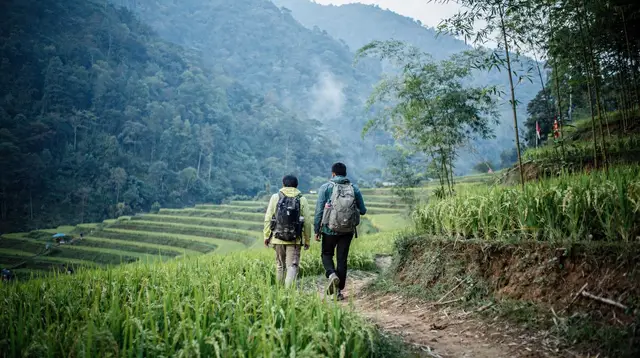
A day trek is the standard introduction. A local guide leads you out of town and down into a valley, past terraces and through villages, with a stop for lunch before the path or a vehicle brings you back. The scenery is the main event: terraced slopes, water buffalo, bamboo, houses on stilts or built of earth and timber, depending on the community.
Two things make the difference between a good and a mediocre day walk. The first is the guide: someone from the area who can explain what you are looking at, and who knows which paths are safe after rain. The second is the season, because the same route looks very different in a green June, a golden October and a grey January.
If you want a simple, bookable version, a [one-day Sapa trekking tour](a guided day walk through the valleys and villages around Sapa) gives you the standard loop without any overnight commitment.
Day walks also let you keep your hotel in town, which matters if you want a hot shower, a warm room in winter and a restaurant that is not a village kitchen.
Treks of several days and the homestay night
A multi-day trek changes the character of the walk. Instead of out-and-back from the town, you move from village to village, and the evening is spent in a homestay: a family house where you eat what the household eats and sleep under a roof that is rarely heated. It is simple, warm in human terms, and cold in the literal sense in winter.
What a homestay trek gives you that a day walk does not:
- Quieter paths. Once you are a day’s walk from the town, you see far fewer other groups.
- A village in the evening and early morning. Light, smoke from the kitchen, the first sounds of the day. This is when the place feels least like a destination.
- Distance. You cover more ground and see more than one valley.
What you give up: comfort, a private bathroom in most cases, and flexibility if the weather turns. A multi-day trek in July rain is a very different thing from the same route in October.
A [three-day, two-night homestay trek](a Sapa trek with two nights in village homestays) is the classic format, with the walking spread across the days and the nights spent with local families. If you are coming from the capital and would rather have the transport folded in, the [two-day trek that includes the train and meals](a two-day Sapa trek from Hanoi with the night train and meals included) removes most of the logistics.
Whichever you choose, read the itinerary for the sleeping arrangements and the walking distance each day. Operators describe these very differently, and the difference matters more than the name of the tour.
Fansipan: on foot or by cable car
Fansipan is the highest peak in Vietnam, at 3,147 m, and it is the mountain the whole area is built around. It can be reached in two completely different ways, and they should not be confused:
- On foot. A genuine mountain walk. It is demanding, it depends on the weather, and it is usually done with a guide. Rain, mist and cold can turn it from a rewarding day into a miserable one, and conditions at the top can be very different from conditions in town.
- By cable car. A sightseeing trip. It takes you most of the way up in comfort, and it is a viable choice for visitors who cannot or do not want to walk, or who want the high-altitude view without the effort.
Neither one is the “real” Fansipan. The difference is that the first is a hike and the second is an excursion. Choose the one that matches how you want to spend the day, not the one that sounds more impressive.
A practical point that applies to both: clear views are never guaranteed. Mist is common at altitude, and it is especially common in summer. If seeing the summit panorama is the point of the trip, the autumn and the dry, cold months give you better odds than the rainy summer. If you plan to walk, the weather forecast on the day matters more than the date in your diary.
When to go: the northern calendar
Sapa follows the north’s pattern of four seasons. Do not apply the climate of Ho Chi Minh City or Hue to it: the country has three regional patterns, and the best time to visit Vietnam guide explains how they differ.
| Season | What to expect for walking |
|---|---|
| Spring (March–April) | Mild, with drizzle. Pleasant temperatures, soft light, some mist |
| Summer (May–September) | Hot in the lowlands, very humid and rainy. Mist and rain in the hills. Terraces turn green from about June |
| Autumn (October–November) | The best season: clearer skies, comfortable temperatures. Terraces golden around September and October |
| Winter (December–February) | Cool and grey. Sapa can come close to freezing |
Green terraces, from about June
From around June the terraces fill with young rice and turn a strong, wet green. This is a beautiful look, but it is also the rainy season, so you trade colour for mud, mist and the risk of paths becoming slippery. If you come in this window, accept that you may spend a morning inside waiting for a cloud to move.
Golden terraces, around September and October
Late September and October are the moment most photographers want: golden terraces, a clearer sky, and walking weather that is comfortable rather than punishing. It is also the busiest time, so book ahead for homestay treks. The rice terraces guide explains the growing cycle and why the colours shift.
Rain and mist in summer
The north’s summer also carries a typhoon risk, roughly from July to September, which can disrupt travel across the region. Heavy rain makes the trails slippery and can close a route. If you travel in this window, build flexibility into the plan and read the rainy season and typhoons guide before booking anything non-refundable.
Winter: cool, grey and occasionally near freezing
Hanoi runs at roughly 13 to 20 °C in winter and the mountains are much colder; Sapa can come close to freezing. Walking in winter is possible and has its own austere charm, but you need real layers, waterproofs and warm clothing for the evening, because village houses are rarely heated. Views can be absent for days. Choose winter for the atmosphere and the empty paths, not for the photographs.
Getting to Sapa: by road, or by night train to Lao Cai
Sapa is in the mountains, a long way from the capital. It is reached by road, or by night train to Lao Cai with a road transfer up to the town.
- By road. Buses and “limousine” minibuses run from Hanoi to Sapa, and private cars with a driver are also available. The sleeper bus guide explains how overnight and daytime coaches work.
- By night train to Lao Cai. The railway runs from Hanoi to Lao Cai, the railhead on the border, and you continue up to Sapa by road. Many visitors like the train because you sleep in a berth and arrive in the morning. The train travel guide covers how Vietnamese sleeper trains work in general. To book the rail leg on its own, the [sleeping train between Hanoi and Lao Cai](the overnight sleeper train from Hanoi to Lao Cai for Sapa) is the usual choice.
Whichever way you go, remember that the north-to-south distances of the country are long, so Sapa belongs in a northern plan alongside Hanoi, Ninh Binh and Ha Long Bay, not in a southern one. A seven-day northern plan is sketched in Northern Vietnam in one week; check that page rather than guessing how to fit the mountains between the other stops.
Choosing between a day, a homestay trek and Fansipan
Use these questions to decide.
You have little time and want the scenery. Pick a day walk. It gives you the valleys, the terraces and a village or two, and you sleep in town.
You want to feel the place after the day-trippers leave. Pick a homestay trek, and accept the simpler comfort in return for the quiet.
You want the summit. Decide first whether the point is the climb or the view. If it is the climb, plan around the season and the forecast, take a guide and give yourself a flexible day. If it is the view, the cable car is a legitimate choice and nobody is keeping score.
You are travelling in summer. Prefer shorter, flexible options and keep a plan B. A rainy day in town is easy to absorb; a rainy third day of a remote trek is harder.
You are travelling in winter. Pick a day walk with a warm room to return to, rather than a multi-day trek with an unheated homestay, unless you are properly equipped.
You are comparing northern mountain destinations. The Sapa or Ha Giang guide sets the options side by side. Mu Cang Chai and the Ha Giang loop are covered on their own pages, including Mu Cang Chai, so this page leaves them aside.
Packing and practical tips
The Vietnam packing list covers the basics for the whole country; for a Sapa walk, add the following.
- Shoes with grip. Paths are often earth or stone and become slick in rain. Trainers with a worn sole are a bad idea.
- Layers. The temperature can drop sharply in the evening and at altitude, even outside winter.
- A rain jacket. Light rain can arrive on any day outside the driest months.
- Water. Tap water is not drinkable anywhere in Vietnam, so carry bottled or filtered water, and bring enough for the day.
- Cash in small notes. Villages and small stalls rarely take cards, and Vietnamese dong is the working currency.
- A phone with offline maps and a charged battery. Signal can disappear in a valley.
- Insurance that covers trekking. Check the policy before you go, particularly if you plan to climb Fansipan on foot.
Etiquette matters in a village. Ask before photographing people, especially children and women at work, and treat a homestay as someone’s house. The etiquette and customs guide covers the general rules, and the article on the ethnic minorities of northern Vietnam gives useful background on the communities you will walk through.
After a day or several on foot, many visitors look for something restorative. The Sapa herbal baths and spas guide covers the local options.
Combining Sapa with the rest of the north
Sapa is easy to add to a wider northern trip. If you have more time and an appetite for walking, the trekking adventure itinerary for two weeks strings several walking regions together. If you are tight on time, a packaged option such as the [three-day Ha Long Bay and Sapa adventure](a three-day trip combining Ha Long Bay and Sapa from Hanoi) pairs a bay with the mountains, although it is a short window for either.
Keep in mind that the name of the province may differ from what older maps show: on 1 July 2025 Vietnam merged its provinces, but the place names did not change. Sapa is still Sapa, and you will find it under that name in signs, timetables and bookings.
FAQ: choosing a Sapa trek
Is a day walk enough to see Sapa?
For a first visit, often yes. A day walk through the valleys and villages gives you the terraces, the hill-tribe hamlets and the scenery. A multi-day trek mainly adds a night in a village, longer distances and fewer other walkers.
Can you climb Fansipan on foot?
Yes. Fansipan, 3,147 m, is the highest peak in Vietnam and can be reached on foot or by cable car. Walking it is a demanding mountain day that depends on the weather and is usually done with a guide; the cable car is a sightseeing trip.
When are the rice terraces green and when are they golden?
The terraces turn green from about June and are golden around September and October, just before the harvest. Summer brings rain and mist that can hide the views, so autumn is the safest bet for both colour and clear skies.
How cold does it get in winter?
Winter, December to February, is cool and grey in the northern mountains, and Sapa can come close to freezing. Hanoi sits at roughly 13 to 20 degrees Celsius in the same months, so bring real layers if you walk in winter.
How do you get from Hanoi to Sapa?
Sapa is reached by road, or by night train to Lao Cai followed by a road transfer up to the town. Many treks and tour packages from Hanoi include the train; others start in Sapa itself.
Is trekking in Sapa safe?
Violent crime is rare in Vietnam. The real risks on a trek are slippery paths after rain, cold and mist, and overestimating your fitness. Go with a local guide, wear proper shoes and check the weather before committing to a high route.
Trekking and Hiking in the Northern Mountains and Beyond
Verified deep-linked GetYourGuide tours. Book through these links and we earn a small commission at no cost to you.
GetYourGuide does not provide a product photo for this activity — the image shows the meeting point, photographed by us.