Vietnam Homestays: Where Staying With a Family Makes Sense
Where are homestays in Vietnam worth booking?
Homestays make most sense in rural areas: the northern mountains around Sapa, Mai Chau and Pu Luong, the Ha Giang loop, the Mekong Delta and the countryside around Hoi An. Expect warm contact and home cooking, but variable comfort, little English and patchy mobile coverage. Ask your host about registration of foreign guests when you book.
Few experiences in Vietnam stay with you the way a meal eaten cross-legged on the floor of a family home does: rice passed hand to hand, a grandmother watching to see whether you like the fish, a child practising English on you before bed. That is the promise of the homestay. It is also a word that Vietnamese tourism uses loosely, so this guide sets out what it really covers, where the formula comes naturally, and where it is best left alone.
What “homestay” means in Vietnam
In everyday use the word stretches across a spectrum.
At one end is the family house that takes guests: a stilt-house in a mountain village, a brick home beside a canal, a farmhouse among rice fields. You sleep on a mattress with a mosquito net, share a bathroom with the household, and eat what the family eats. The money is modest and the contact is real, but the comfort is whatever the house offers.
In the middle sits the purpose-built guesthouse run by a family: a separate building or a few bungalows in the garden, private rooms with their own bathroom, and meals cooked by the owners. This is the most common form in the better-known valleys and the one most visitors actually book.
At the far end is the boutique “homestay”, a name used by small hotels that are homestays in spirit only: stylish rooms, a reception, sometimes a pool. They can be lovely, but they are not what this guide is about, and a good many of them belong in the where to stay in Vietnam overview instead.
A useful test: do the people who own the place live there, and do you share at least one meal or one evening with them? If yes, you are in homestay territory.
What a homestay gives you that a hotel does not
- Contact. You meet the people whose valley, village or river you are visiting, instead of passing through it on a bus.
- Home cooking. Dinner is usually the highlight: dishes built on what the garden, the river or the market that morning supplied. The Vietnamese food varies sharply by region, and a family kitchen shows it far better than a restaurant menu. Our Vietnamese food guide is a useful companion.
- Village rhythm. Early mornings, buffalo on the track, evenings when the generator or the television is the entertainment. You see a place at its own pace.
- Local knowledge. Hosts know which path is passable after rain, which neighbour makes rice wine and when the market is on.
What it does not give you is reliability of the five-star kind. That is not a flaw; it is the trade.
Where homestays come naturally
The formula works best where families have long lived from farming and have gradually opened a room or two to visitors. Five areas stand out.
The northern mountains: Sapa, Mai Chau and Pu Luong
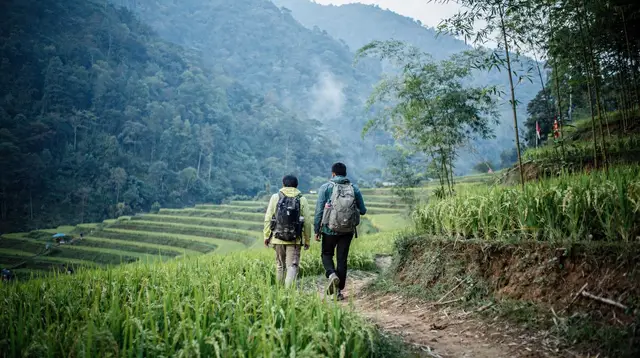
Around Sapa, villages in the valleys below Fansipan host trekkers in family houses belonging to Hmong, Red Dao and Tay communities. The classic pattern is a day’s walk between villages and an evening meal at the house where you stay. If you want that format without organising it yourself, a guided option such as the two-day trek through Ta Van and Lao Chai with a night in a village home shows how it works in practice.
Mai Chau is the gentlest version: a broad valley of White Thai stilt-houses where homestay hosting is a long-established activity, with shared mattresses on the floor of the main room and a communal meal. Further on, Pu Luong is quieter and greener, with lodges and family houses among terraces and water wheels. Both are comfortable for a first homestay.
Season matters. The terraces are green from about June and turn golden around September and October, which is when the most visitors arrive; our rice terraces guide explains the calendar. Winter is cool and grey, and mountain houses are often cold at night, so bring layers.
The Ha Giang loop
The Ha Giang loop across the Dong Van Karst Plateau is the other classic. Most visitors ride pillion with a local easy rider, and overnight stops are in family guesthouses or homestays in small towns and villages along the way. These are often communal in spirit: a long table, shared dishes, rice wine and early nights after a long day of riding. Conditions range from simple to quite comfortable, and the road itself is the main challenge; see our guide to Ha Giang loop tours before you commit.
The Mekong Delta
In the Mekong Delta, the typical homestay is a family garden house reached by a path or a small boat, with fruit trees, canals and a hammock on the veranda. Stays around Ben Tre, Vinh Long and Cai Be are common, and the evening usually brings a home-cooked meal of river fish, fruit and rice. The delta is warm all year, with a dry season roughly from December to April and a wet season roughly May to November, normally in the form of short late-afternoon downpours.
For a boat-based way to see the area at night, there is the firefly and wildlife kayak and boat adventure, which fits well around an overnight in the delta. If you also want the floating market, remember that Cai Rang is at Can Tho and trades at dawn, so a stay near Can Tho is the practical choice.
The countryside around Hoi An
Beyond the lantern-lit old town, the paddies and river channels around Hoi An hold family guesthouses that feel a world away from the tailors and cafés. Staying out here gives you cycle paths between rice fields, water-buffalo, and the chance to learn to cook with the family rather than in a class. If you would rather start with a structured session, the Hoi An cooking tour with a market visit is a good way in, and you can then carry the skills into a family kitchen. For the town itself and its neighbourhoods, our where to stay in Hoi An page covers the options.
Where a homestay is not the right idea
Honesty serves you better than enthusiasm here.
- Inside big cities. Hanoi and Ho Chi Minh City have hotels, guesthouses and apartments in every neighbourhood, and their “homestays” are generally small guesthouses. Which district to pick is a different question, covered in where to stay in Hanoi.
- At the beach. If your aim is sun, sea and a pool, you will be happier at a resort. Our beach resorts guide is the better starting point.
- When you need a quiet, private night. In a village house you share walls with the family, the rooster, the television and sometimes the karaoke. Light sleepers should pack earplugs or choose a bungalow in the garden.
- When you have a tight schedule. Homestay areas are reached by narrow roads, and a single missed connection or a rainy day can move everything.
The limits, stated plainly
Comfort varies
Two homestays in the same village can be worlds apart. Typical differences include:
| Aspect | Simpler family house | Purpose-built guesthouse |
|---|---|---|
| Bed | Mattress on the floor, mosquito net | Bed with linen, sometimes a fan or air conditioning |
| Bathroom | Shared, basic | Often private, hot water usually available |
| Meals | Family meal at a set time | More choice, sometimes à la carte |
| Heating or cooling | Fan or blankets | Varies, with heating in better mountain places |
| Privacy | Low | Moderate |
Read recent reviews and ask the host directly about hot water, bedding and the bathroom. In the mountains in winter, ask specifically about blankets and heating.
English is rare in the countryside
English is common in hotels and tourist restaurants in the main destinations and much less so in villages. Hosts compensate with generosity and gesture. A translation app, offline, is worth installing in advance, and a few words of Vietnamese land well; our list of Vietnamese phrases for travellers is a good place to start.
Connectivity is uneven
Mobile signal and wifi can be strong in one valley and absent in the next. Download offline maps, tickets and your onward transport details before you go, and sort out a data plan on arrival; see eSIM and SIM cards in Vietnam. Do not plan to take an important video call from a hillside homestay.
Registration of foreigners
Vietnamese rules require accommodation providers to declare foreign guests to the local authorities, and hosts will often ask for your passport on arrival for that reason. Procedures differ from place to place and can change, so do not assume. Ask your host how registration is handled and whether they need your passport overnight, and keep a photo of the main page on your phone. Reputable hosts will know exactly what they need and will tell you without fuss.
Water, food and health
Tap water is not drinkable anywhere in Vietnam. Hosts normally provide boiled or filtered water, or sealed bottles, and it is entirely acceptable to ask. Wash fruit and vegetables only with bottled or boiled water if you are cautious, and see our short piece on whether you can drink the tap water in Vietnam. Home cooking is generally fresh and well cooked, but if you have allergies or dietary restrictions, say so when you book, ideally with a written note in Vietnamese, as translation is not guaranteed.
How to be a good guest
A homestay is a house first and a business second, and a few habits make the stay better for everyone.
- Take your shoes off at the door, as the family does, and watch where others leave theirs.
- Dress modestly in the house and village, especially in more traditional communities.
- Accept what is offered where you can, such as tea, a small bowl of rice wine, a piece of fruit. Declining politely is fine, but tasting is appreciated.
- Ask before photographing people, especially children and older family members.
- Be punctual for meals, which are often early in the evening in the mountains, and tell your host in advance if you will be late.
- Mind the household’s routine. Electricity, hot water and quiet hours may not match yours.
- Pay fairly and clearly. Agree what is included, including meals, drinks, transport and any activities, before you settle in, and settle up on the day you leave.
Our etiquette and customs guide goes further on these points.
Cash, paying and extras
Small homestays often take cash only, and cards are rarely accepted in villages. Bring enough in Vietnamese dong for meals, drinks and the final bill, and note that withdrawing money may mean a trip to a town. Our page on money in Vietnam covers cash machines and card use. Quote prices only with the year in mind: exchange rates and costs drift, and it is best to confirm everything with your host rather than trust an old review.
Getting there and moving on
Most homestay areas are reached by road. From Hanoi, Mai Chau and Pu Luong are a few hours by car or minibus, Sapa is reached by road or by night train to Lao Cai, and Ha Giang is a long day by road. In the south, the Mekong Delta is reached from Ho Chi Minh City in a few hours by road, with the final leg by boat. Hoi An’s countryside is a short ride from the old town.
For the long hops between regions, remember the scale of the country: north to south is a domestic flight of about two hours or more than thirty hours on the Reunification Express, never a day trip. A good plan puts one homestay region in each part of a trip rather than trying to string them together.
If you want a village stay combined with a famous landscape without driving yourself, an overnight such as the Lan Ha Bay overnight cruise from Hanoi shows how a night on the water can sit alongside a homestay in the mountains or the delta. For a calm start from the capital, the Ninh Binh countryside is a short drive away and also has family-run stays among the limestone karst.
Choosing and booking
- Decide the experience first. Do you want to share a family’s home, or only a quiet room in a family garden? That determines the kind of place to look for.
- Match the region to the season. The north is best in autumn, the centre in spring and summer, and the south in the dry season. There is no single best time for the whole country, which is why a homestay plan belongs to a region, not to Vietnam as a whole.
- Read recent reviews, particularly those about bedding, bathrooms, noise and the host’s attitude.
- Message the host before you book. Ask about registration, meals, water, hot showers, heating and how to reach the house.
- Plan how you arrive. Narrow roads, rain and darkness make late arrivals unpleasant. Arrive in daylight if you can.
- Keep a margin in your schedule. A rainy day can close a track, and a homestay is a bad place to be rushing.
Is it for you?
A homestay suits travellers who value people over polish, who can live with a shared bathroom or a cold shower, and who are happy to leave the phone in a pocket. Families with older children, couples after something less staged than a resort, and solo travellers wanting company will all find it rewarding. If you are very sensitive to noise, need a precise itinerary, or rely on constant connectivity, a hotel or lodge may serve you better, and there is no shame in mixing the two: a night or two in a village, then the comfort of a city hotel.
Vietnam homestays: questions answered
What exactly is a homestay in Vietnam?
The word covers a wide range, from a family’s own house, such as a stilt-house with mattresses on the floor, to a purpose-built guesthouse run by a family who live next door. What they share is that the hosts are present, often cook for you and treat you as a guest rather than a customer at a front desk.
Is the tap water safe to drink at a homestay?
No. Tap water is not drinkable anywhere in Vietnam. Hosts normally provide boiled, filtered or bottled water, and it is fine to ask for it. Use it for brushing your teeth too if you have a sensitive stomach.
Do homestay hosts speak English?
Often very little outside the main tourist hubs. In rural areas, a translation app, a few Vietnamese phrases and patience go a long way. Some places have a younger family member or a guide who translates, but do not count on it.
Will I have mobile signal and wifi?
Not everywhere. Many homestays have wifi, but it can be slow or drop out, and mobile coverage in mountain valleys or along rivers is patchy. Download maps and messages before you arrive, and treat the lack of a connection as part of the stay.
Do I have to register with the police as a foreigner?
Vietnamese law requires accommodation providers to declare foreign guests to the local authorities, and hosts usually ask for your passport for that purpose. Rules and procedures can change, so ask your host how it is handled and keep your passport details to hand.
Which regions are best for a first homestay?
Mai Chau and Pu Luong in the north, and a riverside stay in the Mekong Delta, are the gentlest introductions: they are used to visitors, easy to reach by road and relaxed about first-timers. Sapa villages and the Ha Giang loop are more rewarding but demand more flexibility.
Can I book a homestay at the last minute?
Often yes in quiet months, but in the peak weeks around Tet, during the golden rice season in the north and on weekends, the better-known places fill up. Booking a few days ahead is safer, especially for small family-run houses with only a handful of rooms.
Trekking and Hiking in the Northern Mountains and Beyond
Verified deep-linked GetYourGuide tours. Book through these links and we earn a small commission at no cost to you.
GetYourGuide does not provide a product photo for this activity — the image shows the meeting point, photographed by us.