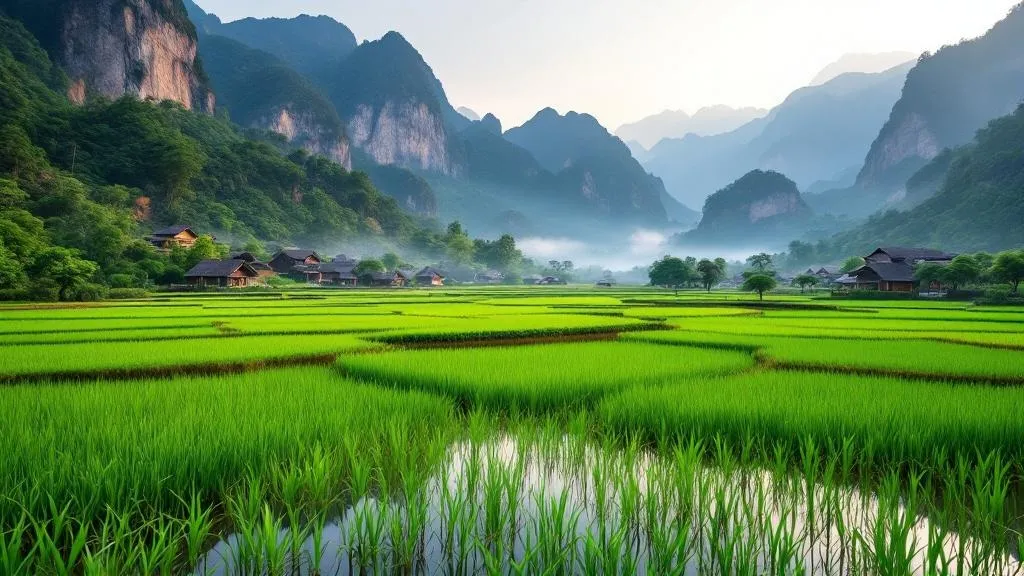
Mai Chau is the northern mountain stop that asks the least of you. There is no summit to climb, no pass to survive, and no queue for a viewpoint. There is a wide, flat-bottomed valley of rice fields ringed by limestone hills, and in it a scatter of villages whose wooden stilt houses have been home to the White Thai people for generations. You walk between paddies, cycle on quiet lanes, eat what the family cooks, and sleep on a mattress laid on a bamboo or timber floor under a mosquito net. That is the whole proposition, and it is a good one.
The honest framing matters, because Mai Chau is sometimes sold with language borrowed from more dramatic places. It is not Sapa, with its high ridges and its mist. It is not a World Heritage Site. And it does not have the sweeping, carved terraces that make Mu Cang Chai famous. If you arrive expecting any of those, you will be underwhelmed. If you arrive expecting a soft valley, friendly hosts and an unhurried day, you will probably leave planning to come back.
What Mai Chau actually is
The valley sits in the hills south-west of Hanoi, in the part of Northern Vietnam where the Red River plain gives way to forested uplands. The floor of the valley is gentle and almost level, which is the key to everything: it is the reason the paddies are so neat, the reason bicycles work so well, and the reason the place suits people who would never contemplate a mountain trek.
The people are mostly White Thai, one of Vietnam’s ethnic minority groups, who live in raised wooden houses with the family’s living and sleeping space above and the animals, tools or looms below. Women still weave brocade on handlooms in many villages, and you will see scarves, bags and cushion covers hung out for sale. Some of this is clearly aimed at visitors, and some of it is simply what the village makes. The two best-known settlements, Lac and Poom Coong, are the most visited and the most set up for tourism, with rows of homestays and small restaurants. Quieter villages lie further out along the lanes, and they are the reason to get on a bicycle.
If you want to understand who lives in the northern uplands more broadly, our piece on the ethnic minorities of Northern Vietnam gives the wider picture, and the etiquette and customs guide covers the basics of behaving well in someone’s home.
Setting expectations: Mai Chau compared with the north’s headline places
It helps to place Mai Chau on the map of northern mountain trips, because they are different kinds of experience and one holiday rarely needs all of them.
| Place | What it offers | Character | Effort |
|---|---|---|---|
| Mai Chau | Rice valley, stilt villages, homestays | Soft, rural, easy | Low |
| Sapa | Big mountain views, trekking, Fansipan | Dramatic, busier | Medium |
| Mu Cang Chai | Sculpted terraces, golden in autumn | Spectacular, remote | Medium to high |
| Ha Giang loop | Karst plateau, high passes | Wild, demanding | High |
| Pu Luong | Wilder valley, terraces, forest | Rugged, quiet | Medium |
If you are still choosing between mountain destinations, Sapa or Ha Giang is the usual comparison, and Mai Chau sits comfortably underneath both as the shorter, easier option. For terraces specifically, the rice terraces guide explains where to see the best of them and when.
Getting there from Hanoi
Mai Chau is reached by road, and only by road. There is no railway and no airport; the practical choices are a private car with a driver, a seat on a tour minibus, a regular coach, or a motorbike if you are properly licensed and experienced.
The drive leaves the capital through its western suburbs, crosses the plain, and climbs into the hills by way of the town of Hoa Binh and a mountain pass where many drivers pause for a view over the valley. Allow roughly half a day door to door once you add traffic on the way out of Hanoi, a coffee stop and a lunch. It is a morning’s drive rather than a quick hop, and rather less than a long haul. Weekends and public holidays are slower on the way out and on the way back, so if you can, travel on a weekday and leave Hanoi early.
For most people the simplest answer is one of the packaged trips from the capital. A two-day tour with a homestay night, meals and transport included removes all the logistics; you can compare options in our guide to multi-day tours from Hanoi. If you prefer to be independent, the getting around Vietnam overview explains how buses and private transfers work, and sleeper buses are worth knowing about even though the Mai Chau run is short enough to be done by day.
Two cautions. First, do not try to do Mai Chau as a same-day return unless you accept spending much of the day in the vehicle; it can be done as a long day trip, and day trips from Hanoi lists the realistic ones, but the valley rewards an overnight stay far more than a hurried afternoon. Second, if you are thinking of riding yourself, read renting a motorbike in Vietnam first: the roads out of Hanoi are busy, and many insurers will not pay out if you ride without the correct licence.
How long to stay
One night is the minimum that makes the journey worthwhile. You arrive around midday, walk or cycle through the villages in the afternoon, eat a family dinner, perhaps watch a dance performance put on for guests, and leave the next morning without feeling you only touched the surface.
Two nights is better if you like to move at your own speed. The second day can be a longer cycle ride out to a cave or waterfall, or simply a morning with a book on a veranda looking at the paddies. Beyond two nights, Mai Chau on its own starts to feel thin for most visitors, and it is better to continue into the wilder valley of Pu Luong, which has its own page and its own rhythm.
Things to do in the valley
Cycle between the villages
Cycling is the signature activity, and the flat floor of the valley makes it genuinely easy. Bicycles can be rented in the main villages for a small fee, and many homestays lend them to guests. The lanes are narrow and mostly quiet, running between paddy and house and bamboo grove, with the limestone ridges always in view. A loop of a few hours is within reach of almost anyone who can ride a bicycle, and you can stop whenever something catches your eye.
If you would like a guide to show you the lanes and handle the logistics, a valley cycling tour combined with Nhim Cave and lunch is one way to do it, but you do not need one to enjoy the ride. Keep to the left of the lane when vehicles approach, carry water, and wear a hat; the sun is stronger than it looks, particularly in the lower summer light.
Walk through the rice fields and villages
Walking is the other pillar. Paths run along the edges of the paddies and between the houses, and the walking is easy enough for children and older visitors. Dawn and late afternoon are the best times: the light is soft, the farmers are working, and the heat has not yet built. In September and October the fields turn gold, and the valley takes on a colour it simply does not have at other times of year.
Greet people with a smile, ask before photographing anyone, and do not walk through planted fields; stay on the bunds and paths. Villagers are used to visitors, but a little courtesy goes a long way.
Stay in a stilt-house homestay
Sleeping in a stilt house is the heart of the trip. The setup is simple: a communal upstairs room with mattresses and mosquito nets laid in a row, shared bathrooms with hot water, and a family meal at a low table or on the floor. Some homes now have private rooms with proper beds; ask when you book. Dinner is usually a spread of sticky rice, grilled fish or chicken, local vegetables and stir-fries, and it is very good. Breakfast is plain and filling.
Expect a modest level of comfort rather than luxury. Nights can be noisy with roosters, dogs and the occasional karaoke from a neighbour, and in the cool months you will want the extra blanket. For a fuller discussion of what to expect and how to behave, see our homestays guide. A two-day tour with homestay meals from Hanoi bundles the transport, the stay and the food if you would rather not arrange it all yourself.
Learn to cook local dishes
Food is a good way into a place, and Mai Chau has its own style: sticky rice, bamboo-tube dishes, river fish, wild herbs and dipping salts. Cooking sessions run at some lodges and homestays, and a cooking class with a Thai chef at Mai Chau Lodge is the option on our list for those who want to learn the dishes properly rather than just eat them. If you are curious about the wider picture, the Vietnamese food guide explains how the cooking changes from region to region.
Visit a waterfall, a cave or a pass
A little beyond the valley floor there is more to see. Short drives lead to waterfalls, viewpoints and small caves, and some operators run jeep or motorbike loops that include them. These are pleasant additions rather than headline attractions, and they work best as half-day extensions. Do not expect the scale of Ha Long Bay or Phong Nha; the appeal is in the countryside you pass through on the way.
When to go
The valley follows the northern pattern of four distinct seasons, and each gives a different Mai Chau.
- September and October are the best months. The rice is ripening and turns gold, the sky is clearer, and the heat of summer has eased. This is also the busiest time, so book homestays ahead at weekends. See Vietnam in October for the month in more detail.
- March to May is green and mild, with fresh young rice in the fields. It is a fine alternative if you cannot travel in autumn.
- June to August is hot, humid and rainy. The valley is lush, but walking is sticky and the afternoon downpours can disrupt plans. Typhoon season in the north runs roughly July to September; check the rainy season and typhoons guide before you commit.
- December to February is cool and grey. It is quiet and the villages feel very still, but the views are muted and the nights can be properly cold in a wooden house. Bring layers.
Tet, the lunar new year, falls between late January and mid-February and its date changes every year. Many businesses close for several days and transport fills up, so it is a poor time to plan a spontaneous trip.
A simple one-night plan
If you have only a short window, this is a sensible shape for the trip.
| Time | Plan |
|---|---|
| Morning, day one | Leave Hanoi early; stop at the mountain pass for the view |
| Lunch | Arrive in the valley and eat at your homestay or a village restaurant |
| Afternoon | Cycle or walk between the villages; pause for tea or fruit |
| Evening | Family dinner; optional music and dance performance |
| Morning, day two | Short walk at dawn, breakfast, then drive back to Hanoi |
A cycling day with a lunch break can take the place of the afternoon walk; a waterfall or scenic drive can fill the second morning if you have time. A Thac May waterfall scenic drive with lunch is a low-effort way to add scenery for those who do not want to pedal or walk much.
Who Mai Chau suits, and who it does not
Mai Chau is excellent for first-time homestay guests, for families, for older travellers and for anyone who wants a night away from Hanoi’s noise without a long journey. It also suits cyclists who like flat riding and photographers who prefer soft landscapes to dramatic ones.
It suits less well people who want serious trekking, big vistas, nightlife or a sense of remoteness. Lac and Poom Coong can feel busy and a little staged at peak times, and the comfort level is modest. For something wilder, the next valley is the answer, and for something more spectacular, look at Ha Giang or the terraces of Mu Cang Chai.
Where Mai Chau fits in a northern itinerary
Mai Chau slots neatly into a trip that includes Hanoi, Ninh Binh and the mountains. A common shape is a night or two in Hanoi, a night in Mai Chau, then onward to Ninh Binh or back to the capital before moving north. Our northern Vietnam in one week and northern mountains loop in 10 days show how stops like this connect, and how much time each really deserves.
Do not try to squeeze Mai Chau into a trip with a very full schedule. It works because it is slow. If your days are already stacked, it is better to skip it and do something else well.
Practical notes
- Money: the currency is the Vietnamese dong, and cash matters in villages. Small restaurants and homestays may not take cards, so carry notes. See money in Vietnam for tips. Prices quoted here are for 2026 and will drift.
- Water: tap water is not drinkable anywhere in Vietnam; use bottled or filtered water.
- What to pack: comfortable shoes, a hat, sunscreen, insect repellent, a light rain layer and a warm layer for cool seasons. Bring small notes for tips and purchases.
- Connectivity: mobile signal is generally fine in the valley, though patchy on the surrounding passes.
- Entry rules: visa requirements depend on your nationality and change; check the official immigration portal or your government’s advice rather than relying on a general guide.
Frequently asked questions about visiting Mai Chau
How far is Mai Chau from Hanoi, and how do I get there?
Mai Chau is reached by road from Hanoi, via Hoa Binh and a mountain pass. Plan roughly half a day door to door including a stop, longer on weekends and holidays. You can go by private car, tour minibus, coach or motorbike if you are properly licensed; there is no railway or airport.
Is Mai Chau a UNESCO World Heritage Site?
No. Mai Chau is a rural valley with ethnic minority villages, not an inscribed site. Vietnam’s World Heritage Sites include places like Ha Long Bay, Trang An, Hue and Hoi An, but not Mai Chau, Sapa or the Mekong Delta.
How many days do I need in Mai Chau?
One night is enough to see the valley, cycle between villages and have a homestay dinner. Two nights is better if you want a relaxed cycling day or a longer walk. More than that is rarely necessary unless you continue to a neighbouring valley such as Pu Luong.
When is the best time to visit Mai Chau?
September and October are best, when the rice is golden and the air is clear. March to May is green and mild. Summer is hot and wet, with typhoon risk in the north, and winter is cool and grey.
Is Mai Chau better than Sapa?
They are different. Sapa offers high mountain scenery, trekking and Fansipan; Mai Chau is a gentle valley for cycling, walking and homestays. If you want drama, choose Sapa or Ha Giang; if you want an easy, short trip from Hanoi, Mai Chau is simpler.
Can I visit Mai Chau as a day trip from Hanoi?
You can, but it is a long day with much of it in a vehicle. The valley rewards staying overnight, because evenings and mornings are the best part. If time is short, a day trip works, but a single night is far more satisfying.
What is a homestay in Mai Chau like?
You sleep in a wooden stilt house on a mattress with a mosquito net, usually in a shared upstairs room, and eat a family meal. Facilities are simple but clean, with shared bathrooms and hot water. Some houses offer private rooms; ask when booking.


