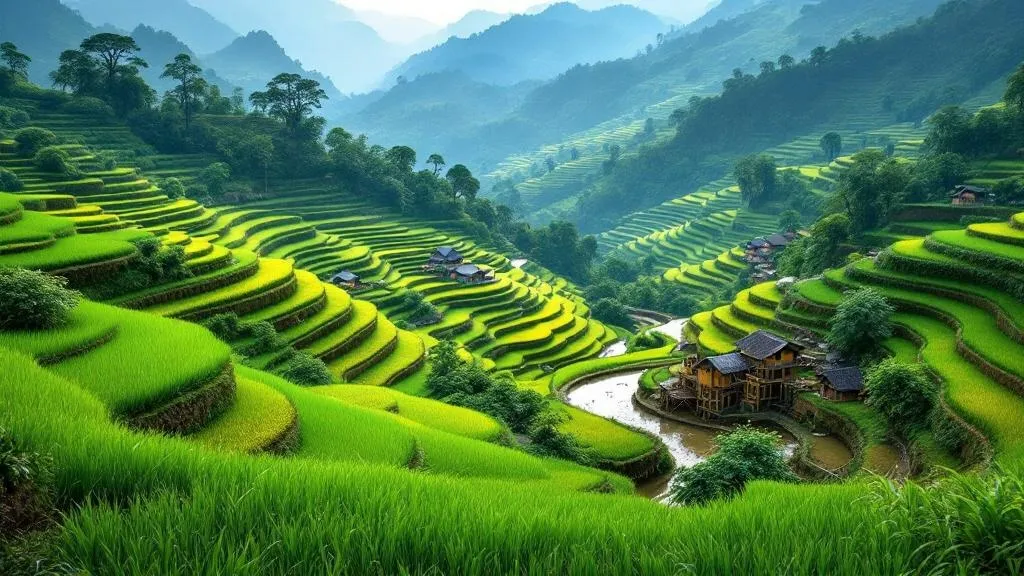
Pu Luong is a place for walking slowly. It is a nature reserve in the hills south-west of Hanoi, a landscape of narrow valleys, terraced rice fields, bamboo water wheels turning in irrigation channels and villages of stilt houses where the main events of the day are breakfast, a long walk and a very large dinner. There is no temple to tick off, no citadel and no viewpoint you must queue for. If that sounds like a gap in the itinerary, it is also exactly the point.
Before going further, three confusions are worth clearing up. Pu Luong is not Mai Chau. The two are neighbours and often sold together, but Mai Chau is a broad, flat valley that is easy to reach and set up for visitors, while Pu Luong is a hillier, more remote reserve with fewer roads. It is not a variant of Sapa either. It is lower, warmer in the mild months, much less developed and has no trekking town at its centre. And the terraces are not always golden: they turn gold around September and October, and they are green from about June. Outside those months you are visiting for the valleys, the walking and the quiet.
What Pu Luong is actually like
The reserve sits in a fold of limestone and forested ridges, and its farming communities, mainly Thai and Muong, have shaped the slopes into terraces over generations. Streams cut between the fields, and the old water wheels, built of bamboo and wood, lift water into channels that feed the paddies. Many are now maintained as much for visitors as for farming, but they are still part of how the valleys work.
Villages such as Don and Lan are the names you will see most often on lodge and tour listings. Each is a scatter of stilt houses, rice stores, vegetable plots and small homestays rather than a town. Accommodation is spread across the valleys, so your choice of lodge largely decides which paths you walk from the doorstep.
Do not expect big infrastructure. There is no cinema, no nightlife and no shopping district. There are a few small shops, simple restaurants attached to homestays, a local market in the area and a lot of birdsong. Evenings are early, with dinner served around a shared table and the valley dark by eight. That is a feature for most people who come, and a deal-breaker for a few.
What you actually do here
The activities are modest and very pleasant:
- Walking between villages, usually two to five hours a day, along terrace edges, over bamboo footbridges and through patches of forest. Distances are short but the paths go up and down.
- Watching the water wheels and the work of the fields, which changes with the season: flooding and planting, growth, harvest, bare winter paddies.
- Staying in a homestay, typically a stilt house with mattresses, a mosquito net and a shared or private bathroom, depending on the price. Meals are local: sticky rice, river fish, bamboo shoots, pork, vegetables from the garden.
- Swimming or kayaking in the streams in the warmer months, and visiting small waterfalls. Some day tours add a cooking class or a short buffalo ride.
- Visiting a local market and seeing brocade weaving, a craft practised by Thai women in the area.
- Doing very little, in a hammock, with a view.
Detailed route descriptions belong in a trekking guide. For a first visit, a lodge host or a guide will tailor a loop to your fitness and the weather, which matters more here than any fixed circuit.
Getting there from Hanoi
Pu Luong is roughly 150 km from the capital, and the honest figure is 4 to 5 hours by road, sometimes more. There is no railway and no airport. The final stretch is on narrow, winding roads that slow everything down, so the distance on a map understates the effort. Your options:
| Option | Typical time | Notes |
|---|---|---|
| Private car with driver | 4 to 5 hours | Most flexible; can stop in Mai Chau on the way. Arranged through a lodge or a Hanoi agency. |
| Tourist minivan or limousine bus | 4 to 5 hours plus last leg | Cheaper; usually to Mai Chau or a drop-off, then a transfer to your lodge. |
| Organised tour | 1 to 3 days | Transport, guide and meals included; the simplest route. |
| Hired motorbike | 5 hours or more | Only for experienced riders with the right licence; roads are steep and often wet. |
Many travellers rent a motorbike in Vietnam without the correct licence, and insurers often refuse a claim in that case. On the hills around Pu Luong, where gradients are steep and surfaces slick after rain, this is not a place to learn. A driver costs little more than the stress.
Booking a transfer through your lodge is usually the easiest solution, and ask them how to reach the specific village; the last few kilometres are not on every navigation app. For long-distance bus basics, see our guide to sleeper buses in Vietnam, though they rarely go to Pu Luong itself.
How long to stay
Count on one night as a minimum, and two nights as a sensible choice. A day trip from Hanoi can be done, and some people do it for lack of time, but a round trip of eight to ten hours in a vehicle leaves only a few hours of daylight on the ground. You see a valley from a car window and a lunch table, which is not what the place is about.
- 1 night: arrive by late morning, walk in the afternoon, dinner at the homestay, a short morning walk, drive back the next day.
- 2 nights: a full day of walking in the middle, with time for a stream, a waterfall and an unhurried evening.
- 3 nights: a loop with Mai Chau at either end, or the same valley at a slower rhythm.
If you only have a day, organised options such as a jeep tour with kayaking and lunch can give you a taste, but they are a sample, not a visit.
When to go
The north has four seasons, and Pu Luong shows every one of them:
| Season | Months | What to expect |
|---|---|---|
| Spring | March to April | Mild, misty, some drizzle; terraces being prepared. |
| Early summer | May to June | Warmer; paddies are flooded and planted, then turn green from about June. |
| Summer | July to August | Hot, humid, rainy; deep green; typhoon risk roughly July to September. |
| Autumn | September to November | The best season. Terraces golden around September and October; clearer, cooler weather. |
| Winter | December to February | Cool and often grey, fog in the valleys; fields bare; fewest visitors. |
The classic photograph of Pu Luong, with gold terraces and a water wheel, is a September to October picture, and the weather is generally the most comfortable. The harvest itself is brief, and exact dates shift with the planting, so ask your lodge what the terraces are doing before you commit. For wider context on the grain calendar across the north, see our rice terraces guide.
The rainy season changes the walking. From roughly May to September, paths turn muddy and slippery, streams rise, and some tracks and bamboo bridges can become unusable. Leeches appear in forested sections. Landslides can close roads after heavy rain, and tropical storms in the north, most likely roughly July to September, can disrupt journeys altogether. Good footwear and flexible plans make the difference, and our guide to the rainy season and typhoons explains how to read the forecast.
Where Pu Luong fits in the north
Northern Vietnam has several mountain destinations that look similar on a screen and feel different on the ground:
- Mu Cang Chai is the most dramatic terrace landscape, best at harvest, higher and more remote.
- Sapa is the best-known mountain base, with Fansipan, a trekking town and far more visitors; if you are weighing the two famous routes, see Sapa or Ha Giang.
- Ha Giang is a long, rugged motorbike loop through karst country; it is about the journey rather than a base.
- Mai Chau is the gentlest and easiest, a flat valley with Thai villages.
- Pu Luong sits between the last of these and the wilder ends of the list: quiet, walkable, and rural without being hard work.
It is also a natural companion to Ninh Binh, with which it is sometimes combined on a route out of Hanoi, and it fits inside the northern Vietnam in one week plan as a mountain pause between city and coast. For a longer sweep of the mountains, see the northern mountains loop in ten days.
Where to stay
Accommodation in Pu Luong is mostly small and family-run. Typical choices are:
- Traditional stilt-house homestays: shared sleeping platform or simple rooms, mosquito nets, shared bathrooms in the cheapest places. Meals and a warm welcome, not comfort.
- Eco-lodges and small bungalow resorts: private rooms, bathrooms, sometimes a pool or a terrace over the paddies. Prices climb quickly with the view.
- Valley position: pick by location. A lodge directly among terraces gives you walking from the door; one near the stream gives you water; one on a ridge gives you views but longer climbs.
Book ahead for September and October, when the best lodges fill, and read recent reviews, as quality varies. More general advice is in our guide to homestays in Vietnam.
Day trip options
Treat these as a compromise rather than a recommendation. A full-day jeep tour with kayaking and lunch from Hanoi is the usual format; the alternatives are small-group trekking days and cooking-class tours with a buffalo ride. They are best when you cannot spare a night, or as part of a longer visit when you want a guide to take you to places you would not find alone.
For a guided jeep, kayaking and lunch format, one option is the full-day jeep tour from Hanoi with kayaking and a village lunch. If you would rather spend the day on foot, a small-group full-day trek through the valleys is closer to what the place is really about. A gentler, more cultural version is the bamboo bridge cooking class with a buffalo ride, which suits families and anyone who would rather cook than climb.
If you are comparing options for a longer stay, our overview of multi-day tours from Hanoi and day trips from Hanoi will help you decide between an organised trip and a lodge booked directly.
Practical notes
- Money: bring cash in dong. ATMs are scarce and homestays often take cash only. Cards work at larger lodges, not everywhere. See money in Vietnam. Prices are given for 2026 and drift; roughly 26,000 VND to 1 USD and 28,000 VND to 1 EUR.
- Water: tap water is not drinkable anywhere in Vietnam. Buy bottled water or ask your lodge to refill from a filter.
- Connectivity: mobile coverage is patchy in the deeper valleys, and Wi-Fi at homestays is slow or absent. Download maps and tickets before you leave Hanoi.
- What to pack: grippy shoes, a light rain jacket, insect repellent, a torch, a warm layer for winter evenings and a small bag of toiletries. A fuller list is in the Vietnam packing list.
- Respect: you are staying in people’s home villages. Ask before photographing people, keep to paths in cultivated fields rather than walking along rice bunds, and remove your shoes where your host does.
- Entry rules: if you are travelling from abroad, check your visa requirements on the official immigration portal or your government’s travel advice; they depend on nationality and change.
Is Pu Luong for you?
Go if you like walking, quiet evenings and local food, and if you accept that nothing here is a “sight”. Skip it if your trip is short, you need a lot of structure, or you want the density of attractions that Hanoi, Hue and Hoi An offer. Pu Luong makes most sense as a deliberate pause in a northern route, a night or two of stillness before or after the energy of the capital, and it is better enjoyed slowly than seen quickly.
For the wider picture, the northern Vietnam hub lists every neighbouring destination, and the things to do around Pu Luong page gathers bookable activities.
Pu Luong travel questions answered
How far is Pu Luong from Hanoi?
It is roughly 150 km to the south-west by road, usually 4 to 5 hours depending on traffic and on which valley your lodge sits in. There is no train and no airport; you arrive by private car, minivan, limousine bus or hired motorbike.
Is Pu Luong the same as Mai Chau?
No. Mai Chau is a wide, flat valley of rice fields and Thai stilt houses that is easy to reach and well set up for visitors. Pu Luong is a separate, hillier nature reserve further in, with steeper terraces, fewer roads and a quieter feel. Many travellers combine the two.
When are the rice terraces golden?
Around September and October, when the rice ripens before harvest. The terraces are green from about June, and bare or brownish after the harvest and through the cool winter months.
Can you visit Pu Luong in one day from Hanoi?
It is possible, and day tours exist, but with the drive in both directions you get only a few hours on the ground. One night on site is the honest minimum, and two nights lets you walk without watching the clock.
Is Pu Luong good in the rainy season?
The scenery is at its greenest, but paths become muddy and slippery, streams swell and landslides can close tracks. Typhoon weather in the north, roughly July to September, can disrupt travel. Go with flexible plans, proper footwear and a lodge that can advise on conditions.
Do you need a guide to walk in Pu Luong?
Not for the main village-to-village paths, which are walked daily by locals, but a guide helps with route-finding, with the language and with understanding what you are seeing. Paths are not always signed and phone coverage can be patchy.
Is it better than Sapa or Mu Cang Chai?
It depends on what you want. Pu Luong is quieter, lower and gentler, with a homestay-and-walking rhythm. Sapa offers higher mountains and more infrastructure, and Mu Cang Chai has the more dramatic terraces at harvest. They suit different trips.


