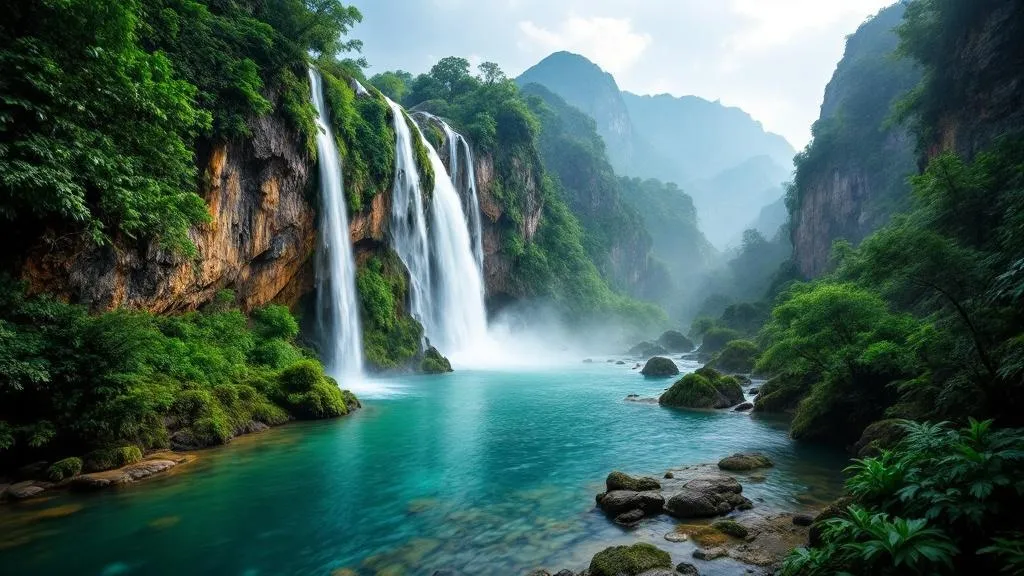
Cao Bang is the far end of northern Vietnam: a quiet karst border country where the Chinese frontier runs through the middle of one of Southeast Asia’s best-known waterfalls. It is also easy to misplace on a map. Ban Gioc is on the border with China, not a stop on a Ha Long Bay cruise and not a station on the Ha Giang loop. It sits in its own corner of the country, a long drive east of Ha Giang and a very long drive north of Hanoi, and it deserves a plan of its own.
This page is about that plan: what you actually see, how far it really is, which season suits the waterfall, and what to confirm before you go. The loop itself, the Dong Van plateau and the Ma Pi Leng Pass belong to the Ha Giang page; here we stay with Cao Bang.
What Cao Bang is, and what it is not
Cao Bang is a mountain region and a small provincial town on the Bang Giang river, close to the Chinese border. It is not on the way to anywhere else, which is exactly why it is quiet. Where Sapa has a tourist industry built around it and Ha Long Bay has a fleet of cruise boats, Cao Bang has a handful of guesthouses, a few small tour operators and a lot of space.
What you see is mostly landscape. Limestone peaks rise abruptly out of flat valley floors, rivers run green or brown depending on the week, and farmland is laid out in narrow terraces and paddies at the foot of the hills. Villages are home to Tay, Nung, Dao and other communities, and the pace of life is agricultural rather than touristic. The region is part of a UNESCO Global Geopark, which is a different programme from World Heritage: the recognition is about geology and landscape, not a protected monument.
It helps to be clear about what Cao Bang is not. It is not a beach, not a city break and not a place with a long list of ticketed attractions. Its appeal is a slow week of scenery, small roads and local food, with Ban Gioc as the headline.
Ban Gioc waterfall: what you actually see
Ban Gioc is a broad, multi-tiered waterfall on the Quay Son river, which forms the border between Vietnam and China. The water does not fall in one narrow ribbon; it spreads across several limestone steps and splits into separate cascades, with grassy islands and clumps of trees in between. On the far bank you can see Chinese territory, and on busy days visitors from both countries are looking across at each other.
The fall changes with the season, and this matters. After the summer rains the river is high, the cascades merge into a wide curtain, and the sound is considerable. By the dry months the flow thins, the individual steps and rock shelves become visible, and the water often turns a clearer green. Neither version is a disappointment, but the picture on a postcard may not be the picture you get. If the full-power version is what you want, aim for autumn; if you like the sculpted limestone and quieter surroundings, winter and spring have their own charm.
Bamboo rafts operate on the pool at the base of the fall and take visitors close to the spray. Treat them as a small, slightly touristy pleasure. Prices and the rules for boats near the border can change, so ask locally rather than relying on a number from a blog.
Close by you will usually find the Nguom Ngao cave, a long cave with well-lit formations that makes a sensible add-on, and in some years a hilltop Buddhist monastery overlooking the area. Check which of these are open when you plan, since access to border-area sites is the kind of thing that changes.
How far is it, really?
An honest order of magnitude: Cao Bang city is roughly 270 km from Hanoi, and the drive typically runs 6 to 7 hours depending on the road, the traffic and how many photo stops you make. Ban Gioc is another 80 to 90 km from Cao Bang, a drive of around two hours on winding roads. In practice, travellers from Hanoi usually count a full day just to get there and a full day to return.
That is the reason this page asks for several days. A single day trip from Hanoi does not work; a two-night trip is the realistic minimum, and three or four nights give you time for the town, the waterfall, a cave, a pass and some slow wandering. Compare this with Ninh Binh, which is a half-day trip from the capital, to see how much further this region is.
Getting there from Hanoi
- Sleeper bus or “limousine” minibus is the independent travellers’ choice. Services run from Hanoi to Cao Bang city; read the sleeper bus guide for the general approach. There is also a bus ticket product that links Cao Bang with Hanoi, Ninh Binh, Ha Giang, Cat Ba and Ha Long, which is useful if you are weaving it into a longer northern route.
- Private car with driver is the most comfortable and the most flexible, and the easiest way to stop at viewpoints. It also costs the most.
- Motorbike is how many visitors experience the region, usually as a pillion passenger with a local rider on an organised tour. Riding yourself requires the right licence and insurance, and many insurers refuse claims without them; see the motorbike rental guide.
There is no airport worth planning around for most visitors, so think road.
The Cao Bang and Ha Giang combination
Because both regions are remote and both reward the same style of travel, they are often combined into a single northern mountain trip. The two do not share a border you can cut across quickly. The usual shape is to ride or drive one region, return to Hanoi or take a long connecting road, and then do the other. A well-run five-day trail linking Ha Giang and Cao Bang is one way to do it without managing the logistics yourself.
If you only have time for one, the choice is a matter of taste. Ha Giang is dramatic, higher and more famous, and has more infrastructure for visitors, including the road known as the loop. Cao Bang is softer, quieter and more about water, caves and small valleys. Many travellers who have done Ha Giang say Cao Bang feels like the calmer sequel; many who have not say it is a good alternative if the crowds put them off. Our Sapa or Ha Giang comparison helps place both, and the Cao Bang loop guide goes through the options in detail.
For a longer trip that strings several northern regions together, the northern mountains loop in ten days is a useful frame; add Cao Bang if you have the time.
What to do around Cao Bang
Cao Bang town and local food
The town is small, practical and pleasant for an evening. It is a base, not a destination, but the food is a good reason to stay a night. The cooking is northern mountain cooking: roast duck, smoked and cured meats, sticky rice in several colours, and regional noodle soups. A local food tour with a cooking session in a home kitchen is a pleasant way to spend an afternoon, particularly after a long day in the saddle or the car.
Pac Bo
Pac Bo is a cave and stream area near the border associated with Ho Chi Minh’s return to Vietnam in 1941. For many Vietnamese visitors it is an important pilgrimage and history site, and it sits in a forested valley that is pleasant to walk through. It makes sense in combination with a day around Cao Bang, and it adds some political and historical context to the region.
Passes and viewpoints
The roads in this region climb and twist through limestone ridges. The Khau Coc Cha pass is one of the best known, and a short ride or drive over it gives you the kind of panorama that makes the effort of getting here feel worthwhile. Guided options such as the two-day motorbike trip from Cao Bang over the Khau Coc Cha pass start from the town itself, which is handy if you are already in the region.
Caves, lakes and villages
Between the waterfall and the town you will pass caves, small lakes and village markets. These are the stops that fill the gaps between big sights, and they are the reason a unhurried trip works better than a rushed one. Weekly markets in the region are lively, with ethnic-minority communities coming in to trade; ask locally which day is market day in the district you are in.
Border area rules: check before you go
Ban Gioc is a border area, and that carries consequences. Rules for visiting border zones, including permits, checkpoints, which areas are open and whether any boat rides are allowed, can change. In some years foreign visitors have needed a permit that guesthouses or tour operators arrange; in others the process has been simpler. We cannot promise what the position will be on the day you travel.
What to do:
- Check the current situation with your accommodation or your tour operator before you leave Hanoi.
- Carry your passport and keep the original, not just a photocopy, with you in the border zone.
- Confirm your visa status on the official immigration portal or your own government’s travel advice; our visa guide explains the general picture but cannot replace the official source.
- Do not cross into China on a whim: the waterfall is a viewing point, not an informal crossing.
- Follow staff and signage near the river. Border police are present, and photographing sensitive installations is not wise.
If you are travelling with a tour, the operator will normally handle the paperwork. That is one practical argument for booking an organised trip rather than going alone.
When to go
The north has four seasons, so timing matters more here than in the south.
| Season | Months | What to expect at Ban Gioc |
|---|---|---|
| Spring | March to April | Mild, often drizzly, green hills; moderate flow |
| Summer | May to September | Hot, humid and rainy; heaviest flow; typhoon risk roughly July to September |
| Autumn | October to November | The favourite: clearer skies, golden rice, good water |
| Winter | December to February | Cool and grey, sometimes cold in the hills; thinner flow, clear green water |
Autumn is the best overall season for the waterfall, the roads and the rice. If you are travelling in the late summer, read the rainy season and typhoons guide, because storms can close roads and wash out landslide-prone sections. The October guide covers what the month is like across the country, and the rice terraces guide explains when the fields turn golden.
Avoid the Tet holiday if you can. It falls between late January and mid-February, on a different date each year, and in a remote region like this, restaurants and guesthouses may close and transport fills up.
Tours: which style suits you
You can visit Cao Bang independently, but most travellers find a tour simpler, because roads are long and the services are thin. These are the main styles.
- Short motorbike trip: a two-day itinerary, sometimes with a driver on the motorbike, that gets you to Ban Gioc and back with a night in between. The two-day motorbike trip to Ban Gioc is a straightforward example. A three-day version adds time for caves and viewpoints.
- Nature-focused trip: two days built around the fall and the countryside, with less emphasis on riding.
- Loop with meals included: a structured loop around the region, useful if you do not want to plan food and logistics yourself.
- Combination with Ha Giang: a longer trip, usually four to five days, covering both regions.
Always ask what is included: transport to and from Hanoi, accommodation, meals, entrance fees, any permits and whether the rider is licensed and insured. For a deeper dive into the options, see the Ban Gioc waterfall tours guide and the things to do page for Cao Bang.
Budget in 2026
Prices change and the dong is drifting downward, so always check the year. As a rough frame for 2026, a day in Cao Bang costs about 700,000 to 1,500,000 VND, which is roughly 300 to 600 NOK. The lower end is a local guesthouse, bus travel and street meals; the upper end includes a guided motorbike trip or a private car and a better room. Cash still matters in this region, so bring more than you think and read the money guide for the general approach to ATMs and cards.
Overnight accommodation is mostly small hotels and homestays, with a few better-equipped places around the town and near the waterfall. Do not expect a large choice and book ahead in autumn.
Safety and practicalities
Violent crime is rare. The real risks are the usual ones: road conditions, rain, fatigue on long rides and hired motorbikes without proper cover. The Ha Giang safety article applies equally here, because the same mountain-road logic holds. Tap water is not drinkable anywhere in Vietnam, so carry bottled or filtered water.
Pack for four-season weather: a light rain jacket in every month, layers for the cool hills in winter and sun protection for the paddy-field stretches. Mobile coverage is generally fine in towns and patchy in remote valleys, so download offline maps before you leave. English is limited outside tour operators and guesthouses, and a handful of Vietnamese phrases go a long way.
A realistic three-day plan
This is one way to structure a trip from Hanoi, assuming you take the road both ways.
- Day 1: Hanoi to Cao Bang by bus or car, with a long lunch stop. Evening in the town; try the local specialities.
- Day 2: Cao Bang to Ban Gioc, with a stop at a viewpoint or pass on the way. Visit the waterfall, the cave and, if time allows, a village. Return to town or sleep near the fall.
- Day 3: Optional Pac Bo or a quieter valley, then back to Hanoi in the afternoon.
With a fourth day you can slow down, add a longer ride or visit a lesser-known lake. With a fifth, you can continue to Ha Giang.
Frequently asked questions about Cao Bang and Ban Gioc
Is Ban Gioc part of Ha Long Bay or the Ha Giang loop?
No. Ban Gioc is on the Chinese border in Cao Bang, in the far north-east, and has nothing to do with Ha Long Bay. It is also not on the standard Ha Giang loop, although many travellers combine the two regions on one longer trip.
How far is Cao Bang from Hanoi?
Roughly 270 km to Cao Bang city, typically 6 to 7 hours by road, then another 80 to 90 km to Ban Gioc. Plan on at least two nights; it is not a day trip.
What is the best time to see the Ban Gioc waterfall?
Autumn, from September to November, usually offers the best combination of full water, clear skies and golden rice. Summer has the heaviest flow but also heavy rain and typhoon risk; winter is cooler and drier with a thinner fall.
Do I need a permit to visit Ban Gioc?
It depends on the current rules, which have changed over the years and can change again. Ask your accommodation or tour operator before you leave Hanoi, carry your passport and check the official immigration portal or your government’s advice for entry rules.
Can I combine Cao Bang with Ha Giang?
Yes, and many travellers do, usually over four to five days. The roads between the two are long, so most trips treat them as two legs with Hanoi or a long connecting drive in between.
Do I need to ride a motorbike myself?
No. Most visitors travel as a passenger with a local rider or by car or bus. Riding yourself requires the correct licence and insurance, and many insurers refuse claims without them.
Is Cao Bang worth visiting compared with Sapa or Ha Giang?
It is a different experience: quieter, less developed and more about water, caves and small valleys than terraces or dramatic passes. If you want fewer crowds and have the time, it is a strong choice; if you have only a few days in the north, Ninh Binh and Ha Long Bay are easier.


