Hue Street Food Tours: Eating the Imperial Table on the Street
Is a street food tour worth it in Hue?
Yes, if you want to understand why Hue cooks differently from Hoi An or the south. A guide chooses the stalls, sets the order of tasting and explains dishes such as bun bo Hue and banh beo, which are easy to misorder on your own. Choose a walking or scooter format, and avoid the rainy months of roughly September to December if you can.
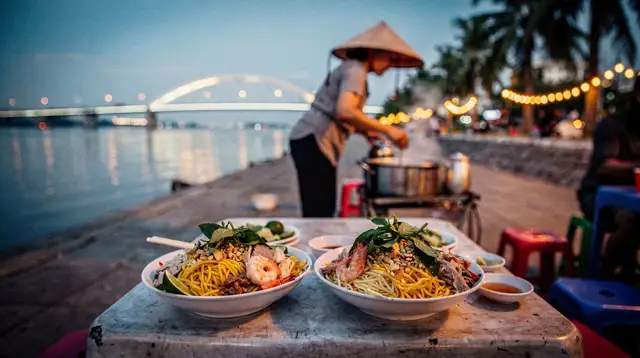
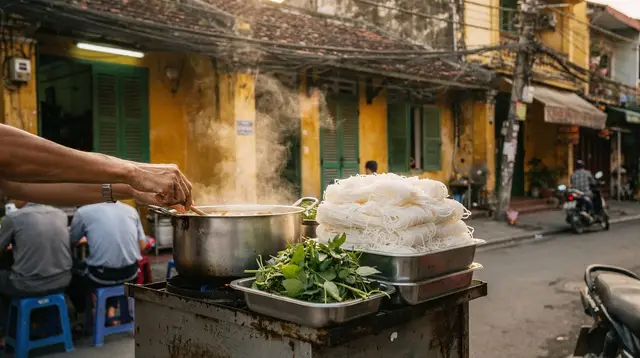
Ask people in Vietnam where the most serious cooking in the country is found and Hue comes up again and again. The city sits in the centre of the country, on the Perfume River, and its reputation rests less on any single restaurant than on a way of eating: small portions, many dishes, a lot of chilli, and a sense that every bowl has a pedigree. On the street, that pedigree is easy to miss. A plastic stool, a steaming pot and a menu in Vietnamese give very little away.
This guide explains what makes Hue’s street food distinctive, which two dishes to know before you arrive, what a guided tour adds compared with wandering alone, and how health and weather should shape your plans. It deliberately leaves the Imperial City and royal tombs and the cooking classes to their own pages, and it leaves Hoi An’s signature noodles to Hoi An.
Why Hue eats differently from the rest of Vietnam
Vietnam is a long country, roughly 1,650 km from the Chinese border to the Mekong Delta, and its food changes along the way. Visitors who move from north to south often notice the shift before they can name it. The north favours restraint and clear broths; the south leans towards sweetness, herbs and generous plates; the centre is where the heat and the intricacy concentrate.
Hue is the heart of that central style. Its cooking is spicier than Hoi An’s or the south’s, and it descends from the imperial table: the court of the Nguyen dynasty valued variety, careful presentation and many small dishes rather than one large one. That inheritance explains two things you will see on the street. First, the portions are small, often meant to be eaten several at a time. Second, the flavours are layered and assertive, with chilli playing a central role rather than a garnish.
If you are comparing the region’s two food capitals, the Hue or Hoi An comparison covers the wider trade-offs. In food terms the simple version is this: Hue is the spicier, more imperial-minded table, while Hoi An is known for dishes such as cao lau and mi quang, which belong to that town and are covered in the Hoi An street food guide.
Hue was the capital, but it is not the capital today
A confusion worth clearing up before you book anything: Hue is not the capital of Vietnam. It was the imperial capital under the Nguyen dynasty until 1945, which is why the city is full of palaces, pagodas and tombs, and why its UNESCO-listed Complex of Hue Monuments dates from 1993. Today the capital is Hanoi, in the north, and the largest city and economic centre is Ho Chi Minh City, still widely called Saigon.
This matters for food because the imperial label is not marketing. It describes a real culinary lineage: dishes that were refined for a court, then taken up by ordinary households and street stalls. When a guide tells you a dish is “from the palace”, the sensible reading is that its style comes from that tradition, not that you are eating a royal recipe preserved untouched.
For the distances, remember that Hue and Hanoi are about a domestic flight apart, roughly an hour and a quarter in the air, and far longer on the ground. If you are also thinking about northern food, the Hanoi street food tours page covers a very different style.
Two dishes to know: bun bo Hue and banh beo
You can eat for days in Hue without running out of things to try, but two names are the ones to fix in your head.
Bun bo Hue
Bun bo Hue is the city’s best-known noodle soup and the dish most visitors have heard of before they arrive. It is the plainest illustration of the Hue style: assertive, spiced and unmistakably regional. It is worth eating where it is made, in the city that gave it its name, because versions served elsewhere in the country tend to be adapted to local taste. If you want to see how it differs from the northern noodle soup most travellers know, the pho versus bun bo Hue article sets them side by side.
A practical note: it is a hearty bowl, not a light snack. If you are doing a multi-stop tour, a guide will usually have you share a bowl or take a small serving so that you keep room for what follows.
Banh beo
Banh beo sits at the opposite end of the scale. It is served in small portions, meant to be eaten in numbers, and it shows the imperial habit of presenting many small things rather than one big one. It is typical of the kind of dish that is easy to order wrongly on your own, because the usual practice is to take several plates at a time and add condiments as you go.
There is no need to know more than that before you arrive. These dishes are best met at the stall with someone explaining what you are looking at; the details of how each is made are better learned on the spot than memorised from a page.
Everything else on the street
Beyond these two, Hue’s street scene is large and changes from stall to stall. You will also meet banh mi, which is found everywhere in Vietnam, and bia hoi, the fresh, light draught beer sold from simple street corners across the country. A guide will normally steer you towards the specialities of a given stall rather than offering a generic menu, which is the point of going with one.
What a guided tour gives you that going alone does not
You can absolutely eat well in Hue without a guide. Street food is the cheapest and most direct way into the city’s cooking, and many travellers do it by pointing and smiling. The case for a tour is not that the food is impossible alone; it is that three specific problems are easier with help.
Reading the addresses. Many of the best stalls have no sign, no English and no obvious menu. Some are open only for a few hours, and some do a single dish and stop when it runs out. A guide who works the same streets daily knows which stall is worth the stop and when it is at its best.
The order of tasting. Hue’s dishes range from delicate to fiery. Eaten in the wrong sequence, a spicy bowl early on can flatten everything after it. A good itinerary moves from lighter plates to heavier or hotter ones, and keeps portions small so that you can finish the route.
Communication. English is common in hotels and tourist restaurants in the main destinations, and much less so in the countryside and at small stalls. A guide handles ordering, asks for less chilli on request, explains what you are eating and tells you what to skip if you have dietary needs.
A fourth, quieter benefit is context. A guide can tell you why the portions are small and the flavours layered, and connect what is on your plate to the city’s imperial history, which turns a series of snacks into a coherent picture.
Guided or independent: a quick comparison
| Guided street food tour | Eating alone | |
|---|---|---|
| Finding stalls | Done for you, including unsigned places | You rely on maps and luck |
| Order of dishes | Planned from light to spicy | Easy to start too heavy |
| Language | Ordering and questions handled | Pointing, apps, patience |
| Hygiene judgement | Stalls chosen for handling and turnover | You decide on the spot |
| Flexibility | Fixed route and timing | Complete freedom |
| Cost | A tour fee, usually including tastings | Pay per dish only |
The wider question of whether to book a tour at all is covered in the organised tour or independent travel guide. For food specifically, a sensible compromise is to join one tour early in your stay, learn the vocabulary and the habits, and then explore by yourself with more confidence.
Tour formats you can choose from
The listings below are the ones this site works with. Check each page for the current itinerary, duration and inclusions, since these change.
On foot
A walking tour is the classic format and the best one for first-timers. You move from stall to stall, so you see how each one works, and the pace is slow enough to ask questions. If you want one tour in Hue, this is the safest choice, and the Hue street walking food tour format is the one most visitors start with. You can book it through a guided street food walk through Hue.
By scooter
If you would rather cover more ground, a scooter format takes you further across the city, to stalls that are too far apart to walk comfortably. One option is led by local women who take you through neighbourhoods and eating places you are unlikely to find on your own, which you can book as a street food tour by scooter with local women guides. You ride as a passenger, so you do not need a licence, and you do not need to worry about traffic yourself. If you are tempted to rent a scooter instead, remember that riding without the right licence can void your insurance; the renting a motorbike guide explains why.
Combined with a day from Hoi An
If you are based in Hoi An or Da Nang, you can reach Hue for a day with a private car and local stops that include food. That works as a way to taste the city without changing hotels, and you can book it as a private road trip from Hoi An to Hue with food stops. The Hue to Hoi An transfers guide describes how the journey works, and the road includes the Hai Van Pass, which is worth knowing about when you plan timing.
What to leave for other pages
If you want to learn to cook the dishes rather than only eat them, the cooking class option is a separate experience and is covered in its own page. Likewise the Citadel and the royal tombs are not part of a street food outing, so plan them on a different half-day. The Hue city tours page covers how to fit sightseeing around meals.
Staying safe on the street: water first
Street food in Vietnam is generally a pleasure and a bargain, but a few habits keep it that way.
Tap water is not drinkable anywhere in Vietnam. Bottled or filtered water is the norm, and the tap water article explains the practical consequences. For stalls, this matters in a particular way: it is the liquid that carries the risk. Pay attention to ice and anything rinsed or diluted with water. Hot soups and freshly cooked dishes are the lower-risk end of the range; cold drinks with ice from an unknown source and raw herbs washed in tap water are where the question mark sits.
A few simple rules help:
- Choose busy stalls with a high turnover, where food does not sit.
- Prefer food that is cooked in front of you and served hot.
- Be cautious with ice if you have a sensitive stomach, and use bottled water for drinking.
- Carry hand gel, as many stalls have no washing facility.
- Keep a little cash for stalls that do not take cards.
The street food safety article goes into this in more depth. A guide takes most of the judgement off your hands, because the stops on a tour are chosen with these points in mind.
If you have allergies or dietary restrictions, tell the tour operator when you book rather than on the day, since many dishes use fish sauce and shellfish-based condiments that are not obvious by sight.
When to go: the rainy season matters
Central Vietnam does not share the weather of the north or the south. In the centre, the weather is hot and mostly dry from roughly February to August. The rainy season runs from about September to December, with typhoons and floods most likely in October and November.
For street food this has a very practical effect. Eating at a plastic stool on a wet pavement is much less enjoyable than eating there in the dry, and tours may be cut short or rescheduled when conditions are poor. Some travellers find a rainy evening and a bowl of hot soup rather appealing, and that is a fair point, but heavy rain and flooding are another matter. If you can choose, aim for the drier months; if your dates are fixed in the wet season, book flexible tours and keep a day free.
You will find a detailed explanation in the rainy season and typhoons guide and the typhoon season in central Vietnam article. For the whole-country picture, remember that there is no single best time for Vietnam: roughly February to April works for most of the country at once, but the north is best in autumn and the south in its dry season.
Tet and business closures
Tet, the lunar new year, falls between late January and mid-February, on a different date each year. Many stalls and businesses close for several days, transport is fully booked and prices rise. If your trip falls close to it, treat food tours as something to confirm in advance rather than assume.
Fitting a food tour into your Hue stay
A food tour works best in the evening or late afternoon, when the city cools and most stalls are in full swing, and leaves the daylight for sights. Because Hue’s monuments take real time, think of the food tour as its own event rather than something squeezed between temples.
If you arrive from the north by plane or by the Reunification Express, which takes more than thirty hours from end to end, you will probably want a night to settle before a food tour. If you are arriving by cruise ship, a port excursion to the city exists, but a food tour requires a longer window than a quick visit allows, so check the schedule carefully before you commit.
For accommodation and the general layout of where to stay, the where to stay in Vietnam guide is a good starting point, and the Hue destination page covers the city itself. You can also see all options together on the street food tours hub. If you are building a longer trip around eating, the Vietnamese food guide shows how regional cuisines connect, and the Ho Chi Minh City street food tours page shows the southern counterpart.
Hue street food tours: your questions answered
Is Hue the capital of Vietnam?
No. Hue was the imperial capital of the Nguyen dynasty until 1945, but the capital of Vietnam today is Hanoi. Ho Chi Minh City, also called Saigon, is the largest city. Hue’s imperial past is the reason its cooking has such a distinct reputation.
What should I eat first in Hue?
Start with bun bo Hue and banh beo, the two dishes that define the city’s table. A guided tour usually lines them up in a sensible order so that the spicier dishes do not overwhelm the lighter ones.
Is Hue street food very spicy?
It is generally spicier than the food of Hoi An or the south, because Hue’s cooking descends from the imperial kitchen and is known for its heat and depth. Chilli is often served on the side, so you can usually adjust it at the table, and a guide can ask for a milder version.
Can I drink tap water when eating street food in Hue?
No. Tap water is not drinkable anywhere in Vietnam. Drink bottled or filtered water, and watch where ice and rinsed produce come from. A guide knows which stalls handle water and ice carefully.
When is the worst time for street food in Hue?
The central rainy season, roughly September to December, with typhoons and floods most likely in October and November. Eating outdoors on wet streets is less pleasant, and tours may be shortened or rescheduled. The dry months from about February to August are easier.
Do I need to book a Hue street food tour in advance?
Booking ahead is wise in peak periods and around Tet, when transport and tours fill up and many businesses close for several days. Outside those dates, you can often arrange a tour a day or two before, but check availability on the listing.
Street Food Tours and Vietnamese Cuisine Tastings
Verified deep-linked GetYourGuide tours. Book through these links and we earn a small commission at no cost to you.
GetYourGuide does not provide a product photo for this activity — the image shows the meeting point, photographed by us.